

[Nov 09, 2023] Fast Exam Updates DP-100 dumps with PDF Test Engine Practice
Exam Valid Dumps with Instant Download Free Updates
Microsoft DP-100 exam is a certification exam that focuses on designing and implementing data science solutions on Azure. DP-100 exam is designed for data professionals who want to demonstrate their skills in implementing machine learning models, processing and transforming data, and designing and implementing data science workflows. DP-100 exam is part of the Microsoft Certified: Azure Data Scientist Associate certification, which validates the skills required to design and implement AI solutions that leverage Microsoft Azure services.
Earning the DP-100 certification can help you advance your career in data science and machine learning. It demonstrates to employers that you have the knowledge and skills to design and implement data-driven solutions using Azure services. Additionally, Microsoft offers a variety of other Azure certifications that can complement the DP-100 and help you build a well-rounded skillset in cloud computing.
NEW QUESTION # 138
You are using hyperparameter tuning in Azure Machine Learning Python SDK v2 to train a model. You configure the hyperparameter tuning experiment by running the following code:
For each of the following statements select Yes if the statement is true. Otherwise, select No. NOTE: Fach correct selection is worth one paint.
D:\mudassar\Untitled.jpg
Answer:
Explanation:
NEW QUESTION # 139
You need to build a feature extraction strategy for the local models.
How should you complete the code segment? To answer, select the appropriate options in the answer area.
NOTE: Each correct selection is worth one point.
Answer:
Explanation:
NEW QUESTION # 140
You plan to explore demographic data for home ownership in various cities. The data is in a CSV file with the following format:
age,city,income,home_owner
21,Chicago,50000,0
35,Seattle,120000,1
23,Seattle,65000,0
45,Seattle,130000,1
18,Chicago,48000,0
You need to run an experiment in your Azure Machine Learning workspace to explore the data and log the results. The experiment must log the following information:
the number of observations in the dataset
a box plot of income by home_owner
a dictionary containing the city names and the average income for each city You need to use the appropriate logging methods of the experiment's run object to log the required information.
How should you complete the code? To answer, drag the appropriate code segments to the correct locations. Each code segment may be used once, more than once, or not at all. You may need to drag the split bar between panes or scroll to view content.
NOTE: Each correct selection is worth one point.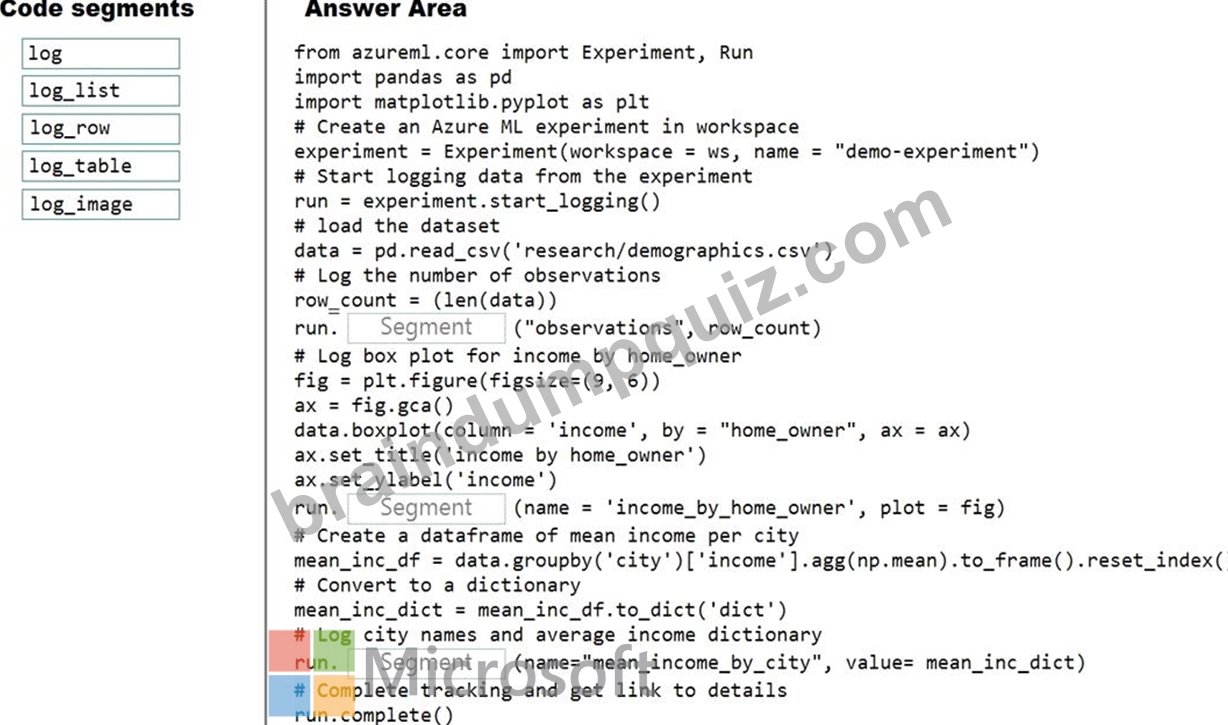
Answer:
Explanation:
NEW QUESTION # 141
You need to define a process for penalty event detection.
Which three actions should you perform in sequence? To answer, move the appropriate actions from the list of actions to the answer area and arrange them in the correct order.
Answer:
Explanation:
1 - Build the global model using PyTorch.
2 - Export the global mode using Neural Network Exchange Format (NNEF).
3 - Import the global model and build the local model using PYTorch
NEW QUESTION # 142
You create an Azure Machine Learning workspace and an Azure Synapse Analytics workspace with a Spark pool. The workspaces are contained within the same Azure subscription.
You must manage the Synapse Spark pool from the Azure Machine Learning workspace.
You need to attach the Synapse Spark pool in Azure Machine Learning by usinq the Python SDK v2.
Which three actions should you perform in sequence? To answer move the appropriate actions from the list of actions to the answer area and arrange them in the correct order.
Answer:
Explanation:
Explanation
NEW QUESTION # 143
You are a lead data scientist for a project that tracks the health and migration of birds. You create a multi-image classification deep learning model that uses a set of labeled bird photos collected by experts. You plan to use the model to develop a cross-platform mobile app that predicts the species of bird captured by app users.
You must test and deploy the trained model as a web service. The deployed model must meet the following requirements:
An authenticated connection must not be required for testing.
The deployed model must perform with low latency during inferencing.
The REST endpoints must be scalable and should have a capacity to handle large number of requests when multiple end users are using the mobile application.
You need to verify that the web service returns predictions in the expected JSON format when a valid REST request is submitted.
Which compute resources should you use? To answer, select the appropriate options in the answer area.
NOTE: Each correct selection is worth one point.
Answer:
Explanation:
Reference:
https://docs.microsoft.com/en-us/azure/machine-learning/data-science-virtual-machine/dsvm-common-identity
https://docs.microsoft.com/en-us/azure/architecture/reference-architectures/ai/training-deep-learning
NEW QUESTION # 144
You have the following Azure subscriptions and Azure Machine Learning service workspaces:
You need to obtain a reference to the ml-project workspace.
Solution: Run the following Python code:
Does the solution meet the goal?
- A. No
- B. Yes
Answer: A
NEW QUESTION # 145
You are developing a deep learning model by using TensorFlow. You plan to run the model training workload on an Azure Machine Learning Compute Instance.
You must use CUDA-based model training.
You need to provision the Compute Instance.
Which two virtual machines sizes can you use? To answer, select the appropriate virtual machine sizes in the answer area.
NOTE: Each correct selection is worth one point.
Answer:
Explanation:
Explanation:
CUDA is a parallel computing platform and programming model developed by Nvidia for general computing on its own GPUs (graphics processing units). CUDA enables developers to speed up compute-intensive applications by harnessing the power of GPUs for the parallelizable part of the computation.
Reference:
https://www.infoworld.com/article/3299703/what-is-cuda-parallel-programming-for-gpus.html
NEW QUESTION # 146
You need to use the Python language to build a sampling strategy for the global penalty detection models.
How should you complete the code segment? To answer, select the appropriate options in the answer area.
NOTE: Each correct selection is worth one point.
Answer:
Explanation:
Explanation
Box 1: import pytorch as deeplearninglib
Box 2: ..DistributedSampler(Sampler)..
DistributedSampler(Sampler):
Sampler that restricts data loading to a subset of the dataset.
It is especially useful in conjunction with class:`torch.nn.parallel.DistributedDataParallel`. In such case, each process can pass a DistributedSampler instance as a DataLoader sampler, and load a subset of the original dataset that is exclusive to it.
Scenario: Sampling must guarantee mutual and collective exclusively between local and global segmentation models that share the same features.
Box 3: optimizer = deeplearninglib.train. GradientDescentOptimizer(learning_rate=0.10)
NEW QUESTION # 147
You need to implement a model development strategy to determine a user's tendency to respond to an ad.
Which technique should you use?
- A. Use a Relative Expression Split module to partition the data based on distance travelled to the event.
- B. Use a Split Rows module to partition the data based on distance travelled to the event.
- C. Use a Relative Expression Split module to partition the data based on centroid distance.
- D. Use a Split Rows module to partition the data based on centroid distance.
Answer: C
Explanation:
Split Data partitions the rows of a dataset into two distinct sets.
The Relative Expression Split option in the Split Data module of Azure Machine Learning Studio is helpful when you need to divide a dataset into training and testing datasets using a numerical expression.
Relative Expression Split: Use this option whenever you want to apply a condition to a number column. The number could be a date/time field, a column containing age or dollar amounts, or even a percentage. For example, you might want to divide your data set depending on the cost of the items, group people by age ranges, or separate data by a calendar date.
Scenario:
Local market segmentation models will be applied before determining a user's propensity to respond to an advertisement.
The distribution of features across training and production data are not consistent Reference:
https://docs.microsoft.com/en-us/azure/machine-learning/studio-module-reference/split-data
NEW QUESTION # 148
You need to define an evaluation strategy for the crowd sentiment models.
Which three actions should you perform in sequence? To answer, move the appropriate actions from the list of actions to the answer area and arrange them in the correct order.
Answer:
Explanation:
Explanation
Step 1: Define a cross-entropy function activation
When using a neural network to perform classification and prediction, it is usually better to use cross-entropy error than classification error, and somewhat better to use cross-entropy error than mean squared error to evaluate the quality of the neural network.
Step 2: Add cost functions for each target state.
Step 3: Evaluated the distance error metric.
References:
https://www.analyticsvidhya.com/blog/2018/04/fundamentals-deep-learning-regularization-techniques/
NEW QUESTION # 149
You train and register a model in your Azure Machine Learning workspace.
You must publish a pipeline that enables client applications to use the model for batch inferencing. You must use a pipeline with a single ParallelRunStep step that runs a Python inferencing script to get predictions from the input data.
You need to create the inferencing script for the ParallelRunStep pipeline step.
Which two functions should you include? Each correct answer presents part of the solution.
NOTE: Each correct selection is worth one point.
- A. init()
- B. batch()
- C. score(mini_batch)
- D. main()
- E. run(mini_batch)
D
Answer: A,E
Explanation:
Reference:
https://github.com/Azure/MachineLearningNotebooks/tree/master/how-to-use-azureml/machine-learningpipeline
NEW QUESTION # 150
You need to define an evaluation strategy for the crowd sentiment models.
Which three actions should you perform in sequence? To answer, move the appropriate actions from the list of actions to the answer area and arrange them in the correct order.
Answer:
Explanation:
1 - Define a cross-entropy function activation
2 - Add cost functions for each target state.
3 - Evaluated the distance error metric.
Reference:
https://www.analyticsvidhya.com/blog/2018/04/fundamentals-deep-learning-regularization-techniques/
NEW QUESTION # 151
You create an Azure Databricks workspace and a linked Azure Machine Learning workspace.
You have the following Python code segment in the Azure Machine Learning workspace:
import mlflow
import mlflow.azureml
import azureml.mlflow
import azureml.core
from azureml.core import Workspace
subscription_id = 'subscription_id'
resourse_group = 'resource_group_name'
workspace_name = 'workspace_name'
ws = Workspace.get(name=workspace_name,
subscription_id=subscription_id,
resource_group=resource_group)
experimentName = "/Users/{user_name}/{experiment_folder}/{experiment_name}" mlflow.set_experiment(experimentName) uri = ws.get_mlflow_tracking_uri() mlflow.set_tracking_uri(uri) Instructions: For each of the following statements, select Yes if the statement is true. Otherwise, select No.
NOTE: Each correct selection is worth one point.
Answer:
Explanation:
Reference:
https://docs.microsoft.com/en-us/python/api/azureml-core/azureml.core.workspace.workspace
https://docs.microsoft.com/en-us/azure/machine-learning/how-to-use-mlflow
NEW QUESTION # 152
Note: This question is part of a series of questions that present the same scenario. Each question in the series contains a unique solution that might meet the stated goals. Some question sets might have more than one correct solution, while others might not have a correct solution.
After you answer a question in this section, you will NOT be able to return to it. As a result, these questions will not appear in the review screen.
You are analyzing a numerical dataset which contain missing values in several columns.
You must clean the missing values using an appropriate operation without affecting the dimensionality of the feature set.
You need to analyze a full dataset to include all values.
Solution: Use the last Observation Carried Forward (IOCF) method to impute the missing data points.
Does the solution meet the goal?
- A. No
- B. Yes
Answer: A
Explanation:
Instead use the Multiple Imputation by Chained Equations (MICE) method.
Replace using MICE: For each missing value, this option assigns a new value, which is calculated by using a method described in the statistical literature as "Multivariate Imputation using Chained Equations" or "Multiple Imputation by Chained Equations". With a multiple imputation method, each variable with missing data is modeled conditionally using the other variables in the data before filling in the missing values.
Note: Last observation carried forward (LOCF) is a method of imputing missing data in longitudinal studies. If a person drops out of a study before it ends, then his or her last observed score on the dependent variable is used for all subsequent (i.e., missing) observation points. LOCF is used to maintain the sample size and to reduce the bias caused by the attrition of participants in a study.
Reference:
https://methods.sagepub.com/reference/encyc-of-research-design/n211.xml
https://www.ncbi.nlm.nih.gov/pmc/articles/PMC3074241/
NEW QUESTION # 153
You need to modify the inputs for the global penalty event model to address the bias and variance issue.
Which three actions should you perform in sequence? To answer, move the appropriate actions from the list of actions to the answer area and arrange them in the correct order.
Answer:
Explanation:
NEW QUESTION # 154
You publish a batch inferencing pipeline that will be used by a business application.
The application developers need to know which information should be submitted to and returned by the REST interface for the published pipeline.
You need to identify the information required in the REST request and returned as a response from the published pipeline.
Which values should you use in the REST request and to expect in the response? To answer, select the appropriate options in the answer area.
NOTE: Each correct selection is worth one point.
Answer:
Explanation:
Explanation
Box 1: JSON containing an OAuth bearer token
Specify your authentication header in the request.
To run the pipeline from the REST endpoint, you need an OAuth2 Bearer-type authentication header.
Box 2: JSON containing the experiment name
Add a JSON payload object that has the experiment name.
Example:
rest_endpoint = published_pipeline.endpoint
response = requests.post(rest_endpoint,
headers=auth_header,
json={"ExperimentName": "batch_scoring",
"ParameterAssignments": {"process_count_per_node": 6}})
run_id = response.json()["Id"]
Box 3: JSON containing the run ID
Make the request to trigger the run. Include code to access the Id key from the response dictionary to get the value of the run ID.
Reference:
https://docs.microsoft.com/en-us/azure/machine-learning/tutorial-pipeline-batch-scoring-classification
NEW QUESTION # 155
You are creating an experiment by using Azure Machine Learning Studio.
You must divide the data into four subsets for evaluation. There is a high degree of missing values in the data.
You must prepare the data for analysis.
You need to select appropriate methods for producing the experiment.
Which three modules should you run in sequence? To answer, move the appropriate actions from the list of actions to the answer area and arrange them in the correct order.
NOTE: More than one order of answer choices is correct. You will receive credit for any of the correct orders you select.
Answer:
Explanation:
Explanation
The Clean Missing Data module in Azure Machine Learning Studio, to remove, replace, or infer missing values.
NEW QUESTION # 156
You create an experiment in Azure Machine Learning Studio- You add a training dataset that contains 10.000 rows. The first 9.000 rows represent class 0 (90 percent). The first 1.000 rows represent class 1 (10 percent).
The training set is unbalanced between two Classes. You must increase the number of training examples for class 1 to 4,000 by using data rows. You add the Synthetic Minority Oversampling Technique (SMOTE) module to the experiment.
You need to configure the module.
Which values should you use? To answer, select the appropriate options in the dialog box in the answer area.
NOTE: Each correct selection is worth one point.
Answer:
Explanation:
NEW QUESTION # 157
You are evaluating a completed binary classification machine.
You need to use the precision as the evaluation metric.
Which visualization should you use?
- A. Gradient descent
- B. scatter plot
- C. coefficient of determination
- D. Receiver Operating Characteristic CROC) curve
Answer: D
NEW QUESTION # 158
You train a model and register it in your Azure Machine Learning workspace. You are ready to deploy the model as a real-time web service.
You deploy the model to an Azure Kubernetes Service (AKS) inference cluster, but the deployment fails because an error occurs when the service runs the entry script that is associated with the model deployment.
You need to debug the error by iteratively modifying the code and reloading the service, without requiring a re- deployment of the service for each code update.
What should you do?
- A. Create an Azure Container Instances (ACI) web service deployment configuration and deploy the model on ACI.
- B. Register a new version of the model and update the entry script to load the new version of the model from its registered path.
- C. Create a local web service deployment configuration and deploy the model to a local Docker container.
- D. Add a breakpoint to the first line of the entry script and redeploy the service to AKS.
- E. Modify the AKS service deployment configuration to enable application insights and re-deploy to AKS.
Answer: A
Explanation:
How to work around or solve common Docker deployment errors with Azure Container Instances (ACI) and Azure Kubernetes Service (AKS) using Azure Machine Learning.
The recommended and the most up to date approach for model deployment is via the Model.deploy() API using an Environment object as an input parameter. In this case our service will create a base docker image for you during deployment stage and mount the required models all in one call. The basic deployment tasks are:
1. Register the model in the workspace model registry.
2. Define Inference Configuration:
a. Create an Environment object based on the dependencies you specify in the environment yaml file or use one of our procured environments.
b. Create an inference configuration (InferenceConfig object) based on the environment and the scoring script.
3. Deploy the model to Azure Container Instance (ACI) service or to Azure Kubernetes Service (AKS).
NEW QUESTION # 159
You need to identify the methods for dividing the data according to the testing requirements.
Which properties should you select? To answer, select the appropriate options in the answer area.
NOTE: Each correct selection is worth one point.
Answer:
Explanation:
Explanation

Scenario: Testing
You must produce multiple partitions of a dataset based on sampling using the Partition and Sample module in Azure Machine Learning Studio.
Box 1: Assign to folds
Use Assign to folds option when you want to divide the dataset into subsets of the data. This option is also useful when you want to create a custom number of folds for cross-validation, or to split rows into several groups.
Not Head: Use Head mode to get only the first n rows. This option is useful if you want to test a pipeline on a small number of rows, and don't need the data to be balanced or sampled in any way.
Not Sampling: The Sampling option supports simple random sampling or stratified random sampling. This is useful if you want to create a smaller representative sample dataset for testing.
Box 2: Partition evenly
Specify the partitioner method: Indicate how you want data to be apportioned to each partition, using these options:
Partition evenly: Use this option to place an equal number of rows in each partition. To specify the number of output partitions, type a whole number in the Specify number of folds to split evenly into text box.
Reference:
https://docs.microsoft.com/en-us/azure/machine-learning/algorithm-module-reference/partition-and-sample
NEW QUESTION # 160
......
Microsoft DP-100 certification exam is designed to test the skills and knowledge required to design and implement a data science solution on Azure. DP-100 exam is aimed at professionals who are involved in building and implementing data science solutions, including data scientists, data engineers, and machine learning engineers. Passing the exam demonstrates that the candidate has the skills and knowledge required to design and implement a data science solution on Azure.
Download DP-100 Exam Dumps PDF Q&A: https://www.braindumpquiz.com/DP-100-exam-material.html
DP-100 Dumps First Attempt Guaranteed Success: https://drive.google.com/open?id=1twBl2DARhBaNWc1GAC-2fg6tqkMVwZV2