

Free DP-100 Exam Study Guide for the NEW [Jun-2025] Dumps Test Engine
DP-100 PDF Dumps Extremely Quick Way Of Preparation
Step 3: Taking Online Learning Paths
In addition, Microsoft recommends that the candidates for the DP-100 exam take online courses to adequately prepare for their test. You can find the following learning paths on the official certification webpage:
- Create Machine Learning Models
- Build AI Solutions with Azure Machine Learning
- Create No-Code Predictive Models with Azure Machine Learning
NEW QUESTION # 119
You are building an intelligent solution using machine learning models.
The environment must support the following requirements:
Data scientists must build notebooks in a cloud environment
Data scientists must use automatic feature engineering and model building in machine learning pipelines.
Notebooks must be deployed to retrain using Spark instances with dynamic worker allocation.
Notebooks must be exportable to be version controlled locally.
You need to create the environment.
Which four actions should you perform in sequence? To answer, move the appropriate actions from the list of actions to the answer area and arrange them in the correct order.
Answer:
Explanation:
1 - Create an Azure HDInsight cluster to include the Apache Spark Mlib library
2 - Install Microsot Machine Learning for Apache Spark
3 - Create and execute the Zeppelin notebooks on the cluster
4 - When the cluster is ready, export Zeppelin notebooks to a local environment.
Reference:
https://docs.microsoft.com/en-us/azure/hdinsight/spark/apache-spark-zeppelin-notebook
https://azuremlbuild.blob.core.windows.net/pysparkapi/intro.html
NEW QUESTION # 120
For each of the following statements, select Yes if the statement is true. Otherwise, select No. NOTE: Each correct selection is worth one point.
Answer:
Explanation:
NEW QUESTION # 121
You create a multi-class image classification deep learning experiment by using the PyTorch framework. You plan to run the experiment on an Azure Compute cluster that has nodes with GPU's.
You need to define an Azure Machine Learning service pipeline to perform the monthly retraining of the image classification model. The pipeline must run with minimal cost and minimize the time required to train the model.
Which three pipeline steps should you run in sequence? To answer, move the appropriate actions from the list of actions to the answer area and arrange them in the correct order.
Answer:
Explanation:
Reference:
https://docs.microsoft.com/en-us/azure/machine-learning/how-to-train-pytorch
NEW QUESTION # 122
You are a data scientist working for a hotel booking website company. You use the Azure Machine Learning service to train a model that identifies fraudulent transactions.
You must deploy the model as an Azure Machine Learning online endpoint by using the Azure Machine Learning Python SDK v2. The deployed model must return real-time predictions of fraud based on transaction data input.
You need to create the script that is specified as the scoring_script parameter for the CodeConfiguration class used to deploy the model.
What should the entry script do?
- A. Load the model and use it to predict labels from input data.
- B. Specify the number of cores and the amount of memory required for the online endpoint compute.
- C. Create a Conda environment for the online endpoint compute and install the necessary Python packages.
- D. Start a node on the inference cluster where the model is deployed.
- E. Register the model with appropriate tags and properties.
Answer: A
NEW QUESTION # 123
You use an Azure Machine Learning workspace. Azure Data Factor/ pipeline, and a dataset monitor that runs en a schedule to detect data drift.
You need to Implement an automated workflow to trigger when the dataset monitor detects data drift and launch the Azure Data Factory pipeline to update the dataset. The solution must minimize the effort to configure the workflow.
How should you configure the workflow? To answer select the appropriate options in the answer area.
NOTE: Each correct selection is worth one point.
Answer:
Explanation:
Explanation
NEW QUESTION # 124
You need to define a process for penalty event detection.
Which three actions should you perform in sequence? To answer, move the appropriate actions from the list of actions to the answer area and arrange them in the correct order.
Answer:
Explanation:
NEW QUESTION # 125
You create a machine learning model by using the Azure Machine Learning designer. You publish the model as a real-time service on an Azure Kubernetes Service (AKS) inference compute cluster. You make no change to the deployed endpoint configuration.
You need to provide application developers with the information they need to consume the endpoint.
Which two values should you provide to application developers? Each correct answer presents part of the solution.
NOTE: Each correct selection is worth one point.
- A. The key for the endpoint.
- B. The name of the AKS cluster where the endpoint is hosted.
- C. The name of the inference pipeline for the endpoint.
- D. The URL of the endpoint.
- E. The run ID of the inference pipeline experiment for the endpoint.
Answer: A,D
Explanation:
Deploying an Azure Machine Learning model as a web service creates a REST API endpoint. You can send data to this endpoint and receive the prediction returned by the model.
You create a web service when you deploy a model to your local environment, Azure Container Instances, Azure Kubernetes Service, or field-programmable gate arrays (FPGA). You retrieve the URI used to access the web service by using the Azure Machine Learning SDK. If authentication is enabled, you can also use the SDK to get the authentication keys or tokens.
Example:
# URL for the web service
scoring_uri = '<your web service URI>'
# If the service is authenticated, set the key or token
key = '<your key or token>'
Reference:
https://docs.microsoft.com/en-us/azure/machine-learning/how-to-consume-web-service
NEW QUESTION # 126
You use Azure Machine Learning to deploy a model as a real-time web service.
You need to create an entry script for the service that ensures that the model is loaded when the service starts and is used to score new data as it is received.
Which functions should you include in the script? To answer, drag the appropriate functions to the correct actions. Each function may be used once, more than once, or not at all. You may need to drag the split bar between panes or scroll to view content NOTE: Each correct selection is worth one point.
Answer:
Explanation:
NEW QUESTION # 127
You manage an Azure Machine Learning workspace.
You must define the execution environments for your jobs and encapsulate the dependencies for your code.
You need to configure the environment from a Docker build context.
How should you complete the rode segment? To answer, select the appropriate option in the answer area.
NOTE: Each correct selection is worth one point.
Answer:
Explanation: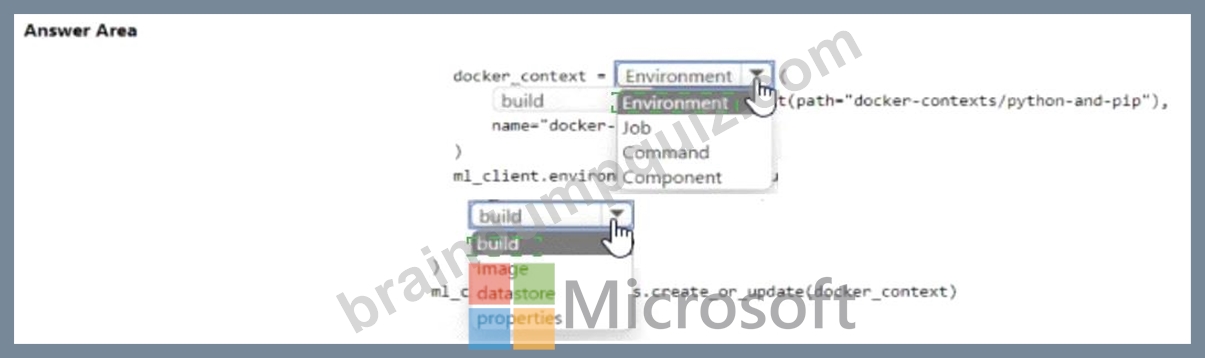
Explanation
NEW QUESTION # 128
You create a Python script named train.py and save it in a folder named scripts. The script uses the scikit- learn framework to train a machine learning model.
You must run the script as an Azure Machine Learning experiment on your local workstation.
You need to write Python code to initiate an experiment that runs the train.py script.
How should you complete the code segment? To answer, select the appropriate options in the answer area.
NOTE: Each correct selection is worth one point.
Answer:
Explanation:
Explanation:
Box 1: source_directory
source_directory: A local directory containing code files needed for a run.
Box 2: script
Script: The file path relative to the source_directory of the script to be run.
Box 3: environment
Reference:
https://docs.microsoft.com/en-us/python/api/azureml-core/azureml.core.scriptrunconfig
NEW QUESTION # 129
You manage an Azure Machine Learning workspace. You submit a training job with the Azure Machine Learning Python SDK v2. You must use MLflow to log metrics, model parameters, and mode! artifacts automatically when training a model.
You start by writing the following code segment:
For each of the following statements, select Yes If the statement is true. Otherwise, select No.
Answer:
Explanation:
NEW QUESTION # 130
You create an Azure Machine Learning workspace.
You must implement dedicated compute for model training in the workspace by using Azure Synapse compute resources. The solution must attach the dedicated compute and start an Azure Synapse session.
You need to implement the compute resources.
Which three actions should you perform in sequence? To answer, move the appropriate actions from the list of actions to the answer area and arrange them in the correct order.
Answer:
Explanation:
Explanation
NEW QUESTION # 131
Note: This question is part of a series of questions that present the same scenario. Each question in the series contains a unique solution that might meet the stated goals. Some question sets might have more than one correct solution, while others might not have a correct solution.
After you answer a question in this section, you will NOT be able to return to it. As a result, these questions will not appear in the review screen.
You are analyzing a numerical dataset which contains missing values in several columns.
You must clean the missing values using an appropriate operation without affecting the dimensionality of the feature set.
You need to analyze a full dataset to include all values.
Solution: Calculate the column median value and use the median value as the replacement for any missing value in the column.
Does the solution meet the goal?
- A. Yes
- B. No
Answer: B
Explanation:
Explanation/Reference:
Explanation:
Use the Multiple Imputation by Chained Equations (MICE) method.
References:
https://www.ncbi.nlm.nih.gov/pmc/articles/PMC3074241/
https://docs.microsoft.com/en-us/azure/machine-learning/studio-module-reference/clean-missing-data
NEW QUESTION # 132
You create a new Azure subscription. No resources are provisioned in the subscription.
You need to create an Azure Machine Learning workspace.
What are three possible ways to achieve this goal? Each correct answer presents a complete solution.
NOTE: Each correct selection is worth one point.
- A. Use the Azure Command Line Interface (CLI) with the Azure Machine Learning extension to call the az group create function with --name and --location parameters, and then the az ml workspace create function, specifying -w and -g parameters for the workspace name and resource group.
- B. Run Python code that uses the Azure ML SDK library and calls the Workspace.create method with name, subscription_id, resource_group, and location parameters.
- C. Use an Azure Resource Management template that includes a Microsoft.MachineLearningServices/ workspaces resource and its dependencies.
- D. Run Python code that uses the Azure ML SDK library and calls the Workspace.get method with name, subscription_id, and resource_group parameters.
- E. Navigate to Azure Machine Learning studio and create a workspace.
Answer: A,C,E
Explanation:
B: You can use an Azure Resource Manager template to create a workspace for Azure Machine Learning.
Example:
{"type": "Microsoft.MachineLearningServices/workspaces",
...
C: You can create a workspace for Azure Machine Learning with Azure CLI Install the machine learning extension.
Create a resource group: az group create --name <resource-group-name> --location <location> To create a new workspace where the services are automatically created, use the following command: az ml workspace create -w <workspace-name> -g <resource-group-name> D: You can create and manage Azure Machine Learning workspaces in the Azure portal.
Sign in to the Azure portal by using the credentials for your Azure subscription.
In the upper-left corner of Azure portal, select + Create a resource.
Use the search bar to find Machine Learning.
Select Machine Learning.
In the Machine Learning pane, select Create to begin.
Reference:
https://docs.microsoft.com/en-us/azure/machine-learning/how-to-create-workspace-template
https://docs.microsoft.com/en-us/azure/machine-learning/how-to-manage-workspace-cli
https://docs.microsoft.com/en-us/azure/machine-learning/how-to-manage-workspace
NEW QUESTION # 133
You are analyzing the asymmetry in a statistical distribution.
The following image contains two density curves that show the probability distribution of two datasets.
Use the drop-down menus to select the answer choice that answers each question based on the information presented in the graphic.
NOTE: Each correct selection is worth one point.
Answer:
Explanation:
Explanation:
Box 1: Positive skew
Positive skew values means the distribution is skewed to the right.
Box 2: Negative skew
Negative skewness values mean the distribution is skewed to the left.
References:
https://docs.microsoft.com/en-us/azure/machine-learning/studio-module-reference/compute-elementary- statistics
NEW QUESTION # 134
You are creating a new experiment in Azure Machine Learning Studio. You have a small dataset that has missing values in many columns. The data does not require the application of predictors for each column.
You plan to use the Clean Missing Data.
You need to select a data cleaning method.
Which method should you use?
- A. Replace using Probabilistic PCA
- B. Replace using MICE
- C. Synthetic Minority Oversampling Technique (SMOTE)
- D. Normalization
Answer: A
Explanation:
Replace using Probabilistic PCA: Compared to other options, such as Multiple Imputation using Chained Equations (MICE), this option has the advantage of not requiring the application of predictors for each column. Instead, it approximates the covariance for the full dataset. Therefore, it might offer better performance for datasets that have missing values in many columns.
References:
https://docs.microsoft.com/en-us/azure/machine-learning/studio-module-reference/clean-missing- data
NEW QUESTION # 135
You create an Azure Machine Learning workspace.
You need to use the shared file system of the workspace to store a clone of a private Git repository.
Which four actions should you perform in sequence? To answer, move the appropriate actions from the list of actions to the answer area and arrange them in the correct order.
Answer:
Explanation:
Explanation
NEW QUESTION # 136
You run an experiment that uses an AutoMLConfig class to define an automated machine learning task with a maximum of ten model training iterations. The task will attempt to find the best performing model based on a metric named accuracy.
You submit the experiment with the following code:
You need to create Python code that returns the best model that is generated by the automated machine learning task. Which code segment should you use?
- A.

- B.

- C.

- D.

Answer: D
Explanation:
Explanation
The get_output method returns the best run and the fitted model.
Reference:
https://notebooks.azure.com/azureml/projects/azureml-getting-started/html/how-to-use-azureml/automated-mach
NEW QUESTION # 137
You are developing a deep learning model by using TensorFlow. You plan to run the model training workload on an Azure Machine Learning Compute Instance.
You must use CUDA-based model training.
You need to provision the Compute Instance.
Which two virtual machines sizes can you use? To answer, select the appropriate virtual machine sizes in the answer area.
NOTE: Each correct selection is worth one point.
Answer:
Explanation:
Explanation:
CUDA is a parallel computing platform and programming model developed by Nvidia for general computing on its own GPUs (graphics processing units). CUDA enables developers to speed up compute-intensive applications by harnessing the power of GPUs for the parallelizable part of the computation.
nce:
https://www.infoworld.com/article/3299703/what-is-cuda-parallel-programming-for-gpus.html
NEW QUESTION # 138
Hotspot Question
You have an Azure Machine learning workspace. The workspace contains a dataset with data in a tabular form.
You plan to use the Azure Machine Learning SDK for Python v1 to create a control script that will load the dataset into a pandas dataframe in preparation for model training. The script will accept a parameter designating the dataset.
You need to complete the script.
How should you complete the script? To answer, select the appropriate options in the answer area.
NOTE: Each correct selection is worth one point.
Answer:
Explanation:
NEW QUESTION # 139
Note: This question is part of a series of questions that present the same scenario. Each question in the series contains a unique solution that might meet the stated goals. Some question sets might have more than one correct solution, while others might not have a correct solution.
After you answer a question in this section, you will NOT be able to return to it. As a result, these questions will not appear in the review screen.
You are a data scientist using Azure Machine Learning Studio.
You need to normalize values to produce an output column into bins to predict a target column.
Solution: Apply a Quantiles binning mode with a PQuantile normalization.
Does the solution meet the goal?
- A. Yes
- B. No
Answer: B
Explanation:
Use the Entropy MDL binning mode which has a target column.
References:
https://docs.microsoft.com/en-us/azure/machine-learning/studio-module-reference/group-data-into-bins
NEW QUESTION # 140
Hotspot Question
You create an Azure Machine Learning workspace. You train a classification model by using automated machine learning (automated ML) in Azure Machine Learning studio. The training data contains multiple classes that have significantly different numbers of samples.
You must use a metric type to avoid labeling negative samples as positive and an averaging method that will minimize the class imbalance.
You need to configure the metric type and the averaging method.
Which configurations should you use? To answer, select the appropriate options in the answer area.
NOTE: Each correct selection is worth one point.
Answer:
Explanation:
NEW QUESTION # 141
......
Knowing Associated Certification
The Microsoft DP-100 test is associated with the Microsoft Certified: Azure Data Scientist Associate certificate. It is a recently launched certification by Microsoft trying to impart the knowledge of concepts related to machine learning techniques. As a rule, earners are known to have industry-standard expertise related to evaluation and deployment models for building ML solutions. Apart from grating this noteworthy designation, the Microsoft DP-100 exam will also help the test-taker to gain some ACE college credits.
Microsoft DP-100 (Designing and Implementing a Data Science Solution on Azure) Certification Exam is a highly sought-after certification exam for data scientists and professionals looking to validate their skills in designing and implementing data science solutions on the Azure cloud platform. DP-100 exam measures a candidate's ability to design and implement solutions that use Azure services to support data scientists in building, training, and deploying machine learning models.
Enhance your career with DP-100 PDF Dumps - True Microsoft Exam Questions: https://www.braindumpquiz.com/DP-100-exam-material.html
Download DP-100 Dumps (2025) - Free PDF Exam Demo: https://drive.google.com/open?id=12ipVKUV_zLhVk3O5L6di8neh5iiguKfS