

[May-2024] The Best Microsoft Azure Study Guide for the DP-100 Exam
DP-100 certification guide Q&A from Training Expert BraindumpQuiz
The Microsoft DP-100 exam consists of various topics, including data exploration and preparation, modeling, deployment, and monitoring. The candidates need to have hands-on experience in these topics to pass the exam successfully. DP-100 exam also covers the use of Azure Machine Learning, Azure Databricks, and other Azure services that are used for implementing data science solutions.
NEW QUESTION # 135
You need to identify the methods for dividing the data according, to the testing requirements.
Which properties should you select? To answer, select the appropriate option-, m the answer are a. NOTE: Each correct selection is worth one point.
Answer:
Explanation:
NEW QUESTION # 136
Note: This question is part of a series of questions that present the same scenario. Each question in the series contains a unique solution that might meet the stated goals. Some question sets might have more than one correct solution, while others might not have a correct solution.
After you answer a question in this section, you will NOT be able to return to it. As a result, these questions will not appear in the review screen.
You create an Azure Machine Learning service datastore in a workspace. The datastore contains the following files:
* /data/2018/Q1.csv
* /data/2018/Q2.csv
* /data/2018/Q3.csv
* /data/2018/Q4.csv
* /data/2019/Q1.csv
All files store data in the following format:
id,f1,f2i
1,1.2,0
2,1,1,
1 3,2.1,0
You run the following code:
You need to create a dataset named training_data and load the data from all files into a single data frame by using the following code:
Solution: Run the following code:
Does the solution meet the goal?
- A. Yes
- B. No
Answer: B
NEW QUESTION # 137
You train a classification model by using a decision tree algorithm.
You create an estimator by running the following Python code. The variable feature_names is a list of all feature names, and class_names is a list of all class names.
from interpret.ext.blackbox import TabularExplainer
You need to explain the predictions made by the model for all classes by determining the importance of all features.
For each of the following statements, select Yes if the statement is true. Otherwise, select No.
NOTE: Each correct selection is worth one point.
Answer:
Explanation:
Explanation
Box 1: Yes
TabularExplainer calls one of the three SHAP explainers underneath (TreeExplainer, DeepExplainer, or KernelExplainer).
Box 2: Yes
To make your explanations and visualizations more informative, you can choose to pass in feature names and output class names if doing classification.
Box 3: No
TabularExplainer automatically selects the most appropriate one for your use case, but you can call each of its three underlying explainers underneath (TreeExplainer, DeepExplainer, or KernelExplainer) directly.
Reference:
https://docs.microsoft.com/en-us/azure/machine-learning/how-to-machine-learning-interpretability-aml
NEW QUESTION # 138
You use the Two-Class Neural Network module in Azure Machine Learning Studio to build a binary classification model. You use the Tune Model Hyperparameters module to tune accuracy for the model.
You need to configure the Tune Model Hyperparameters module.
Which two values should you use? Each correct answer presents part of the solution.
NOTE: Each correct selection is worth one point.
- A. Number of learning iterations
- B. Learning Rate
- C. Number of hidden nodes
- D. Hidden layer specification
- E. The type of the normalizer
Answer: A,D
Explanation:
D: For Number of learning iterations, specify the maximum number of times the algorithm should process the training cases.
E: For Hidden layer specification, select the type of network architecture to create.
Between the input and output layers you can insert multiple hidden layers. Most predictive tasks can be accomplished easily with only one or a few hidden layers.
Reference:
https://docs.microsoft.com/en-us/azure/machine-learning/studio-module-reference/two-class-neural-network
NEW QUESTION # 139
You are evaluating a completed binary classification machine learning model.
You need to use the precision as the evaluation metric.
Which visualization should you use?
- A. Box plot
- B. Violin plot
- C. Binary classification confusion matrix
- D. Gradient descent
Answer: C
Explanation:
Incorrect Answers:
A: A violin plot is a visual that traditionally combines a box plot and a kernel density plot.
B: Gradient descent is a first-order iterative optimization algorithm for finding the minimum of a function. To find a local minimum of a function using gradient descent, one takes steps proportional to the negative of the gradient (or approximate gradient) of the function at the current point.
C: A box plot lets you see basic distribution information about your data, such as median, mean, range and quartiles but doesn't show you how your data looks throughout its range.
References:
https://machinelearningknowledge.ai/confusion-matrix-and-performance-metrics-machine-learning/
NEW QUESTION # 140
You have several machine learning models registered in an Azure Machine Learning workspace.
You must use the Fairlearn dashboard to assess fairness in a selected model.
Which three actions should you perform in sequence? To answer, move the appropriate actions from the list of actions to the answer area and arrange them in the correct order.
Answer:
Explanation:
Explanation
Graphical user interface, text, application Description automatically generated
Step 1: Select a model feature to be evaluated.
Step 2: Select a binary classification or regression model.
Register your models within Azure Machine Learning. For convenience, store the results in a dictionary, which maps the id of the registered model (a string in name:version format) to the predictor itself.
Example:
model_dict = {}
lr_reg_id = register_model("fairness_logistic_regression", lr_predictor) model_dict[lr_reg_id] = lr_predictor svm_reg_id = register_model("fairness_svm", svm_predictor) model_dict[svm_reg_id] = svm_predictor Step 3: Select a metric to be measured Precompute fairness metrics.
Create a dashboard dictionary using Fairlearn's metrics package.
Reference:
https://docs.microsoft.com/en-us/azure/machine-learning/how-to-machine-learning-fairness-aml
NEW QUESTION # 141
Note: This question is part of a series of questions that present the same scenario. Each question in the series contains a unique solution that might meet the stated goals. Some question sets might have more than one correct solution, while others might not have a correct solution.
After you answer a question in this section, you will NOT be able to return to it. As a result, these questions will not appear in the review screen.
You have a Python script named train.py in a local folder named scripts. The script trains a regression model by using scikit-learn. The script includes code to load a training data file which is also located in the scripts folder.
You must run the script as an Azure ML experiment on a compute cluster named aml-compute.
You need to configure the run to ensure that the environment includes the required packages for model training. You have instantiated a variable named aml-compute that references the target compute cluster.
Solution: Run the following code:
Does the solution meet the goal?
- A. No
- B. Yes
Answer: B
Explanation:
Explanation
The scikit-learn estimator provides a simple way of launching a scikit-learn training job on a compute target. It is implemented through the SKLearn class, which can be used to support single-node CPU training.
Example:
from azureml.train.sklearn import SKLearn
}
estimator = SKLearn(source_directory=project_folder,
compute_target=compute_target,
entry_script='train_iris.py'
)
Reference:
https://docs.microsoft.com/en-us/azure/machine-learning/how-to-train-scikit-learn
NEW QUESTION # 142
You are a data scientist building a deep convolutional neural network (CNN) for image classification.
The CNN model you build shows signs of overfitting.
You need to reduce overfitting and converge the model to an optimal fit.
Which two actions should you perform? Each correct answer presents a complete solution.
NOTE: Each correct selection is worth one point.
- A. Add L1/L2 regularization.
- B. Add an additional dense layer with 512 input units.
- C. Add an additional dense layer with 64 input units.
- D. Use training data augmentation.
- E. Reduce the amount of training data.
Answer: A,E
Explanation:
B: Weight regularization provides an approach to reduce the overfitting of a deep learning neural network model on the training data and improve the performance of the model on new data, such as the holdout test set.
Keras provides a weight regularization API that allows you to add a penalty for weight size to the loss function.
Three different regularizer instances are provided; they are:
* L1: Sum of the absolute weights.
* L2: Sum of the squared weights.
* L1L2: Sum of the absolute and the squared weights.
D: Because a fully connected layer occupies most of the parameters, it is prone to overfitting. One method to reduce overfitting is dropout. At each training stage, individual nodes are either "dropped out" of the net with probability 1-p or kept with probability p, so that a reduced network is left; incoming and outgoing edges to a dropped-out node are also removed.
By avoiding training all nodes on all training data, dropout decreases overfitting.
References:
https://machinelearningmastery.com/how-to-reduce-overfitting-in-deep-learning-with-weight-regularization/
https://en.wikipedia.org/wiki/Convolutional_neural_network
NEW QUESTION # 143
You are developing a machine learning, experiment by using Azure. The following images show the input and output of a machine learning experiment:
Use the drop-down menus to select the answer choice that answers each question based on the information presented in the graphic.
NOTE: Each correct selection is worth one point.
Answer:
Explanation:
NEW QUESTION # 144
You are building an intelligent solution using machine learning models.
The environment must support the following requirements:
Data scientists must build notebooks in a cloud environment
Data scientists must use automatic feature engineering and model building in machine learning pipelines.
Notebooks must be deployed to retrain using Spark instances with dynamic worker allocation.
Notebooks must be exportable to be version controlled locally.
You need to create the environment.
Which four actions should you perform in sequence? To answer, move the appropriate actions from the list of actions to the answer area and arrange them in the correct order.
Answer:
Explanation:
Explanation:
Step 1: Create an Azure HDInsight cluster to include the Apache Spark Mlib library Step 2: Install Microsot Machine Learning for Apache Spark You install AzureML on your Azure HDInsight cluster.
Microsoft Machine Learning for Apache Spark (MMLSpark) provides a number of deep learning and data science tools for Apache Spark, including seamless integration of Spark Machine Learning pipelines with Microsoft Cognitive Toolkit (CNTK) and OpenCV, enabling you to quickly create powerful, highly-scalable predictive and analytical models for large image and text datasets.
Step 3: Create and execute the Zeppelin notebooks on the cluster
Step 4: When the cluster is ready, export Zeppelin notebooks to a local environment.
Notebooks must be exportable to be version controlled locally.
References:
https://docs.microsoft.com/en-us/azure/hdinsight/spark/apache-spark-zeppelin-notebook
https://azuremlbuild.blob.core.windows.net/pysparkapi/intro.html
NEW QUESTION # 145
You need to build a feature extraction strategy for the local models.
How should you complete the code segment? To answer, select the appropriate options in the answer area.
NOTE: Each correct selection is worth one point.
Answer:
Explanation:
NEW QUESTION # 146
Note: This question is part of a series of questions that present the same scenario. Each question in the series contains a unique solution that might meet the stated goals. Some question sets might have more than one correct solution, while others might not have a correct solution.
After you answer a question in this section, you will NOT be able to return to it. As a result, these questions will not appear in the review screen.
You are creating a model to predict the price of a student's artwork depending on the following variables: the student's length of education, degree type, and art form.
You start by creating a linear regression model.
You need to evaluate the linear regression model.
Solution: Use the following metrics: Accuracy, Precision, Recall, F1 score and AUC.
Does the solution meet the goal?
- A. Yes
- B. No
Answer: B
Explanation:
Those are metrics for evaluating classification models, instead use: Mean Absolute Error, Root Mean Absolute Error, Relative Absolute Error, Relative Squared Error, and the Coefficient of Determination.
References:
https://docs.microsoft.com/en-us/azure/machine-learning/studio-module-reference/evaluate-model
NEW QUESTION # 147
You write code to retrieve an experiment that is run from your Azure Machine Learning workspace.
The run used the model interpretation support in Azure Machine Learning to generate and upload a model explanation.
Business managers in your organization want to see the importance of the features in the model.
You need to print out the model features and their relative importance in an output that looks similar to the following.
How should you complete the code? To answer, select the appropriate options in the answer area.
NOTE: Each correct selection is worth one point.
Answer:
Explanation:
Explanation
Box 1: from_run_id
from_run_id(workspace, experiment_name, run_id)
Create the client with factory method given a run ID.
Returns an instance of the ExplanationClient.
Parameters
Workspace Workspace An object that represents a workspace.
experiment_name str The name of an experiment.
run_id str A GUID that represents a run.
Box 2: list_model_explanations
list_model_explanations returns a dictionary of metadata for all model explanations available.
Returns
A dictionary of explanation metadata such as id, data type, explanation method, model type, and upload time, sorted by upload time Box 3: explanation Reference:
https://docs.microsoft.com/en-us/python/api/azureml-contrib-interpret/azureml.contrib.interpret.explanation.expl
NEW QUESTION # 148
Note: This question is part of a series of questions that present the same scenario. Each question in the series contains a unique solution that might meet the stated goals. Some question sets might have more than one correct solution, while others might not have a correct solution.
After you answer a question in this section, you will NOT be able to return to it. As a result, these questions will not appear in the review screen.
You create a model to forecast weather conditions based on historical data.
You need to create a pipeline that runs a processing script to load data from a datastore and pass the processed data to a machine learning model training script.
Solution: Run the following code: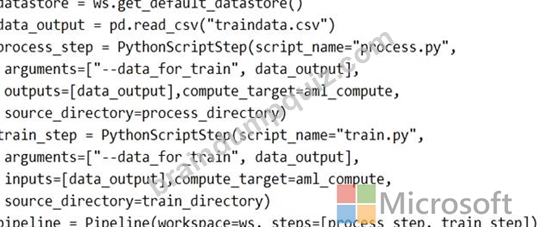
Does the solution meet the goal?
- A. No
- B. Yes
Answer: B
Explanation:
The two steps are present: process_step and train_step
Note:
Data used in pipeline can be produced by one step and consumed in another step by providing a PipelineData object as an output of one step and an input of one or more subsequent steps.
PipelineData objects are also used when constructing Pipelines to describe step dependencies. To specify that a step requires the output of another step as input, use a PipelineData object in the constructor of both steps.
For example, the pipeline train step depends on the process_step_output output of the pipeline process step:
from azureml.pipeline.core import Pipeline, PipelineData
from azureml.pipeline.steps import PythonScriptStep
datastore = ws.get_default_datastore()
process_step_output = PipelineData("processed_data", datastore=datastore) process_step = PythonScriptStep(script_name="process.py", arguments=["--data_for_train", process_step_output], outputs=[process_step_output], compute_target=aml_compute, source_directory=process_directory) train_step = PythonScriptStep(script_name="train.py", arguments=["--data_for_train", process_step_output], inputs=[process_step_output], compute_target=aml_compute, source_directory=train_directory) pipeline = Pipeline(workspace=ws, steps=[process_step, train_step]) Reference:
https://docs.microsoft.com/en-us/python/api/azureml-pipeline-core/azureml.pipeline.core.pipelinedata?view=azure-ml-py
NEW QUESTION # 149
You plan to use automated machine learning to train a regression model. You have data that has features which have missing values, and categorical features with few distinct values.
You need to configure automated machine learning to automatically impute missing values and encode categorical features as part of the training task.
Which parameter and value pair should you use in the AutoMLConfig class?
- A. enable_voting_ensemble = True
- B. featurization = 'auto'
- C. exclude_nan_labels = True
- D. task = 'classification'
- E. enable_tf = True
Answer: B
Explanation:
Explanation
Featurization str or FeaturizationConfig
Values: 'auto' / 'off' / FeaturizationConfig
Indicator for whether featurization step should be done automatically or not, or whether customized featurization should be used.
Column type is automatically detected. Based on the detected column type preprocessing/featurization is done as follows:
Categorical: Target encoding, one hot encoding, drop high cardinality categories, impute missing values.
Numeric: Impute missing values, cluster distance, weight of evidence.
DateTime: Several features such as day, seconds, minutes, hours etc.
Text: Bag of words, pre-trained Word embedding, text target encoding.
Reference:
https://docs.microsoft.com/en-us/python/api/azureml-train-automl-client/azureml.train.automl.automlconfig.auto
NEW QUESTION # 150
You are creating a machine learning model. You have a dataset that contains null rows.
You need to use the Clean Missing Data module in Azure Machine Learning Studio to identify and resolve the null and missing data in the dataset.
Which parameter should you use?
- A. Remove entire row
- B. Replace with mean
- C. Remove entire column
- D. Hot Deck
Answer: C
Explanation:
Explanation
Remove entire row: Completely removes any row in the dataset that has one or more missing values. This is useful if the missing value can be considered randomly missing.
References:
https://docs.microsoft.com/en-us/azure/machine-learning/studio-module-reference/clean-missing-data
NEW QUESTION # 151
......
The Best Microsoft DP-100 Study Guides and Dumps of 2024: https://www.braindumpquiz.com/DP-100-exam-material.html
DP-100 Certification Overview Latest DP-100 PDF Dumps: https://drive.google.com/open?id=1MEPaZoUfKHYoYSbRMPL1hA78g-Q3RWea