

AZ-400 Dumps are Available for Instant Access [2026]
Practice with these AZ-400 dumps Certification Sample Questions
NEW QUESTION # 226
Task 6
You have an Azure function hosted in an App Service plan named az400-38443478-funct You need to configure az400 38443478-funcl lo update the functions automatically whenever new code is committed to the main branch of https://githubcom/Azure-Samples/functions-quickstart.
NOTE: Access to GitHub is blocked in the exam environment. Access to GitHub is NOT required to complete the task successfully.
Answer:
Explanation:
See the solution below in explanation
Explanation:
To configure your Azure Function az400-38443478-funct to automatically update whenever new code is committed to the main branch of the specified GitHub repository, you can use GitHub Actions for continuous deployment. Here's how to set it up:
Create a GitHub Actions Workflow:
In your GitHub repository, navigate to the .github/workflows/ directory.
Create a new file for your workflow (e.g., azure-function-cd.yml).
Define the Workflow:
In the workflow file, define the steps for the build and deployment process.
Use the Azure/functions-action to deploy to your Azure Function App.
Set up triggers for the main branch to initiate the workflow on every commit.
Generate Deployment Credentials:
In the Azure Portal, navigate to your Function App az400-38443478-funct.
Download the publish profile from the Overview section by clicking on Get publish profile.
Store the Publish Profile as a GitHub Secret:
In your GitHub repository, go to Settings > Secrets and variables > Actions.
Create a new secret (e.g., AZURE_FUNCTIONAPP_PUBLISH_PROFILE) and paste the content of the publish profile.
Configure the Workflow to Use the Secret:
In the workflow file, reference the secret to authenticate the deployment to Azure.
Here's a sample GitHub Actions workflow snippet:
name: Deploy Azure Function
on:
push:
branches:
- main
jobs:
build-and-deploy:
runs-on: ubuntu-latest
steps:
- uses: actions/checkout@v2
- name: Set up Python version
uses: actions/setup-python@v2
with:
python-version: '3.x'
- name: Install dependencies
run: |
pip install -r requirements.txt
- name: Deploy to Azure Functions
uses: Azure/functions-action@v1
with:
app-name: az400-38443478-funct
publish-profile: ${{ secrets.AZURE_FUNCTIONAPP_PUBLISH_PROFILE }}
package: .
Replace the app-name with the name of your Azure Function App and ensure the Python version and dependencies match your application's requirements.
By following these steps, your Azure Function will automatically update whenever new code is pushed to the main branch of the GitHub repository. This setup minimizes manual effort and ensures that your function app is always running the latest code.
NEW QUESTION # 227
Hotspot Question
Your company uses Team Foundation Server 2013 (TFS 2013).
You plan to migrate to Azure DevOps.
You need to recommend a migration strategy that meets the following requirements:
- Preserves the dates of Team Foundation Version Control changesets
- Preserves the changes dates of work items revisions
- Minimizes migration effort
- Migrates all TFS artifacts
What should you recommend? To answer, select the appropriate options in the answer area.
NOTE: Each correct selection is worth one point.
Answer:
Explanation:
Explanation:
Box 1: Upgrade TFS to the most recent RTM release.
One of the major prerequisites for migrating your Team Foundation Server database is to get your database schema version as close as possible to what is currently deployed in Azure Devops Services.
Box 2: Use the TFS Database Import Service
In Phase 3 of your migration project, you will work on upgrading your Team Foundation Server to one of the supported versions for the Database Import Service in Azure Devops Services.
NEW QUESTION # 228
HOTSPOT
You are using PowerShell to administer Azure Log Analytics workspaces.
You need to list the available workspaces and their properties.
How should you complete the command? To answer, select the appropriate options in the answer area.
NOTE: Each correct selection is worth one point.
Answer:
Explanation:
Explanation:
Box 1: Get-AzResource
Use the following command to examine the access control mode for all workspaces in the subscription:
PowerShell
Get-Az Resource -Resource Type Microsoft. Operational Insights/workspaces -Expand Properties | for each
{s.Name + ": " + $_.Properties.features.enableLogAccessUsingOnlyResourcePermissions Box 2: -Resource Type Reference:
https://docs.microsoft.com/en-us/azure/azure-monitor/logs/manage-access
NEW QUESTION # 229
You manage projects by using Azure Boards.
You have a current work item name itemA that is dependant on a work item named itemB.
You need to define the dependency for itemA.
What should you do in the web portal for Azure DevOps?
- A. From Backlogs, open the context menu, select Add link, and then select itemA. Set Link type to Successor and add the ID of itemB.
- B. From itemA, open the Links tab, and then select Add link. Set Link type to Related and add the ID of itemB.
- C. From itemA, open the Links tab, and then select Add link. Set Link type to References and add the ID of itemB.
- D. From Queries, open the context menu, select Add link, and then select Existing Item. Set Link type to Affected By and add the ID of itemB.
Answer: A
Explanation:
In Azure DevOps, you can manage work item dependencies using the "Predecessors" and
"Successors" fields.
NEW QUESTION # 230
You need to configure a cloud service to store the secrets required by the mobile applications to call the share.
What should you include in thesolution? To answer, select the appropriate options m the answer area, NOTE:
Each correct selection is worth one point.
Answer:
Explanation:
Explanation:
Every request made against a storage service must be authorized, unless the request is for a blob or container resource that has been made available for public or signed access. One option for authorizing a request is by using Shared Key.
Scenario: The mobile applications must be able to call the share pricing service of the existing retirement fund management system. Until the system is upgraded, the service will only support basic authentication over HTTPS.
The investment planning applications suite will include one multi-tier web application and two iOS mobile application. One mobile application will be used by employees; the other will be used by customers.
References:https://docs.microsoft.com/en-us/rest/api/storageservices/authorize-with-shared-key
NEW QUESTION # 231
HOTSPOT
You have an Azure virtual machine named VM1 that runs Linux.
You plan to deploy the Desired State Configuration (DSC) extension to VM1.
You need to grant the Log Analytics agent the appropriate directory permissions.
How should you complete the command? To answer, select the appropriate options in the answer area.
NOTE: Each correct selection is worth one point.
Answer:
Explanation:
Explanation
Box 1: rwx
The Log Analytics agent for Linux runs as the omsagent user. To grant >write permission to the omsagent user, run the command setfacl -m u:omsagent:rwx /tmp.
Box 2: /tmp
Deploying DSC to a Linux node uses the /tmp folder.
Reference:
https://docs.microsoft.com/en-us/azure/automation/automation-dsc-onboarding
NEW QUESTION # 232
You are implementing a package management solution for a Node.js application by using Azure Artifacts.
You need to configure the development environment to connect to the package repository. The solution must minimize the likelihood that credentials will be leaked.
Which file should you use to configure each connection? To answer, drag the appropriate files to the correct connections. Each file may be used once, more than once, or not at all. You may need to drag the split bar between panes or scroll to view content NOTE: Each correct selection is worth one point.
Answer:
Explanation:
Reference:
https://docs.microsoft.com/en-us/azure/devops/artifacts/npm/npmrc?view=azure-devops&tabs=windows
NEW QUESTION # 233
Note: This question is part of a series of questions that present the same scenario. Each question in the series contains a unique solution that might meet the stated goals. Some question sets might have more than one correct solution, while others might not have a correct solution.
After you answer a question in this section, you will NOT be able to return to it. As a result, these questions will not appear in the review screen.
Your company has a project in Azure DevOps for a new web application.
You need to ensure that when code is checked in, a build runs automatically.
Solution: From the Pre-deployment conditions settings of the release pipeline, you select Batch changes while a build is in progress.
Does this meet the goal?
- A. No
- B. Yes
Answer: A
Explanation:
In Visual Designer you enable continuous integration (CI) by:
1. Select the Triggers tab.
2. Enable Continuous integration.
A continuous integration trigger on a build pipeline indicates that the system should automatically queue a new build whenever a code change is committed.
Reference:
https://docs.microsoft.com/en-us/azure/devops/pipelines/get-started-designer
NEW QUESTION # 234
Note: This question is part of a series of questions that present the same scenario. Each question in the series contains a unique solution that might meet the stated goals. Some question sets might have more than one correct solution, while others might not have a correct solution.
After you answer a question in this section, you will NOT be able to return to it. As a result, these questions will not appear in the review screen.
You plan to create a release pipeline that will deploy Azure resources by using Azure Resource Manager templates. The release pipeline will create the following resources:
Two resource groups
Four Azure virtual machines in one resource group
Two Azure SQL databases in other resource group
You need to recommend a solution to deploy the resources.
Solution: Create a main template that has two linked templates, each of which will deploy the resource in its respective group.
Does this meet the goal?
- A. No
- B. Yes
Answer: A
Explanation:
To deploy your solution, you can use either a single template or a main template with many related templates. The related template can be either a separate file that is linked to from the main template, or a template that is nested within the main template.
NEW QUESTION # 235
You are configuring a release pipeline in Azure DevOps as shown in the exhibit.
Use thedrop-down menus to select the answer choice that answers each question based on the information presented in the graphic.
NOTE:Each correct selection is worth one point.
Answer:
Explanation:
Explanation:
Box 1: 5
There are five stages: Development, QA, Pre-production, Load Test and Production. They all have triggers.
Box 2: The Internal Review stage
References:https://docs.microsoft.com/en-us/azure/devops/pipelines/release/triggers
NEW QUESTION # 236
You have an Azure Kubernetes Service (AKSJ pod that hosts an app named App1.
You need to configure the AKS container to restart automatically if the container stops responding. The solution must check the status of App1 once every three seconds.
How should you complete the deployment? To answer, drag the appropriate values to the correct targets. Each value may be used once, more than once, or not at all. You may need to drag the split bar between panes or scroll to view content NOTE: Each correct selection is worth one point.
Answer:
Explanation:
Explanation
NEW QUESTION # 237
Your company uses Team Foundation Server 2013 (TFS 2013).
You plan to migrate to Azure DevOps.
You need to recommend a migration strategy that meets the following requirements:
Preserves the dates of Team Foundation Version Control changesets
Preserves the changes dates of work items revisions
Minimizes migration effort
Migrates all TFS artifacts
What should you recommend? To answer, select the appropriate options in the answer area.
NOTE: Each correct selection is worth one point.
Answer:
Explanation:
NEW QUESTION # 238
Your company uses Team Foundation Server 2013 (TFS 2013).
You plan to migrate to Azure DevOps.
You need to recommend a migration strategy that meets the following requirements:
Preserves the dates of Team Foundation Version Control changesets
Preserves the changes dates of work items revisions
Minimizes migration effort
Migrates all TFS artifacts
What should you recommend? To answer, select the appropriate options in the answer area.
NOTE: Each correct selection is worth one point.
Answer:
Explanation:
Explanation:
Box 1: Upgrade TFS to the most recent RTM release.
One of the major prerequisites for migrating your Team Foundation Server database is to get your database schema version as close as possible to what is currently deployed in Azure Devops Services.
Box 2: Use the TFS Database Import Service
In Phase 3 of your migration project, you will work on upgrading your Team Foundation Server to one of the supported versions for the Database Import Service in Azure Devops Services.
References:
Team Foundation Server to Azure Devops Services Migration Guide
NEW QUESTION # 239
You are creating a NuGet package.
You plan to distribute the package to your development team privately.
You need to share the package and test that the package can be consumed.
Which four actions should you perform in sequence? To answer, move the appropriate actions from the list of actions to the answer area and arrange them in the correct order.
Answer:
Explanation:
Explanation:
Step 1: Configure a self-hosted agent.
The build will run on a Microsoft hosted agent.
Step 2: Create a new Azure Artifacts feed
Microsoft offers an official extension for publishing and managing your private NuGet feeds.
Step 3: Publish the package.
Publish, pack and push the built project to your NuGet feed.
Step 4: Connect to an Azure Artifacts feed.
With the package now available, you can point Visual Studio to the feed, and download the newly published package References:
https://medium.com/@dan.cokely/creating-nuget-packages-in-azure-devops-with-azure-pipelines-and-yaml- d6fa30f0f15e
NEW QUESTION # 240
You manage the Git repository for a large enterprise application.
You need to minimize the data size of the repository.
How should you complete the commands? To answer, select the appropriate options in the answer area.
NOTE: Each correct selection is worth one point.
Answer:
Explanation:
Reference:
https://gist.github.com/Zoramite/2039636
NEW QUESTION # 241
Your company plans to deploy an application to the following endpoints:
* Ten virtual machines hosted in Azure
* Ten virtual machines hosted in an on-premises data center environment All the virtual machines have the Azure Pipelines agent.
You need to implement a release strategy for deploying the application to the endpoints.
What should you recommend using to deploy the application to the endpoints? To answer, drag the appropriate components to the correct endpoints. Each component may be used once, more than once, or not at all. You may need to drag the split bar between panes or scroll to view content.
NOTE: Each correct selection is worth one point.
Answer:
Explanation:
Box 1: A deployment group
When authoring an Azure Pipelines or TFS Release pipeline, you can specify the deployment targets for a job using a deployment group.
If the target machines are Azure VMs, you can quickly and easily prepare them by installing the Azure Pipelines Agent Azure VM extension on each of the VMs, or by using the Azure Resource Group Deployment task in your release pipeline to create a deployment group dynamically.
Box 2: A deployment group
References: https://docs.microsoft.com/en-us/azure/devops/pipelines/release/deployment-groups
NEW QUESTION # 242
Your company deploys applications m Docket containers.
You want to detect known exploits in the Docket images used to provision the Docker containers.
You need to integrate image scanning into the application lifecycle. The solution must expose the exploits as early as possible during the application lifecycle.
What should you configure?
- A. a task executed in the continuous integration pipeline and a scheduled task that analyzes the image registry
- B. manual tasks performed during the planning phase and the deployment phase
- C. a task executed in the continuous deployment pipeline and a scheduled task against a running production container.
- D. a task executed in the continuous integration pipeline and a scheduled task that analyzes the production container.
Answer: A
Explanation:
You can use the Docker task to sign into ACR and then use a subsequent script to pull an image and scan the container image for vulnerabilities.
Use the docker task in a build or release pipeline. This task can be used with Docker or Azure Container registry.
NEW QUESTION # 243
You need to meet the technical requirements for controlling access to Azure DevOps.
What should you use?
- A. conditional access policies in Azure AD
- B. on-premises firewall rules
- C. Azure role-based access control (Azure RBAC)
- D. Azure Multi-Factor Authentication (MFA)
Answer: B
Explanation:
Scenario: Access to Azure DevOps must be restricted to specific IP addresses.
Azure DevOps is authenticated through Azure Active Directory. You can use Azure AD's conditional access to prevent logins from certain geographies and address ranges.
Reference:
https://www.rebeladmin.com/2018/08/step-step-guide-configure-location-based-conditional-access-policies/
NEW QUESTION # 244
You are configuring a release pipeline in Azure DevOps as shown in the exhibit.
Use the drop-down menus to select the answer choice that answers each question based on the information presented in the graphic.
NOTE: Each correct selection is worth one point.
Answer:
Explanation:
Explanation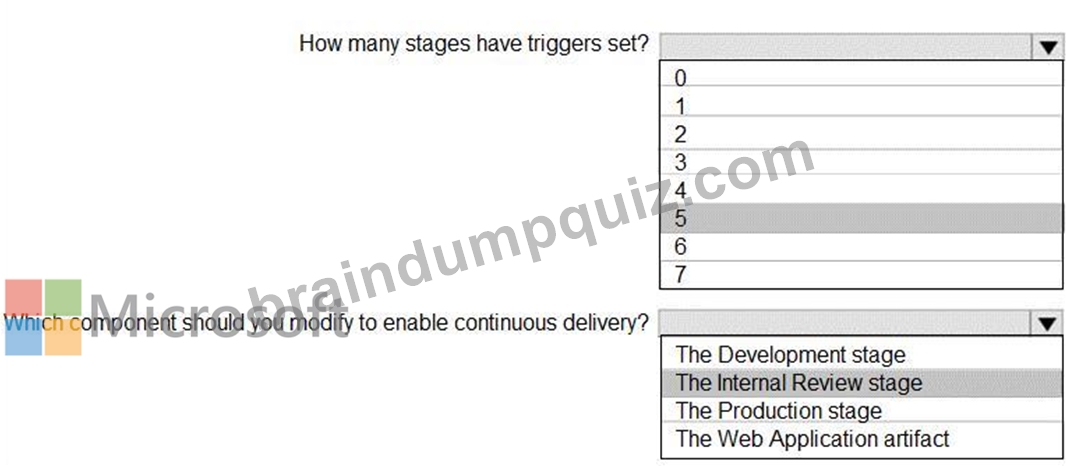
Box 1: 5
There are five stages: Development, QA, Pre-production, Load Test and Production. They all have triggers.
Box 2: The Internal Review stage
References: https://docs.microsoft.com/en-us/azure/devops/pipelines/release/triggers
NEW QUESTION # 245
You manage build and release pipelines by using Azure DevOps. Your entire managed environment resides in Azure.
You need to configure a service endpoint for accessing Azure Key Vault secrets. The solution must meet the following requirements:
Ensure that the secrets are retrieved by Azure DevOps.
Avoid persisting credentials and tokens in Azure DevOps.
How should you configure the service endpoint? To answer, select the appropriate options in the answer area.
NOTE: Each correct selection is worth one point.
Answer:
Explanation:
Explanation
Box 1: Azure Pipelines service connection
Box 2: Managed Service Identity Authentication
The managed identities for Azure resources feature in Azure Active Directory (Azure AD) provides Azure services with an automatically managed identity in Azure AD. You can use the identity to authenticate to any service that supports Azure AD authentication, including Key Vault, without any credentials in your code.
Reference:
https://docs.microsoft.com/en-us/azure/devops/pipelines/tasks/deploy/azure-key-vault
https://docs.microsoft.com/en-us/azure/active-directory/managed-identities-azure-resources/overview
NEW QUESTION # 246
Your company has an Azure subscription.
The company requires that all resource group in the subscription have a tag named organization set to a value of Contoso.
You need to implement a policy to meet the tagging requirement.
How should you complete the policy? To answer, select the appropriate options in the answer area.
NOTE: Each correct selection is worth one point.
Answer:
Explanation:
Explanation
Box 1: " Microsoft.Resources/subscriptions/resourceGroups"
Box 2: "Deny",
Sample - Enforce tag and its value on resource groups
},
"policyRule": {
"if": {
"allOf": [
{
"field": "type",
"equals": "Microsoft.Resources/subscriptions/resourceGroups"
},
{
"not": {
"field": "[concat('tags[',parameters('tagName'), ']')]",
"equals": "[parameters('tagValue')]"
}
}
]
},
"then": {
"effect": "deny"
}
}
}
}
References:
https://docs.microsoft.com/en-us/azure/governance/policy/samples/enforce-tag-on-resource-groups
NEW QUESTION # 247
......
Get Instant Access REAL AZ-400 DUMP Pass Your Exam Easily: https://www.braindumpquiz.com/AZ-400-exam-material.html
AZ-400 Free Exam Questions with Quality Guaranteed: https://drive.google.com/open?id=1EhqgqvZ-JxJvnDw_6dIsDg7RBSpQgvnA