

Pass BCS CTFL18 With BraindumpQuiz Exam Dumps - Updated on Mar-2024
Fully Updated CTFL18 Dumps - 100% Same Q&A In Your Real Exam
BCS CTFL18 (ISTQB Certified Tester Foundation Level 2018) Certification Exam is a globally recognized certification program that is designed to certify individuals who have a solid understanding of the fundamentals of software testing. ISTQB Certified Tester Foundation Level 2018 certification is highly valued in the IT industry and is a prerequisite for many advanced level certifications in software testing.
The BCS CTFL18 exam consists of 40 multiple-choice questions, and the duration of the exam is 60 minutes. The passing score for the exam is 65%. CTFL18 exam can be taken online or at a testing center. CTFL18 exam fee varies depending on the country and location.
NEW QUESTION # 232
Which of the following is a white box testing design characteristic?
- A. To be based on an analysis of the structure of the component or system
- B. To be based on an analysis of the test basis documentation
- C. To include both functional and non-functional testing
- D. To be based on specifications
Answer: A
NEW QUESTION # 233
According to the ISTQB Glossary, regression testing is required for what purpose?
- A. To verify the success of corrective actions.
- B. To prevent a task from being incorrectly considered completed.
- C. To motivate better unit testing by the programmers.
- D. To ensure that defects have not been introduced by a modification.
Answer: D
NEW QUESTION # 234
Regarding the process described above, what is the most important recommendation you would make using IEEE 1044 as a guide?
- A. No classification on type of incident
- B. No mentioning of reproduceability
- C. Incident numbering is manual rather than automated
- D. No priority or severity assigned
Answer: D
Explanation:
Topic 20, "Automatic Teller Machine (ATM)"
You are a test manager in charge of integration, system and acceptance testing for a bank. You are working on a project to upgrade an existing ATM to allow customers to obtain cash advances from supported credit cards. The system should allow cash advances from 20 to 500, inclusively, for all supported credit cards. The supported credit cards are American Express, VISA, Eurocard and Mastercard.
In the master test plan the following items are listed in the section named "items and/or features to be tested":
I All supported credit cards
II Language localization
II Valid and invalid advances
IV Usability
V Response time
NEW QUESTION # 235
Which of the following BEST matches the attributes with a level of testing?
I. Stubs and drivers are often used
II. The test environment should correspond to the production environment II. Finding defects is not the main focus IV. Testing can be based on use cases
V. Testing is normally performed by testers
VI. Testing for functional and non-functional characteristics
- A. Component - VI
Integration - IV
System - I
Acceptance - III - B. Component - V
Integration - I
System - VI
Acceptance - V - C. Component - V
Integration - II
System - IV
Acceptance - VI - D. Component - I
Integration - V
System - II
Acceptance - IV
Answer: D
NEW QUESTION # 236
Equivalence Partitioning is best defined as:
- A. An analysis technique that divides inputs into groups that are expected to exhibit similar behaviors.
- B. A form of white-box testing.
- C. Applying to time-related data classes only.
- D. A method to reduce test coverage.
Answer: A
NEW QUESTION # 237
Which of the following would you least expect to form part of the analysis of initial tool costs?
- A. Tool portability
- B. Evaluation of suitable tools
- C. Learning time required to use the new tool
- D. Integration with other tools
Answer: A
Explanation:
Topic 4, V1 "Test Management Tool"
A software development company that sells an established capture-replay tool has decided to complement it with a test management tool. The capture-replay tool was developed over a number of years and is used by a large number of clients.
The test management tool will be developed by the same team that developed the capture-replay tool, using the same technology. The company test strategy mandates that structural testing is focussed at the component test level and dynamic non-functional testing is focussed at the acceptance test level.
In response to growing customer demand, it is proposed to develop the test management tool in an incremental manner. Each increment will be developed using the V life cycle model. The target platform is a PC in a local area network. The PC uses a proprietary relational database and communicates with a single PC which acts as a server.
The test management tool must interface with the company s capture replay tool. Over the first 12 months of the development period the following functionality will be developed for the tool (in two increments): basic requirements management, support for test case creation; support for test procedures, test scripts and test suites. The functionality to be included in later increments will be driven by customer demand: however they expect to provide an incident management system, a web front-end, and interfaces to other proprietary tools and database management systems.
NEW QUESTION # 238
Debugging and Testing are key activities in the software development lifecycle.
Which of the following are 'Debugging' activities?
A) Identifying a failure
B) Locating the cause of failure
C) Fixing the defect
D) Checking the fix has resolved the failure
- A. a & b
- B. c & d
- C. a & d
- D. b & c
Answer: D
NEW QUESTION # 239
Which of the following test techniques is structure-based?
- A. State transition testing
- B. Use case testing
- C. Control flow testing
- D. Decision table testing
Answer: D
NEW QUESTION # 240
Which of the following is NOT a factor on which test estimation is dependent upon?
- A. Characteristics of the product
- B. The outcome of testing of previous test cycle
- C. Defect debugging and resolution
- D. Characteristics of the development process
Answer: D
NEW QUESTION # 241
Which of the following is a key difference between black box and white box test design techniques?
- A. White box techniques use functional design specifications to derive test cases, black box techniques do not.
- B. Black box techniques use software code to derive test cases, white box techniques do not.
- C. White box techniques derive test cases from models of the software, black box techniques do not.
- D. White box techniques can measure the extent of code coverage, black box techniques can not.
Answer: D
NEW QUESTION # 242
Which of the following has the typical formal review activities in the correct sequence?
- A. Kick-off, review meeting, planning, follow-up.
- B. Planning, kick-off, individual preparation, review meeting.
- C. Kick-off, planning, review meeting, re-work.
- D. Planning, individual preparation, follow-up, re-work.
Answer: B
Explanation:
The correct sequence is: planning, kick-off, individual preparation, review meeting, re- work,follow-up. All of the other options have either the activities in the wrong order or activities missing from the strict flow.
NEW QUESTION # 243
It is recommended to perform exhaustive tests for covering all combinations of inputs and preconditions.
- A. Yes, and it's also necessary to include all the exit combinations
- B. Only the expert testers can make exhaustive tests.
- C. Yes, it's strongly recommended.
- D. No, risk analysis and priorities should be used to focus testing efforts
Answer: D
NEW QUESTION # 244
Who is responsible for conducting test readiness review..?
- A. Test Manager
- B. None of the above
- C. Project Manager
- D. Test Engineer
Answer: A
NEW QUESTION # 245
system requirement states that up to 100 users should be able to carry out a transaction, with responses returned within 5 seconds.
What type of non-functional testing would you carry out to verify these requirements?
- A. Maintenance testing
- B. Stress testing
- C. Usability testing
- D. Load testing
Answer: B
NEW QUESTION # 246
Which of the following metrics could be used to monitor progress along with test preparation and execution?
- A. The total number of tests planned
- B. The failure rate in testing already completed
- C. The number of testers used for test execution so far
- D. The total number of requirements to be tested
Answer: B
NEW QUESTION # 247
Which of the following are the most important factors to be taken into account when selecting test techniques?
(i) Tools available.
(ii) Regulatory standards.
(iii) Experience of the development team.
(iv) Knowledge of the test team.
The need to maintain levels of capability in each technique.
- A. (ii) and (iv)
- B. (iii) and (iv)
- C. (i) and (v)
- D. (i) and (ii)
Answer: A
Explanation:
Answer (i) looks temptingly right, and the availability of tools might make the use of a technique more or less attractive, but it would not be decisive in the way that regulatory standards and tester knowledge are.
Answer (iii) is irrelevant because testing should be independent of development anyway, but it could tempt someone who is unsure about the relationship between development and testing.
Answer (v) is a factor in managing the test team, and experience would need to be maintained, but this should not influence the selection of techniques for a live project.
NEW QUESTION # 248
The purpose of requirement phase is:
- A. All of the above
- B. To define the scope of testing
- C. To understand user needs
- D. To freeze requirements
Answer: A
NEW QUESTION # 249
During the development of a software change for a system, the developer makes a mistake in his work, which leads to a fault in the code. Unfortunately the fault is not found by software testing and is released into live.
What is the definite consequence of this mistake?
- A. If the defect is executed, the system may fail.
- B. The system will fail, causing a defect.
- C. Contractual requirements have not been met by testing.
- D. Loss of money, time, or business reputation.
Answer: A
NEW QUESTION # 250
Which of the following is NOT one of the test objectives?
- A. Finding defects
- B. Preventing defects
- C. Fixing bugs
- D. Gaining confidence about the level of quality
Answer: C
NEW QUESTION # 251
Refer to the exhibit, which of the following test cases will ensure that the statement `Print `Hold'' is exercised?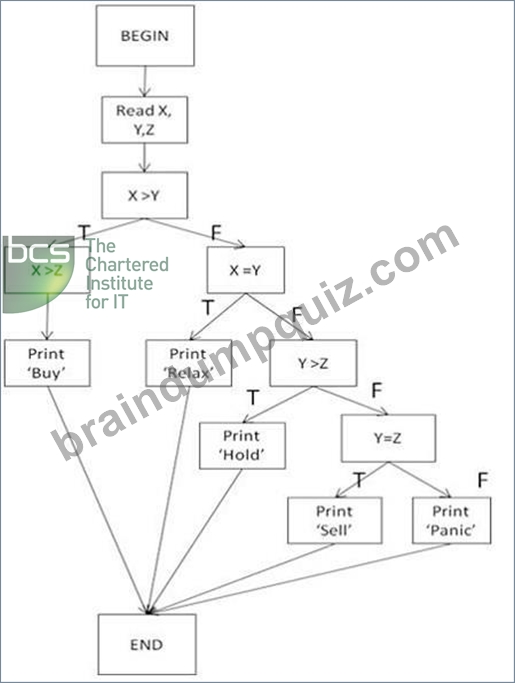
- A. X=2, Y=2, Z=2
- B. X=2, Y=3, Z=4
- C. X=2, Y=4, Z=3
- D. X=4, Y=3, Z=2
Answer: C
NEW QUESTION # 252
Which statement about deriving test cases from a use case is TRUE?
- A. There should only be one test case for each use case.
- B. Test cases can only be derived if there is an activity diagram.
- C. It is not possible to measure use case test coverage.
- D. Test cases are designed to exercise the defined behaviours.
Answer: D
NEW QUESTION # 253
......
Latest CTFL18 Exam Dumps - Valid and Updated Dumps: https://www.braindumpquiz.com/CTFL18-exam-material.html
Verified CTFL18 Exam Questions Certain Success: https://drive.google.com/open?id=12ux8AzQmz6VTlddiwo8PBNKHZb9bkmSm