

New (2024) Download free Databricks-Certified-Data-Engineer-Associate PDF for Databricks Practice Tests
100% Free Databricks-Certified-Data-Engineer-Associate Files For passing the exam Quickly
Achieving the Databricks Certified Data Engineer Associate certification demonstrates that an individual has the skills and knowledge needed to work with big data, data engineering, and distributed systems using Databricks. Databricks Certified Data Engineer Associate Exam certification is recognized globally and can help professionals advance their careers in data engineering.
Databricks Certified Data Engineer Associate Exam is designed for data engineers, software developers, and IT professionals who work with data on a regular basis. Databricks Certified Data Engineer Associate Exam certification program is ideal for individuals who want to demonstrate their expertise in designing and building data pipelines, working with big data, and developing data-driven applications using Databricks.
Passing the Databricks Certified Data Engineer Associate certification exam is a great achievement that can enhance the career prospects of the candidates. Databricks Certified Data Engineer Associate Exam certification exam is recognized globally and is highly valued by the employers. Certified Data Engineer Associates can work as data engineers, data architects, data analysts, machine learning engineers, and data scientists in various industries such as healthcare, finance, retail, and technology. Databricks Certified Data Engineer Associate Exam certification exam is also a stepping stone towards the advanced Databricks Certified Data Engineer Professional certification exam.
NEW QUESTION # 46
A data engineer has joined an existing project and they see the following query in the project repository:
CREATE STREAMING LIVE TABLE loyal_customers AS
SELECT customer_id -
FROM STREAM(LIVE.customers)
WHERE loyalty_level = 'high';
Which of the following describes why the STREAM function is included in the query?
- A. The data in the customers table has been updated since its last run.
- B. The customers table is a reference to a Structured Streaming query on a PySpark DataFrame.
- C. The table being created is a live table.
- D. The customers table is a streaming live table.
- E. The STREAM function is not needed and will cause an error.
Answer: D
Explanation:
Explanation
https://docs.databricks.com/en/sql/load-data-streaming-table.html
Load data into a streaming table
To create a streaming table from data in cloud object storage, paste the following into the query editor, and then click Run:
SQL
Copy to clipboardCopy
/* Load data from a volume */
CREATE OR REFRESH STREAMING TABLE <table-name> AS
SELECT * FROM STREAM read_files('/Volumes/<catalog>/<schema>/<volume>/<path>/<folder>')
/* Load data from an external location */
CREATE OR REFRESH STREAMING TABLE <table-name> AS
SELECT * FROM STREAM read_files('s3://<bucket>/<path>/<folder>')
NEW QUESTION # 47
A data engineer has created a new database using the following command:
CREATE DATABASE IF NOT EXISTS customer360;
In which of the following locations will the customer360 database be located?
- A. More information is needed to determine the correct response
- B. dbfs:/user/hive/warehouse
- C. dbfs:/user/hive/customer360
- D. dbfs:/user/hive/database/customer360
Answer: B
Explanation:
Explanation
dbfs:/user/hive/warehouse - which is the default location
NEW QUESTION # 48
A data engineering team has two tables. The first table march_transactions is a collection of all retail transactions in the month of March. The second table april_transactions is a collection of all retail transactions in the month of April. There are no duplicate records between the tables.
Which of the following commands should be run to create a new table all_transactions that contains all records from march_transactions and april_transactions without duplicate records?
- A. CREATE TABLE all_transactions AS
SELECT * FROM march_transactions
INTERSECT SELECT * from april_transactions; - B. CREATE TABLE all_transactions AS
SELECT * FROM march_transactions
OUTER JOIN SELECT * FROM april_transactions; - C. CREATE TABLE all_transactions AS
SELECT * FROM march_transactions
INNER JOIN SELECT * FROM april_transactions; - D. CREATE TABLE all_transactions AS
SELECT * FROM march_transactions
UNION SELECT * FROM april_transactions; - E. CREATE TABLE all_transactions AS
SELECT * FROM march_transactions
MERGE SELECT * FROM april_transactions;
Answer: D
Explanation:
The correct command to create a new table that contains all records from two tables without duplicate records is to use the UNION operator. The UNION operator combines the results of two queries and removes any duplicate rows. The INNER JOIN, OUTER JOIN, and MERGE operators do not remove duplicate rows, and the INTERSECT operator only returns the rows that are common to both tables. Therefore, option B is the only correct answer. References: Databricks SQL Reference - UNION, Databricks SQL Reference - JOIN, Databricks SQL Reference - MERGE, [Databricks SQL Reference - INTERSECT]
NEW QUESTION # 49
In which of the following scenarios should a data engineer select a Task in the Depends On field of a new Databricks Job Task?
- A. When another task needs to be replaced by the new task
- B. When another task needs to fail before the new task begins
- C. When another task needs to successfully complete before the new task begins
- D. When another task needs to use as little compute resources as possible
- E. When another task has the same dependency libraries as the new task
Answer: C
NEW QUESTION # 50
A data engineer needs to create a table in Databricks using data from a CSV file at location /path/to/csv.
They run the following command: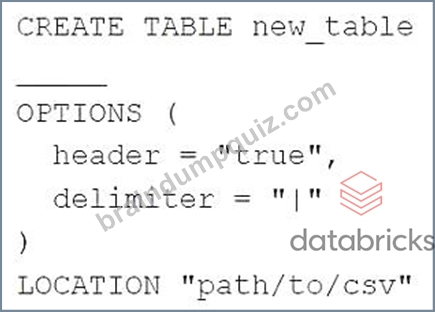
Which of the following lines of code fills in the above blank to successfully complete the task?
- A. FROM "path/to/csv"
- B. FROM CSV
- C. USING CSV
- D. None of these lines of code are needed to successfully complete the task
- E. USING DELTA
Answer: A
Explanation:
A data lakehouse is a new paradigm that can be used to simplify and unify siloed data architectures that are specialized for specific use cases. A data lakehouse combines the best of both data lakes and data warehouses, providing a single platform that supports diverse data types, open standards, low-cost storage, high-performance queries, ACID transactions, schema enforcement, and governance. A data lakehouse enables data engineers to build reliable and scalable data pipelines that can serve various downstream applications and users, such as data science, machine learning, analytics, and reporting. A data lakehouse leverages the power of Delta Lake, a storage layer that brings reliability and performance to data lakes. References: What is a data lakehouse?, Delta Lake, Lakehouse: A New Generation of Open Platforms that Unify Data Warehousing and Advanced Analytics
NEW QUESTION # 51
An engineering manager uses a Databricks SQL query to monitor ingestion latency for each data source. The manager checks the results of the query every day, but they are manually rerunning the query each day and waiting for the results.
Which of the following approaches can the manager use to ensure the results of the query are updated each day?
- A. They can schedule the query to refresh every 1 day from the SQL endpoint's page in Databricks SQL.
- B. They can schedule the query to refresh every 12 hours from the SQL endpoint's page in Databricks SQL.
- C. They can schedule the query to run every 12 hours from the Jobs UI.
- D. They can schedule the query to run every 1 day from the Jobs UI.
- E. They can schedule the query to refresh every 1 day from the query's page in Databricks SQL.
Answer: E
Explanation:
Explanation
https://docs.databricks.com/en/sql/user/queries/schedule-query.html
NEW QUESTION # 52
A data engineer is using the following code block as part of a batch ingestion pipeline to read from a composable table:
Which of the following changes needs to be made so this code block will work when the transactions table is a stream source?
- A. Replace schema(schema) with option ("maxFilesPerTrigger", 1)
- B. Replace format("delta") with format("stream")
- C. Replace "transactions" with the path to the location of the Delta table
- D. Replace spark.read with spark.readStream
- E. Replace predict with a stream-friendly prediction function
Answer: D
Explanation:
Explanation
https://docs.databricks.com/en/structured-streaming/delta-lake.html
In the context of Databricks, when transitioning from batch processing to stream processing, one common change that needs to be made is replacing spark.read with spark.readStream. This modification is essential because spark.read is used for batch processing, while spark.readStream is used for stream processing. The rest of the code can often remain the same or require minimal changes. References: The information can be referenced from Databricks documentation on structured streaming: Structured Streaming Programming Guide.
NEW QUESTION # 53
Which of the following Git operations must be performed outside of Databricks Repos?
- A. Commit
- B. Pull
- C. Push
- D. Merge
- E. Clone
Answer: D
Explanation:
Databricks Repos is a visual Git client and API in Databricks that supports common Git operations such as commit, pull, push, branch management, and visual comparison of diffs when committing1. However, merge is not supported in the Git dialog2. You need to use the Repos UI or your Git provider to merge branches3. Merge is a way to combine the commit history from one branch into another branch1. During a merge, a merge conflict is encountered when Git cannot automatically combine code from one branch into another. Merge conflicts require manual resolution before a merge can be completed1. References: 4: Run Git operations on Databricks Repos4, 1: CI/CD techniques with Git and Databricks Repos1, 3: Collaborate in Repos3, 2: Databricks Repos - What it is and how we can use it2.
Databricks Repos is a visual Git client and API in Databricks that supports common Git operations such as commit, pull, push, merge, and branch management. However, to clone a remote Git repository to a Databricks repo, you must use the Databricks UI or API. You cannot clone a Git repo using the CLI through a cluster's web terminal, as the files won't display in the Databricks UI1. References: 1: Run Git operations on Databricks Repos | Databricks on AWS2
NEW QUESTION # 54
A data engineer needs to determine whether to use the built-in Databricks Notebooks versioning or version their project using Databricks Repos.
Which of the following is an advantage of using Databricks Repos over the Databricks Notebooks versioning?
- A. Databricks Repos supports the use of multiple branches
- B. Databricks Repos provides the ability to comment on specific changes
- C. Databricks Repos automatically saves development progress
- D. Databricks Repos is wholly housed within the Databricks Lakehouse Platform
- E. Databricks Repos allows users to revert to previous versions of a notebook
Answer: A
NEW QUESTION # 55
A data engineer needs to create a table in Databricks using data from their organization's existing SQLite database.
They run the following command: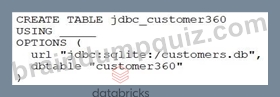
Which of the following lines of code fills in the above blank to successfully complete the task?
- A. DELTA
- B. autoloader
- C. org.apache.spark.sql.jdbc
- D. sqlite
- E. org.apache.spark.sql.sqlite
Answer: C
Explanation:
Explanation
CREATE TABLE new_employees_table
USING JDBC
OPTIONS (
url "<jdbc_url>",
dbtable "<table_name>",
user '<username>',
password '<password>'
) AS
SELECT * FROM employees_table_vw
https://docs.databricks.com/external-data/jdbc.html#language-sql
NEW QUESTION # 56
A data engineer that is new to using Python needs to create a Python function to add two integers together and return the sum?
Which of the following code blocks can the data engineer use to complete this task?
- A.

- B.

- C.

- D.

- E.

Answer: C
Explanation:
https://www.w3schools.com/python/python_functions.asp
https://www.geeksforgeeks.org/python-functions/
NEW QUESTION # 57
Which of the following describes the relationship between Gold tables and Silver tables?
- A. Gold tables are more likely to contain a less refined view of data than Silver tables.
- B. Gold tables are more likely to contain truthful data than Silver tables.
- C. Gold tables are more likely to contain valuable data than Silver tables.
- D. Gold tables are more likely to contain more data than Silver tables.
- E. Gold tables are more likely to contain aggregations than Silver tables.
Answer: E
Explanation:
Explanation
In some data processing pipelines, especially those following a typical "Bronze-Silver-Gold" data lakehouse architecture, Silver tables are often considered a more refined version of the raw or Bronze data. Silver tables may include data cleansing, schema enforcement, and some initial transformations. Gold tables, on the other hand, typically represent a stage where data is further enriched, aggregated, and processed to provide valuable insights for analytical purposes. This could indeed involve more aggregations compared to Silver tables.
NEW QUESTION # 58
Which of the following describes a scenario in which a data engineer will want to use a single-node cluster?
- A. When they are running automated reports to be refreshed as quickly as possible
- B. When they are working with SQL within Databricks SQL
- C. When they are concerned about the ability to automatically scale with larger data
- D. When they are manually running reports with a large amount of data
- E. When they are working interactively with a small amount of data
Answer: E
Explanation:
Explanation
A Single Node cluster is a cluster consisting of an Apache Spark driver and no Spark workers. A Single Node cluster supports Spark jobs and all Spark data sources, including Delta Lake. A Standard cluster requires a minimum of one Spark worker to run Spark jobs.
NEW QUESTION # 59
A data engineer has configured a Structured Streaming job to read from a table, manipulate the data, and then perform a streaming write into a new table.
The cade block used by the data engineer is below:
If the data engineer only wants the query to execute a micro-batch to process data every 5 seconds, which of the following lines of code should the data engineer use to fill in the blank?
- A. trigger(processingTime="5 seconds")
- B. trigger("5 seconds")
- C. trigger(once="5 seconds")
- D. trigger()
- E. trigger(continuous="5 seconds")
Answer: A
Explanation:
Explanation
# ProcessingTime trigger with two-seconds micro-batch interval
df.writeStream \
format("console") \
trigger(processingTime='2 seconds') \
start()
https://spark.apache.org/docs/latest/structured-streaming-programming-guide.html#triggers
NEW QUESTION # 60
A dataset has been defined using Delta Live Tables and includes an expectations clause:
CONSTRAINT valid_timestamp EXPECT (timestamp > '2020-01-01') ON VIOLATION DROP ROW What is the expected behavior when a batch of data containing data that violates these constraints is processed?
- A. Records that violate the expectation are dropped from the target dataset and recorded as invalid in the event log.
- B. Records that violate the expectation are dropped from the target dataset and loaded into a quarantine table.
- C. Records that violate the expectation are added to the target dataset and flagged as invalid in a field added to the target dataset.
- D. Records that violate the expectation are added to the target dataset and recorded as invalid in the event log.
- E. Records that violate the expectation cause the job to fail.
Answer: A
Explanation:
Delta Live Tables expectations are optional clauses that apply data quality checks on each record passing through a query. An expectation consists of a description, a boolean statement, and an action to take when a record fails the expectation. The ON VIOLATION clause specifies the action to take, which can be one of the following: warn, drop, or fail. The drop action means that invalid records are dropped from the target dataset before data is written to the target. The failure is reported as a metric for the dataset, which can be viewed by querying the Delta Live Tables event log. The event log contains information such as the number of records that violate an expectation, the number of records dropped, and the number of records written to the target dataset. References:
* Manage data quality with Delta Live Tables
* Monitor Delta Live Tables pipelines
* Delta Live Tables SQL language reference
NEW QUESTION # 61
A data engineer wants to schedule their Databricks SQL dashboard to refresh every hour, but they only want the associated SQL endpoint to be running when it is necessary. The dashboard has multiple queries on multiple datasets associated with it. The data that feeds the dashboard is automatically processed using a Databricks Job.
Which of the following approaches can the data engineer use to minimize the total running time of the SQL endpoint used in the refresh schedule of their dashboard?
- A. They can set up the dashboard's SQL endpoint to be serverless.
- B. They can turn on the Auto Stop feature for the SQL endpoint.
- C. They can ensure the dashboard's SQL endpoint is not one of the included query's SQL endpoint.
- D. They can reduce the cluster size of the SQL endpoint.
- E. They can ensure the dashboard's SQL endpoint matches each of the queries' SQL endpoints.
Answer: B
NEW QUESTION # 62
A data engineer is using the following code block as part of a batch ingestion pipeline to read from a composable table:
Which of the following changes needs to be made so this code block will work when the transactions table is a stream source?
- A. Replace schema(schema) with option ("maxFilesPerTrigger", 1)
- B. Replace format("delta") with format("stream")
- C. Replace "transactions" with the path to the location of the Delta table
- D. Replace spark.read with spark.readStream
- E. Replace predict with a stream-friendly prediction function
Answer: D
Explanation:
Explanation
https://docs.databricks.com/en/structured-streaming/delta-lake.html
NEW QUESTION # 63
......
Databricks-Certified-Data-Engineer-Associate Premium Exam Engine - Download Free PDF Questions: https://www.braindumpquiz.com/Databricks-Certified-Data-Engineer-Associate-exam-material.html