

Get Ready to Boost your Prepare for your DP-300 Exam with 290 Questions
Use Free DP-300 Exam Questions that Stimulates Actual EXAM
Microsoft DP-300 certification exam is a valuable credential for professionals who want to demonstrate their expertise in cloud-based database administration. By passing the exam, candidates can prove that they have the skills and knowledge needed to effectively manage and optimize databases on Microsoft Azure, making them a sought-after asset in the technology industry.
The DP-300 certification is ideal for database administrators, database developers, and data engineers who want to demonstrate their expertise in managing and maintaining relational databases on the Azure platform. Administering Relational Databases on Microsoft Azure certification validates the candidate's ability to manage and secure database environments, troubleshoot common issues, and optimize database performance for maximum efficiency. It is also a great way to showcase your skills and expertise to potential employers and advance your career in the field of database management.
NEW QUESTION # 28
You need to recommend a configuration for ManufacturingSQLDb1 after the migration to Azure. The solution must meet the business requirements.
What should you include in the recommendation? To answer, select the appropriate options in the answer area.
NOTE: Each correct selection is worth one point.
Answer:
Explanation: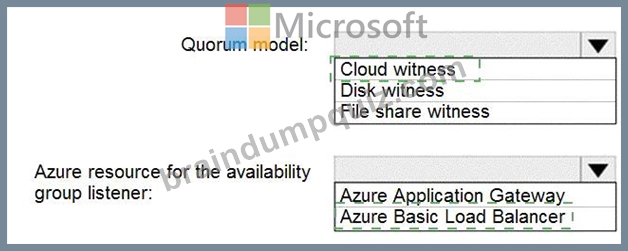
Explanation
Scenario: Business Requirements
Litware identifies business requirements include: meet an SLA of 99.99% availability for all Azure deployments.
Box 1: Cloud witness
If you have a Failover Cluster deployment, where all nodes can reach the internet (by extension of Azure), it is recommended that you configure a Cloud Witness as your quorum witness resource.
Box 2: Azure Basic Load Balancer
Microsoft guarantees that a Load Balanced Endpoint using Azure Standard Load Balancer, serving two or more Healthy Virtual Machine Instances, will be available 99.99% of the time.
Note: There are two main options for setting up your listener: external (public) or internal. The external (public) listener uses an internet facing load balancer and is associated with a public Virtual IP (VIP) that is accessible over the internet. An internal listener uses an internal load balancer and only supports clients within the same Virtual Network.
Reference:
https://technet.microsoft.com/windows-server-docs/failover-clustering/deploy-cloud-witness
https://azure.microsoft.com/en-us/support/legal/sla/load-balancer/v1_0/
NEW QUESTION # 29
You have an Azure subscription that contains an Azure SQL managed instance, a database named db1, and an Azure web app named Appl. Appl uses db1.
You need to enable Resource Governor for a App1. The solution must meet the following requirements:
App1 must be able to consume all available CPU resources.
App1 must have at least half of the available CPU resources always available.
Which three actions should you perform in sequence? To answer. move the appropriate actions from the list of actions to the answer area and arrange them in the correct order NOTE: More than one order of answer choices is correct. You will receive credit for any of the correct orders you select.
Answer:
Explanation:
1 - Create a resource pool that has the following configurations...
2 - Create a workload group.
3 - Create a classifier function in the master database.
NEW QUESTION # 30
You need to apply 20 built-in Azure Policy definitions to all new and existing Azure SQL Database deployments in an Azure subscription. The solution must minimize administrative effort.
Which three actions should you perform in sequence? To answer, move the appropriate actions from the list of actions to the answer area and arrange them in the correct order.
Answer:
Explanation:
Explanation:
Step 1: Create an Azure Policy Initiative
The first step in enforcing compliance with Azure Policy is to assign a policy definition. A policy definition defines under what condition a policy is enforced and what effect to take.
With an initiative definition, you can group several policy definitions to achieve one overarching goal. An initiative evaluates resources within scope of the assignment for compliance to the included policies.
Step 2: Create an Azure Policy Initiative assignment
Assign the initiative definition you created in the previous step.
Step 3: Run Azure Policy remediation tasks
To apply the Policy Initiative to the existing SQL databases.
Reference:
https://docs.microsoft.com/en-us/azure/governance/policy/tutorials/create-and-manage
NEW QUESTION # 31
You have an Azure SQL Database managed instance named sqldbmi1 that contains a database name Sales.
You need to initiate a backup of Sales.
How should you complete the Transact-SQL statement? To answer, select the appropriate options in the answer area.
NOTE:Each correct selection is worth one point.
Answer:
Explanation:
Explanation
Box 1: TO URL = 'https://storage1.blob.core.windows.net/blob1/Sales.bak' Native database backup in Azure SQL Managed Instance.
You can backup any database using standard BACKUP T-SQL command:
BACKUP DATABASE tpcc2501
TO URL = 'https://myacc.blob.core.windows.net/testcontainer/tpcc2501.bak' WITH COPY_ONLY Box 2: WITH COPY_ONLY Reference:
https://techcommunity.microsoft.com/t5/azure-sql-database/native-database-backup-in-azure-sql-managed-instan
NEW QUESTION # 32
From a website analytics system, you receive data extracts about user interactions such as downloads, link clicks, form submissions, and video plays.
The data contains the following columns:
You need to design a star schema to support analytical queries of the dat a. The star schema will contain four tables including a date dimension.
To which table should you add each column? To answer, select the appropriate options in the answer area.
NOTE: Each correct selection is worth one point.
Answer:
Explanation:
Reference:
https://docs.microsoft.com/en-us/power-bi/guidance/star-schema
NEW QUESTION # 33
You have an Azure SQL database.
You discover that the plan cache is full of compiled plans that were used only once.
You run the select * from sys.database_scoped_configurationsTransact-SQL command and receive the results shown in the following table.
You need relieve the memory pressure.
What should you configure?
- A. LEGACY_CARDINALITY_ESTIMATION
- B. ACCELERATED_PLAN_FORCING
- C. QUERY_OPTIMIZER_HOTFIXES
- D. OPTIMIZE_FOR_AD_HOC_WORKLOADS
Answer: D
Explanation:
OPTIMIZE_FOR_AD_HOC_WORKLOADS = { ON | OFF }
Enables or disables a compiled plan stub to be stored in cache when a batch is compiled for the first time. The default is OFF. Once the database scoped configuration OPTIMIZE_FOR_AD_HOC_WORKLOADS is enabled for a database, a compiled plan stub will be stored in cache when a batch is compiled for the first time.
Plan stubs have a smaller memory footprint compared to the size of the full compiled plan.
Incorrect Answers:
A: LEGACY_CARDINALITY_ESTIMATION = { ON | OFF | PRIMARY }
Enables you to set the query optimizer cardinality estimation model to the SQL Server 2012 and earlier version independent of the compatibility level of the database. The default is OFF, which sets the query optimizer cardinality estimation model based on the compatibility level of the database.
B: QUERY_OPTIMIZER_HOTFIXES = { ON | OFF | PRIMARY }
Enables or disables query optimization hotfixes regardless of the compatibility level of the database. The default is OFF, which disables query optimization hotfixes that were released after the highest available compatibility level was introduced for a specific version (post-RTM).
Reference:
https://docs.microsoft.com/en-us/sql/t-sql/statements/alter-database-scoped-configuration-transact-sql
NEW QUESTION # 34
You are planning the migration of the SERVER1 databases. The solution must meet the business requirements.
What should you include in the migration plan? To answer, select the appropriate options in the answer area.
NOTE: Each correct selection is worth one point.
Answer:
Explanation:
Reference:
https://azure.microsoft.com/pricing/details/database-migration/
https://docs.microsoft.com/en-us/azure/dms/tutorial-sql-server-azure-sql-online
NEW QUESTION # 35
You configure a long-term retention policy for an Azure SQL database as shown in the exhibit. (Click the Exhibit tab.)
The first weekly backup occurred on January 4, 2020. The dates for the first 10 weekly backups are:
January 4, 2020
January 11, 2020
January 18, 2020
January 25, 2020
February 1, 2020
February 8, 2020
February 15, 2020
February 22, 2020
February 29, 2020
March 7, 2020
Use the drop-down menus to select the answer choice that completes each statement based on the information presented in the graphic.
NOTE: Each correct selection is worth one point.
Answer:
Explanation:
NEW QUESTION # 36
You have SQL Server on an Azure virtual machine that contains a database named DB1. DB1 is 30 TB and has a 1-GB daily rate of change.
You back up the database by using a Microsoft SQL Server Agent job that runs Transact-SQL commands.
You perform a weekly full backup on Sunday, daily differential backups at 01:00, and transaction log backups every five minutes.
The database fails on Wednesday at 10:00.
Which three backups should you restore in sequence? To answer, move the appropriate backups from the list of backups to the answer area and arrange them in the correct order.
Answer:
Explanation:
Explanation
NEW QUESTION # 37
You have an on-premises Microsoft SQL Server 2016 server named Server1 that contains a database named DB1.
You need to perform an online migration of DB1 to an Azure SQL Database managed instance by using Azure Database Migration Service.
How should you configure the backup of DB1? To answer, select the appropriate options in the answer area.
NOTE: Each correct selection is worth one point.
Answer:
Explanation:
Explanation
Box 1: Full and log backups only
Make sure to take every backup on a separate backup media (backup files). Azure Database Migration Service doesn't support backups that are appended to a single backup file. Take full backup and log backups to separate backup files.
Box 2: WITH CHECKSUM
Azure Database Migration Service uses the backup and restore method to migrate your on-premises databases to SQL Managed Instance. Azure Database Migration Service only supports backups created using checksum.
Reference:
https://docs.microsoft.com/en-us/azure/dms/known-issues-azure-sql-db-managed-instance-online
NEW QUESTION # 38
You have an Azure SQL database named sqldb1.
You need to minimize the possibility of Query Store transitioning to a read-only state.
What should you do?
- A. Decrease by half the value of Data Flush Interval
- B. Double the value of Data Flush interval
- C. Decrease by half the value of Statistics Collection interval
- D. Double the value of Statistics Collection Interval
Answer: A
Explanation:
Section: [none]
Explanation:
The Max Size (MB) limit isn't strictly enforced. Storage size is checked only when Query Store writes data to
disk. This interval is set by the Data Flush Interval (Minutes) option. If Query Store has breached the maximum
size limit between storage size checks, it transitions to read-only mode.
Incorrect Answers:
C: Statistics Collection Interval: Defines the level of granularity for the collected runtime statistic, expressed in
minutes. The default is 60 minutes. Consider using a lower value if you require finer granularity or less time to
detect and mitigate issues. Keep in mind that the value directly affects the size of Query Store data.
Reference:
https://docs.microsoft.com/en-us/sql/relational-databases/performance/best-practice-with-the-query-store
NEW QUESTION # 39
HOTSPOT
You need to implement the monitoring of SalesSQLDb1. The solution must meet the technical requirements.
How should you collect and stream metrics? To answer, select the appropriate options in the answer area.
NOTE: Each correct selection is worth one point.
Hot Area:
Answer:
Explanation:
Explanation:
Box 1: The server, the elastic pool, and the database
Senario:
SalesSQLDb1 is in an elastic pool named SalesSQLDb1Pool.
Litware technical requirements include: all SQL Server and Azure SQL Database metrics related to CPU and storage usage and limits must be analyzed by using Azure built-in functionality.
Box 2: Azure Event hubs
Scenario: Migrate ManufacturingSQLDb1 to the Azure virtual machine platform.
Event hubs are able to handle custom metrics.
Incorrect Answers:
Azure Log Analytics
Azure metric and log data are sent to Azure Monitor Logs, previously known as Azure Log Analytics, directly by Azure. Azure SQL Analytics is a cloud only monitoring solution supporting streaming of diagnostics telemetry for all of your Azure SQL databases.
However, because Azure SQL Analytics does not use agents to connect to Azure Monitor, it does not support monitoring of SQL Server hosted on-premises or in virtual machines.
Monitor and Optimize Operational Resources
Question Set 2
NEW QUESTION # 40
You plan to migrate on-premises Microsoft SQL Server databases to Azure.
You need to identify which deployment and resiliency options meet the following requirements:
Support user-initiated backups.
Support multiple automatically replicated instances across Azure regions.
Minimize administrative effort to implement and maintain business continuity.
What should you identify? To answer, select the appropriate options in the answer area.
NOTE: Each correct selection is worth one point.
Answer:
Explanation:
Explanation
Box 1: SQL Server on Azure VMs
SQL Server on Azure Virtual Machines can take advantage of Automated Backup, which regularly creates backups of your database to blob storage. You can also manually use this technique.
Box 2: Active geo-replication
Geo-replication for services such as Azure SQL Database and Cosmos DB will create secondary replicas of your data across multiple regions. While both services will automatically replicate data within the same region, geo-replication protects you against a regional outage by enabling you to fail over to a secondary region.
Reference:
https://docs.microsoft.com/en-us/azure/azure-sql/virtual-machines/windows/sql-server-on-azure-vm-iaas-what-is
https://docs.microsoft.com/en-us/dotnet/architecture/cloud-native/infrastructure-resiliency-azure
NEW QUESTION # 41
You have an Azure Databricks workspace named workspace1 in the Standard pricing tier. Workspace1 contains an all-purpose cluster named cluster1.
You need to reduce the time it takes for cluster1 to start and scale up. The solution must minimize costs.
What should you do first?
- A. Upgrade workspace1 to the Premium pricing tier.
- B. Create a pool in workspace1.
- C. Configure a global init script for workspace1.
- D. Create a cluster policy in workspace1.
Answer: B
Explanation:
Explanation
You can use Databricks Pools to Speed up your Data Pipelines and Scale Clusters Quickly.
Databricks Pools, a managed cache of virtual machine instances that enables clusters to start and scale 4 times faster.
Reference:
https://databricks.com/blog/2019/11/11/databricks-pools-speed-up-data-pipelines.html
NEW QUESTION # 42
You have a new Azure SQL database. The database contains a column that stores confidential information.
You need to track each time values from the column are returned in a query. The tracking information must be stored for 365 days from the date the query was executed.
Which three actions should you perform? Each correct answer presents part of the solution.
NOTE: Each correct selection is worth one point.
- A. Turn on Azure Advanced Threat Protection (ATP).
- B. Turn on auditing and write audit logs to an Azure Storage account.
- C. Add extended properties to the column.
- D. Turn on Advanced Data Security for the Azure SQL server.
- E. Apply sensitivity labels named Highly Confidential to the column.
Answer: B,D,E
Explanation:
C: Advanced Data Security (ADS) is a unified package for advanced SQL security capabilities. ADS is available for Azure SQL Database, Azure SQL Managed Instance, and Azure Synapse Analytics. It includes functionality for discovering and classifying sensitive data D: You can apply sensitivity-classification labels persistently to columns by using new metadata attributes that have been added to the SQL Server database engine. This metadata can then be used for advanced, sensitivity-based auditing and protection scenarios.
A: An important aspect of the information-protection paradigm is the ability to monitor access to sensitive data. Azure SQL Auditing has been enhanced to include a new field in the audit log called data_sensitivity_information. This field logs the sensitivity classifications (labels) of the data that was returned by a query. Here's an example:
Reference:
https://docs.microsoft.com/en-us/azure/azure-sql/database/data-discovery-and-classification-overview
NEW QUESTION # 43
You have an instance of SQL Server on Azure Virtual Machines named SQL1. SQL1 contains a database named DB1.
You need to enable Transparent Data Encryption (TDE) for DB1.
Which three objects should you create in sequence? To answer, move the appropriate objects from the list of objects to the answer area and arrange them in the correct order.
Answer:
Explanation:
Explanation
NEW QUESTION # 44
You have an on-premises Microsoft SQL Server 2019 instance that hosts a database named DB1.
You plan to perform an online migration of DB1 to an Azure SQL managed instance by using the Azure Database Migration Service.
You need to create a backup of DB1 that is accessible to the Azure Database Migration Service.
What should you run for the backup and where should you store the backup? To answer, select the appropriate options in the answer area.
NOTE: Each correct selection is worth one point.
Answer:
Explanation:
Reference:
https://docs.microsoft.com/en-us/azure/dms/tutorial-sql-server-managed-instance-online
NEW QUESTION # 45
Your company uses Azure Stream Analytics to monitor devices.
The company plans to double the number of devices that are monitored.
You need to monitor a Stream Analytics job to ensure that there are enough processing resources to handle the
additional load.
Which metric should you monitor?
- A. Watermark delay
- B. Late Input Events
- C. Early Input Events
- D. Input Deserialization Errors
Answer: A
Explanation:
The Watermark delay metric is computed as the wall clock time of the processing node minus the largest watermark it has seen so far.
The watermark delay metric can rise due to:
1. Not enough processing resources in Stream Analytics to handle the volume of input events.
2. Not enough throughput within the input event brokers, so they are throttled.
3. Output sinks are not provisioned with enough capacity, so they are throttled.
Reference:
https://docs.microsoft.com/en-us/azure/stream-analytics/stream-analytics-time-handling
NEW QUESTION # 46
You have an Azure SQL database named DBI that contains a nonclustered index named index1.
End users report slow queries when they use index1.
You need to identify the operations that are being performed on the index.
Which dynamic management view should you use?
- A. Option C
- B. Option A
- C. Option B
- D. Option D
Answer: D
NEW QUESTION # 47
You have an Azure SQL database.
You have a query and the associated execution plan as shown in the following exhibit.
Use the drop-down menus to select the answer choice that completes each statement based on the information presented in the graphic.
NOTE: Each correct selection is worth one point.
Answer:
Explanation:
Explanation
Graphical user interface, text, application, email Description automatically generated
Box 1: Key Lookup
The Key Lookup cost is 99% so that is the performance bottleneck.
Box 2: nonclustered index
The key lookup on the clustered index is used because the nonclustered index does not include the required columns to resolve the query. If you add the required columns to the nonclustered index, the key lookup will not be required.
NEW QUESTION # 48
You configure version control for an Azure Data Factory instance as shown in the following exhibit.
Use the drop-down menus to select the answer choice that completes each statement based on the information presented in the graphic.
NOTE: Each correct selection is worth one point.
Answer:
Explanation: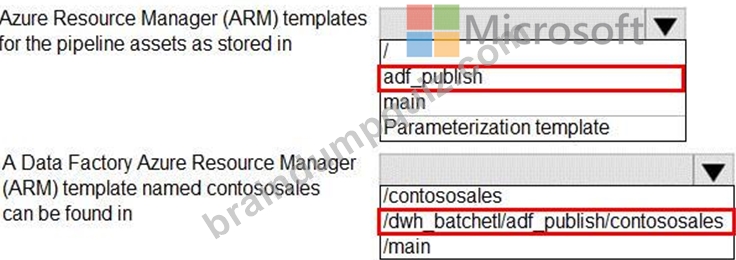
Reference:
https://docs.microsoft.com/en-us/azure/data-factory/source-control
NEW QUESTION # 49
Based on the PaaS prototype, which Azure SQL Database compute tier should you use?
- A. Business Critical 4-vCore
- B. Serverless
- C. Hyperscale
- D. General Purpose v-vCore
Answer: A
Explanation:
There are CPU and Data I/O spikes for the PaaS prototype. Business Critical 4-vCore is needed.
Reference:
https://docs.microsoft.com/en-us/azure/azure-sql/database/reserved-capacity-overview
Topic 3, ADatum Corporation
Existing Environment
ADatum has one database server that has Microsoft SQL Server 2016 installed. The server hosts three mission-critical databases named SALESDB, DOCDB, and REPORTINGDB.
SALESDB collects data from the stores and the website.
DOCDB stores documents that connect to the sales data in SALESDB. The documents are stored in two different JSON formats based on the sales channel.
REPORTINGDB stores reporting data and contains several columnstore indexes. A daily process creates reporting data in REPORTINGDB from the data in SALESDB. The process is implemented as a SQL Server Integration Services (SSIS) package that runs a stored procedure from SALESDB.
Requirements
Planned Changes
ADatum plans to move the current data infrastructure to Azure. The new infrastructure has the following requirements:
Migrate SALESDB and REPORTINGDB to an Azure SQL database.
Migrate DOCDB to Azure Cosmos DB.
The sales data, including the documents in JSON format, must be gathered as it arrives and analyzed online by using Azure Stream Analytics. The analytics process will perform aggregations that must be done continuously, without gaps, and without overlapping.
As they arrive, all the sales documents in JSON format must be transformed into one consistent format.
Azure Data Factory will replace the SSIS process of copying the data from SALESDB to REPORTINGDB.
Technical Requirements
The new Azure data infrastructure must meet the following technical requirements:
Data in SALESDB must encrypted by using Transparent Data Encryption (TDE). The encryption must use your own key.
SALESDB must be restorable to any given minute within the past three weeks.
Real-time processing must be monitored to ensure that workloads are sized properly based on actual usage patterns.
Missing indexes must be created automatically for REPORTINGDB.
Disk IO, CPU, and memory usage must be monitored for SALESDB.
NEW QUESTION # 50
HOTSPOT
You are evaluating the role assignments.
For each of the following statements, select Yes if the statement is true. Otherwise, select No.
NOTE: Each correct selection is worth one point.
Hot Area:
Answer:
Explanation:
Section: [none]
Explanation:
Box 1: Yes
DBAGroup1 is member of the Contributor role.
The Contributor role grants full access to manage all resources, but does not allow you to assign roles in Azure RBAC, manage assignments in Azure Blueprints, or share image galleries.
Box 2: No
Box 3: Yes
DBAGroup2 is member of the SQL DB Contributor role.
The SQL DB Contributor role lets you manage SQL databases, but not access to them. Also, you can't manage their security-related policies or their parent SQL servers. As a member of this role you can create and manage SQL databases.
Reference:
https://docs.microsoft.com/en-us/azure/role-based-access-control/built-in-roles Question Set 3
NEW QUESTION # 51
......
Get information about the advantages of Getting the Microsoft DP-300 Certification Exam
Microsoft Azure is a leader in the cloud, offering 9 role-based Azure ratings based on market requirements. By earning some or all of your Azure role-based certifications, you can ensure career advancement and market recognition. Currently, most companies use Azure cloud services and the demand for Microsoft Azure certified experts is increasing.
Another crucial factor in obtaining a Microsoft Azure certified is higher revenue and much better recognition in the market. As a Microsoft Azure Accredited Professional, your certifications represent your skills. With the increasing demand for cloud computing experts, you are creating much better compensation packages in the world than other IT fields.
The structured discovery methodology for obtaining Microsoft Azure certifications allows you to quickly learn various tools. Candidates discover many common tools like Hadoop, GitHub, Eclipse, etc. They are easy to learn, as well as interested new candidates can quickly adapt to Azure system and services with simplicity and ease.
Microsoft Azure Certifications are extremely essential when looking for a job in cloud computing and using adaptive career alternatives. Microsoft Azure certifications help protect credible companies such as Cloud Administrator, Developer, Security Engineer, Artificial Intelligence Designer, Data Engineer, Options Architect, and DevOps Designer. Microsoft Azure provides nine role-based certifications that not only increase your versatility in the role you are in, but also in the industry in which you work.
With a proven knowledge of Azure, it could be a truly critical asset to your organization and enhance business growth. Microsoft Azure ratings take advantage of the productivity benefits of Azure cloud setup. By using the pay-as-you-go feature, you can help your business minimize IT expenses and avoid incurring additional expenses.
BEST Verified Microsoft DP-300 Exam Questions (2023) : https://www.braindumpquiz.com/DP-300-exam-material.html
Get 100% Real DP-300 Free Online Practice Test: https://drive.google.com/open?id=1itU9ug2v_0J4y6fmDR61fR-se3tqNJqs