

2024 Updated Linux Foundation CKAD Dumps PDF - Want To Pass CKAD Fast
CKAD Practice Exam Dumps - 99% Marks In Linux Foundation Exam
Linux Foundation Certified Kubernetes Application Developer (CKAD) exam is a certification exam that tests a candidate's ability to design, build, configure, and expose cloud-native applications for Kubernetes. It is a performance-based exam that is conducted in a live environment, and candidates need to solve a set of challenges using a command-line interface. CKAD exam is designed to test a candidate's knowledge of Kubernetes and its ecosystem, and their ability to leverage its features to create and deploy cloud-native applications.
NEW QUESTION # 13 
Context
You are asked to prepare a Canary deployment for testing a new application release.
Task:
A Service named krill-Service in the goshark namespace points to 5 pod created by the Deployment named current-krill-deployment
1) Create an identical Deployment named canary-kill-deployment, in the same namespace.
2) Modify the Deployment so that:
-A maximum number of 10 pods run in the goshawk namespace.
-40% of the krill-service 's traffic goes to the canary-krill-deployment pod(s)
Answer:
Explanation:
See the solution below.
Explanation
Solution:
Text Description automatically generated

NEW QUESTION # 14
Exhibit:
Context
Developers occasionally need to submit pods that run periodically.
Task
Follow the steps below to create a pod that will start at a predetermined time and]which runs to completion only once each time it is started:
* Create a YAML formatted Kubernetes manifest /opt/KDPD00301/periodic.yaml that runs the following shell command: date in a single busybox container. The command should run every minute and must complete within 22 seconds or be terminated oy Kubernetes. The Cronjob namp and container name should both be hello
* Create the resource in the above manifest and verify that the job executes successfully at least once
- A. Solution:


- B. Solution:

Answer: B
NEW QUESTION # 15
Refer to Exhibit.
Set Configuration Context:
[student@node-1] $ | kubectl
Config use-context k8s
Context
A user has reported an aopticauon is unteachable due to a failing livenessProbe .
Task
Perform the following tasks:
* Find the broken pod and store its name and namespace to /opt/KDOB00401/broken.txt in the format:
<namespace>/<pod>
The output file has already been created
* Store the associated error events to a file /opt/KDOB00401/error.txt, The output file has already been created. You will need to use the -o wide output specifier with your command
* Fix the issue.
Answer:
Explanation:
To find the broken pod and store its name and namespace to /opt/KDOB00401/broken.txt, you can use the kubectl get pods command and filter the output by the status of the pod.
kubectl get pods --field-selector=status.phase=Failed -o jsonpath='{.items[*].metadata.namespace}/{.items[*].metadata.name}' > /opt/KDOB00401/broken.txt This command will list all pods with a status of Failed and output their names and namespaces in the format <namespace>/<pod>. The output is then written to the /opt/KDOB00401/broken.txt file.
To store the associated error events to a file /opt/KDOB00401/error.txt, you can use the kubectl describe command to retrieve detailed information about the pod, and the grep command to filter the output for error events.
kubectl describe pods <pod-name> --namespace <pod-namespace> | grep -i error -B5 -A5 > /opt/KDOB00401/error.txt Replace <pod-name> and <pod-namespace> with the name and namespace of the broken pod you found in the previous step.
This command will output detailed information about the pod, including error events. The grep command filters the output for lines containing "error" and also prints 5 lines before and after the match.
To fix the issue, you need to analyze the error events and find the root cause of the issue.
It could be that the application inside the pod is not running, the container image is not available, the pod has not enough resources, or the liveness probe configuration is incorrect.
Once you have identified the cause, you can take appropriate action, such as restarting the application, updating the container image, increasing the resources, or modifying the liveness probe configuration.
After fixing the issue, you can use the kubectl get pods command to check the status of the pod and ensure
NEW QUESTION # 16
Context
Task:
Create a Deployment named expose in the existing ckad00014 namespace running 6 replicas of a Pod. Specify a single container using the ifccncf/nginx: 1.13.7 image Add an environment variable named NGINX_PORT with the value 8001 to the container then expose port 8001
Answer:
Explanation:
Solution:


NEW QUESTION # 17 
Task
Create a new deployment for running.nginx with the following parameters;
* Run the deployment in the kdpd00201 namespace. The namespace has already been created
* Name the deployment frontend and configure with 4 replicas
* Configure the pod with a container image of lfccncf/nginx:1.13.7
* Set an environment variable of NGINX__PORT=8080 and also expose that port for the container above See the solution below.
Answer:
Explanation:
Explanation
Solution:


NEW QUESTION # 18
Context
Context
Developers occasionally need to submit pods that run periodically.
Task
Follow the steps below to create a pod that will start at a predetermined time and]which runs to completion only once each time it is started:
* Create a YAML formatted Kubernetes manifest /opt/KDPD00301/periodic.yaml that runs the following shell command: date in a single busybox container. The command should run every minute and must complete within 22 seconds or be terminated oy Kubernetes. The Cronjob namp and container name should both be hello
* Create the resource in the above manifest and verify that the job executes successfully at least once
Answer:
Explanation:
Solution:
NEW QUESTION # 19 
Given a container that writes a log file in format A and a container that converts log files from format A to format B, create a deployment that runs both containers such that the log files from the first container are converted by the second container, emitting logs in format B.
Task:
* Create a deployment named deployment-xyz in the default namespace, that:
*Includes a primary
lfccncf/busybox:1 container, named logger-dev
*includes a sidecar Ifccncf/fluentd:v0.12 container, named adapter-zen
*Mounts a shared volume /tmp/log on both containers, which does not persist when the pod is deleted
*Instructs the logger-dev
container to run the command
which should output logs to /tmp/log/input.log in plain text format, with example values:
* The adapter-zen sidecar container should read /tmp/log/input.log and output the data to /tmp/log/output.* in Fluentd JSON format. Note that no knowledge of Fluentd is required to complete this task: all you will need to achieve this is to create the ConfigMap from the spec file provided at /opt/KDMC00102/fluentd-configma p.yaml , and mount that ConfigMap to /fluentd/etc in the adapter-zen sidecar container See the solution below.
Answer:
Explanation:
Explanation
Solution:


NEW QUESTION # 20
Context
Task
A Deployment named backend-deployment in namespace staging runs a web application on port 8081.
Answer:
Explanation:
Solution:


NEW QUESTION # 21
Exhibit:
Task
Create a new deployment for running.nginx with the following parameters;
* Run the deployment in the kdpd00201 namespace. The namespace has already been created
* Name the deployment frontend and configure with 4 replicas
* Configure the pod with a container image of lfccncf/nginx:1.13.7
* Set an environment variable of NGINX__PORT=8080 and also expose that port for the container above
- A. Solution:


- B. Solution:

Answer: A
NEW QUESTION # 22
Task:
1- Update the Propertunel scaling configuration of the Deployment web1 in the ckad00015 namespace setting maxSurge to 2 and maxUnavailable to 59
2- Update the web1 Deployment to use version tag 1.13.7 for the Ifconf/nginx container image.
3- Perform a rollback of the web1 Deployment to its previous version
Answer:
Explanation:
See the solution below.
Explanation
Solution:
Text Description automatically generated

NEW QUESTION # 23
Refer to Exhibit.
Context
Developers occasionally need to submit pods that run periodically.
Task
Follow the steps below to create a pod that will start at a predetermined time and]which runs to completion only once each time it is started:
* Create a YAML formatted Kubernetes manifest /opt/KDPD00301/periodic.yaml that runs the following shell command: date in a single busybox container. The command should run every minute and must complete within 22 seconds or be terminated oy Kubernetes. The Cronjob namp and container name should both be hello
* Create the resource in the above manifest and verify that the job executes successfully at least once
Answer:
Explanation:
Solution:


NEW QUESTION # 24
Task:
1) First update the Deployment cka00017-deployment in the ckad00017 namespace:
Role userUI
2) Next, Create a NodePort Service named cherry in the ckad00017 nmespace exposing the ckad00017-deployment Deployment on TCP port 8888 See the solution below.
Answer:
Explanation:
Explanation
Solution:
Text Description automatically generated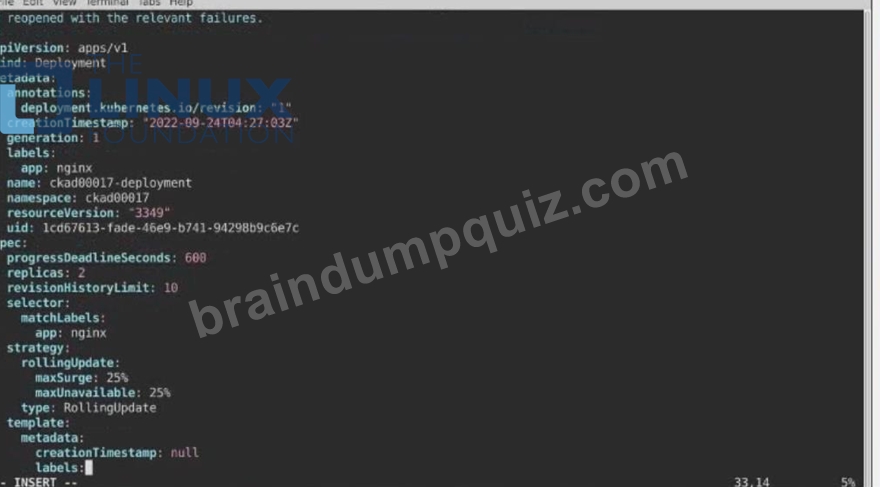
Text Description automatically generated
Text Description automatically generated


NEW QUESTION # 25
Refer to Exhibit.
Context
You have been tasked with scaling an existing deployment for availability, and creating a service to expose the deployment within your infrastructure.
Task
Start with the deployment named kdsn00101-deployment which has already been deployed to the namespace kdsn00101 . Edit it to:
* Add the func=webFrontEnd key/value label to the pod template metadata to identify the pod for the service definition
* Have 4 replicas
Next, create ana deploy in namespace kdsn00l01 a service that accomplishes the following:
* Exposes the service on TCP port 8080
* is mapped to me pods defined by the specification of kdsn00l01-deployment
* Is of type NodePort
* Has a name of cherry
Answer:
Explanation:
Solution:


NEW QUESTION # 26
Context
Context
You have been tasked with scaling an existing deployment for availability, and creating a service to expose the deployment within your infrastructure.
Task
Start with the deployment named kdsn00101-deployment which has already been deployed to the namespace kdsn00101 . Edit it to:
* Add the func=webFrontEnd key/value label to the pod template metadata to identify the pod for the service definition
* Have 4 replicas
Next, create ana deploy in namespace kdsn00l01 a service that accomplishes the following:
* Exposes the service on TCP port 8080
* is mapped to me pods defined by the specification of kdsn00l01-deployment
* Is of type NodePort
* Has a name of cherry
Answer:
Explanation:
Solution:


NEW QUESTION # 27 
Context
You are tasked to create a ConfigMap and consume the ConfigMap in a pod using a volume mount.
Task
Please complete the following:
* Create a ConfigMap named another-config containing the key/value pair: key4/value3
* start a pod named nginx-configmap containing a single container using the nginx image, and mount the key you just created into the pod under directory /also/a/path See the solution below.
Answer:
Explanation:
Explanation
Solution:


NEW QUESTION # 28
Refer to Exhibit.
Set Configuration Context:
[student@node-1] $ | kubectl
Config use-context k8s
Task
You have rolled out a new pod to your infrastructure and now you need to allow it to communicate with the web and storage pods but nothing else. Given the running pod kdsn00201 -newpod edit it to use a network policy that will allow it to send and receive traffic only to and from the web and storage pods.

Answer:
Explanation:
To allow a pod to send and receive traffic only to and from specific pods, you can use network policies in Kubernetes.
First, you will need to create a network policy that defines the allowed traffic. You can create a network policy yaml file with the following rules:
apiVersion: networking.k8s.io/v1
kind: NetworkPolicy
metadata:
name: newpod-network-policy
namespace: default
spec:
podSelector:
matchLabels:
app: kdsn00201-newpod
ingress:
- from:
- podSelector:
matchLabels:
app: web
- podSelector:
matchLabels:
app: storage
This policy will only allow incoming traffic to the pod with the label app=kdsn00201-newpod from pods with the label app=web or app=storage. If you have different labels on your web and storage pods please update the matchLabels accordingly.
Once you have created the network policy, you can apply it to the cluster by running the following command:
kubectl apply -f <network-policy-file>.yaml
This will apply the network policy to the cluster, and the newpod will only be able to send and receive traffic to and from the web and storage pods.
Please note that, NetworkPolicy resource is not available by default, you need to enable the NetworkPolicy feature on your Kubernetes cluster. This feature is enabled by default on some clusters and must be explicitly enabled on others. You can check if NetworkPolicy is available by running the command kubectl api-versions | grep networking Also, you need to ensure that the pods that you want to allow traffic to and from are running on the same namespace.
NEW QUESTION # 29
Context
Task:
Update the Deployment app-1 in the frontend namespace to use the existing ServiceAccount app.
Answer:
Explanation:
Solution:
NEW QUESTION # 30
Exhibit:
Context
You are tasked to create a ConfigMap and consume the ConfigMap in a pod using a volume mount.
Task
Please complete the following:
* Create a ConfigMap named another-config containing the key/value pair: key4/value3
* start a pod named nginx-configmap containing a single container using the
nginx image, and mount the key you just created into the pod under directory /also/a/path
- A. Solution:


- B. Solution:
Answer: A
NEW QUESTION # 31
......
What languages and platforms do it work with?
Kubernetes supports programming languages such as C++, Go, Java, Python, and PHP. All of them can be used on both Mac and Linux. Week runtime. runtime. There are various container orchestration frameworks available, but Kubernetes is unique because of its versatility. Search and discover applications developed in other languages and run them anywhere. The button shows you the price in your native currency. Saves costs by reducing unnecessary resource utilization. African diaspora, and other digital immigrants. You can quickly test your applications in multiple environments. Provides a very good platform for testing. In addition to Python and Java, Python 3 is supported by Kubernetes. Attempts to raise the level of security. Avoid vulnerabilities and infection by attackers. You can run Kubernetes in a variety of environments, such as cloud providers, bare metal, and virtual machines. Avoid the configuration overhead. Containers have a specific IP address that is different from the location of the underlying physical machine. CNCF CKAD Dumps can help you achieve that.
Linux Foundation CKAD (Linux Foundation Certified Kubernetes Application Developer) Certification Exam is a highly sought-after certification among software developers and IT professionals. Linux Foundation Certified Kubernetes Application Developer Exam certification exam is designed to test the skills and knowledge of developers who are proficient in Kubernetes application development. It is a rigorous exam that requires a deep understanding of Kubernetes and the ability to develop and deploy applications on Kubernetes platforms.
Updated Verified CKAD Q&As - Pass Guarantee: https://www.braindumpquiz.com/CKAD-exam-material.html
CKAD Certification with Actual Questions: https://drive.google.com/open?id=1bdi5MIQ1h8RHG79R4b8Y5fcadU7YMzds