

Real JN0-224 Exam Questions are the Best Preparation Material
Practice on 2026 LATEST JN0-224 Exam Updated 68 Questions
Juniper JN0-224 Exam Syllabus Topics:
| Topic | Details |
|---|---|
| Topic 1 |
|
| Topic 2 |
|
| Topic 3 |
|
| Topic 4 |
|
| Topic 5 |
|
NEW QUESTION # 23
Your organization is developing an application to automate management of Junos network appliances. You want to use the existing PyEZ libraries to improve the development process. Which API would satisfy this requirement?
- A. REST API
- B. RPC API
- C. XML API
- D. JETAPI
Answer: A
NEW QUESTION # 24
Which two statements about XML schema definition (XSD) files are correct? (Choose two.)
- A. Every XML document must have an XSD file defined for it.
- B. An XSD file is not an XML document.
- C. XSD files ensure that everyone working with the XML document uses a common set of tags.
- D. XSD files define all the elements in an XML document and the document XML hierarchy.
Answer: C,D
Explanation:
XML Schema Definition (XSD) files are used to define the structure and data types of an XML document. They ensure that the XML document adheres to a specific structure by defining the allowed elements, attributes, and their data types, thereby enforcing a consistent format.
Option A is correct because XSD files define the elements, attributes, and structure (hierarchy) of an XML document.
Option D is correct because XSD files provide a standardized format, ensuring that all parties working with the XML document use the same set of tags and structure.
Option B (Every XML document must have an XSD file defined for it) is incorrect; not every XML document requires an XSD file, although it's beneficial for validation.
Option C (An XSD file is not an XML document) is incorrect because XSD files themselves are written in XML.
Supporting Reference:
W3C XML Schema Definition (XSD) Documentation: Explains the purpose and structure of XSD files, including their role in defining XML document schemas.
NEW QUESTION # 25
What are two important aspects of the DevOps culture? (Choose two.)
- A. communication
- B. use of specific tools
- C. people
- D. separation of duties
Answer: A,C
Explanation:
Two important aspects of the DevOps culture are:
Communication (A): In a DevOps environment, continuous and effective communication between development, operations, and other stakeholders is crucial. It ensures that everyone is aligned, reduces misunderstandings, and facilitates faster and more efficient workflows.
People (D): DevOps is as much about the people as it is about the processes and tools. The culture emphasizes collaboration, shared responsibility, and a mindset focused on continuous improvement. Empowering people to work together across different disciplines is at the heart of DevOps.
Options B and C are not primary aspects of the DevOps culture. While tools are essential in implementing DevOps practices, the culture emphasizes communication and collaboration among people more than the use of specific tools or rigid separation of duties.
Reference:
DevOps Handbook: Discusses the cultural aspects of DevOps, with a focus on communication and people.
DevOps Best Practices: Highlights the importance of fostering a culture that prioritizes collaboration and shared goals.
NEW QUESTION # 26
A REST API client uses which two HTTP methods to execute RPC requests on the server? (Choose two.)
- A. GET
- B. POST
- C. CONNECT
- D. HEAD
Answer: A,B
Explanation:
REST APIs use HTTP methods to perform different operations on resources. In the context of RPC (Remote Procedure Call) requests:
GET: This method is used to retrieve data from the server. In a REST API, it is commonly used to fetch information about resources, such as the current configuration or operational state.
POST: This method is used to send data to the server to create or update a resource. In the context of RPC, POST is often used to execute a procedure on the server that may result in the modification of a resource or triggering of an action.
Options B (HEAD) and D (CONNECT) are not typically used for executing RPC requests:
HEAD is similar to GET but only retrieves the headers, not the body of the response.
CONNECT is used to establish a tunnel to the server, primarily for SSL-encrypted communication, and is not commonly associated with RESTful RPC operations.
Supporting Reference:
Juniper Networks REST API Documentation: The documentation provides detailed information about the use of HTTP methods in Juniper's RESTful services.
"RESTful Web Services" by Leonard Richardson and Sam Ruby: This book explains the principles of REST and how different HTTP methods, particularly GET and POST, are used to interact with RESTful APIs.
NEW QUESTION # 27
Which HTTP status code indicates a response to a successful request?
- A. 0
- B. 1
- C. 2
- D. 3
Answer: C
Explanation:
Explanation
Reference: https://www.juniper.net/documentation/en_US/junos-space-sdk/13.1/apiref/ com.juniper.junos_space.sdk.help/html/reference/Commonbehav.html
NEW QUESTION # 28
Using the set rest control configuration command, what are two ways to control access to the REST API running on a Junos device? (Choose two.)
- A. Limit the number of simultaneous connections.
- B. Limit management access to specific users.
- C. Limit access to only certain source IP addresses
- D. Limit management access to only SSH
Answer: A,C
Explanation:
When using the set rest control configuration command on a Junos device, you have several options to control access to the REST API. Two effective methods include:
Limiting the number of simultaneous connections: This ensures that the REST API is not overwhelmed by too many concurrent requests, which could potentially lead to performance issues or denial of service.
Limiting access to certain source IP addresses: This method restricts API access to specific IP addresses, enhancing security by ensuring that only trusted sources can interact with the REST API.
Option A (Limit management access to only SSH) is unrelated to controlling REST API access specifically.
Option B (Limit management access to specific users) might be relevant in a different context, but it is not directly tied to REST API control via the specific command mentioned.
Supporting Reference:
Juniper Networks REST API Documentation: This documentation explains how to configure and control access to the REST API on Junos devices, including connection limits and IP-based access control.
NEW QUESTION # 29
Exhibit.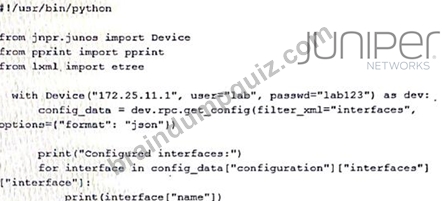
Referring to the exhibit, which two statements about the script are correct? (Choose two.)
- A. The script prints interface information for each interface name.
- B. The script prints the name of each configured interface.
- C. The script retrieves the interface configuration in JSON.
- D. The script retrieves the interface configuration in XML
Answer: B,C
NEW QUESTION # 30
Which type of on-box automation script is designed to run every time a user executes a configuration change?
- A. SNMP
- B. operation
- C. commit
- D. event
Answer: C
Explanation:
In Junos OS, a commit script is an on-box automation script that runs every time a configuration change is committed. Commit scripts are used to enforce configuration policies, validate configuration changes, or make automatic adjustments to configurations when certain conditions are met.
Commit Script (C): Executes automatically during the commit process, ensuring that the new configuration adheres to specific rules or conventions before it is applied to the system.
Event, SNMP, and operation scripts are used for other purposes in Junos automation but do not run automatically with every configuration change.
Reference:
Junos OS Automation Scripts Guide: Provides details on different types of scripts, including commit scripts, and their use cases.
Juniper Networks Documentation: Offers examples and best practices for creating and using commit scripts.
NEW QUESTION # 31
Which two statements are correct about a Python dictionary data type? (Choose two.)
- A. The data stored in a dictionary data type is sequenced and indexed.
- B. The data contained in a dictionary data type is a key/value pair.
- C. The data stored in a dictionary data type is not sequenced or indexed.
- D. The data contained in a dictionary data type cannot be removed once the dictionary has been created.
Answer: B,C
Explanation:
A Python dictionary is a data type that stores data in the form of key/value pairs. It has the following characteristics:
Key/Value Pair (C): Each entry in a dictionary is a pair consisting of a unique key and a value. The key is used to access the corresponding value.
Not Sequenced or Indexed (D): Unlike lists or tuples, dictionaries do not maintain order for their entries (in versions prior to Python 3.7). Even though Python 3.7+ maintains insertion order, dictionaries are not considered indexed or sequenced in the traditional sense like lists, where elements are accessed via positional index.
Option A is incorrect because dictionary entries can be added, modified, or removed after the dictionary is created. Option B is incorrect because dictionaries are not accessed by a numeric index but rather by their keys.
Reference:
Python Official Documentation: Details the nature of dictionaries, including their mutability and key/value structure.
Python Data Structures Guide: Explains dictionary operations and characteristics.
NEW QUESTION # 32
Why is a REST API considered stateless?
- A. No client context is stored on the server between requests.
- B. The REST API is an international API.
- C. The client requests to the server do not include state information.
- D. The state of the server is not important when making requests.
Answer: C
NEW QUESTION # 33
Which development model is the classic approach to software development?
- A. Lean
- B. Kanban
- C. Waterfall
- D. Scrum
Answer: C
NEW QUESTION # 34
Exhibit.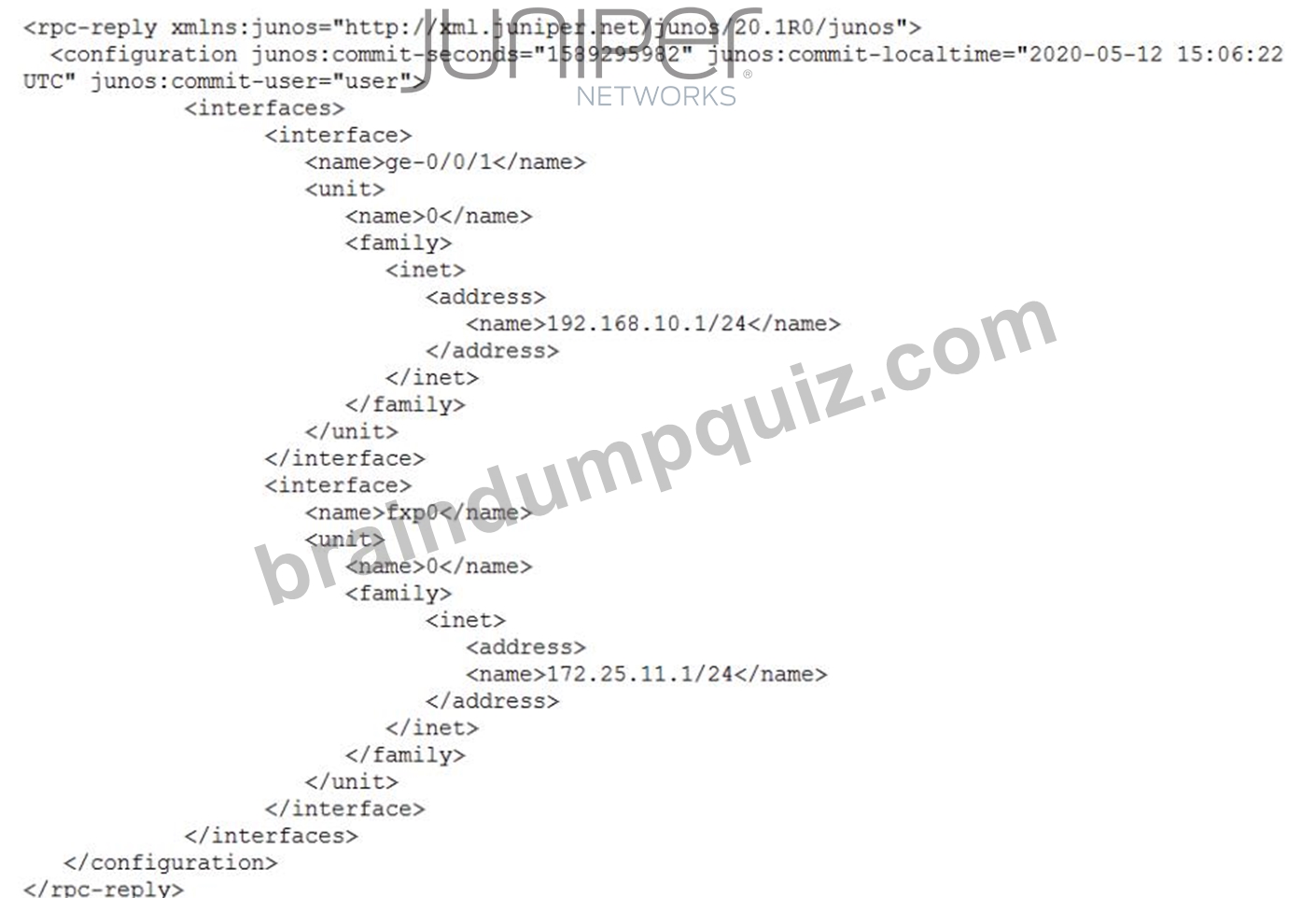
Referring to the exhibit, which XML XPath expression will only show the IP address XML elements?
- A. //name
- B. /name
- C. //address/name
- D. /address/name
Answer: C
Explanation:
https://www.w3schools.com/xml/xpath_syntax.asp
NEW QUESTION # 35
What is the correct sequence for Python script execution?
- A. The code is translated to byte code, the byte code is executed in runtime, and then the code is interpreted.
- B. The code is translated to byte code, the code is interpreted, and then the byte code is executed in runtime.
- C. The byte code is executed in runtime, the code is interpreted, and then the code is translated to byte code.
- D. The code is interpreted, the code is translated to byte code, and then the byte code is executed in runtime.
Answer: D
Explanation:
Python follows a specific execution flow when a script is run:
The code is interpreted:
Python is an interpreted language, meaning that the Python interpreter reads the code line by line. When a Python script is executed, the interpreter first reads the source code.
The code is translated to bytecode:
After interpreting the source code, Python translates it into bytecode. Bytecode is an intermediate representation of the source code that is portable and efficient for execution by the Python Virtual Machine (PVM).
The bytecode is executed in runtime:
Finally, the Python Virtual Machine (PVM) executes the bytecode. The PVM is a part of the Python runtime environment, responsible for interpreting the bytecode into machine-specific instructions for execution.
Hence, the correct sequence is: interpreted → translated to bytecode → bytecode executed in runtime.
Why the Other Options Are Incorrect:
Options A, C, and D present an incorrect order of the script execution process, especially in how bytecode is generated and executed.
Reference:
Python's documentation on the interpreter and its execution model explains this standard process.
NEW QUESTION # 36
You are asked to write an on-box script that will be triggered when a specific interface on a Junos device goes down.
Which type of on-box script should you use to accomplish this task?
- A. SNMP
- B. commit
- C. event
- D. operation
Answer: C
Explanation:
An event script is used to automate responses to system events in Junos, such as an interface going down. These scripts are triggered automatically when a specified event occurs, making them suitable for tasks like monitoring interface status and executing actions when the status changes.
Option B (event) is correct because event scripts are designed for reacting to system events like an interface going down.
Option A (commit) is used for configuration changes, Option C (operation) is used for operational tasks, and Option D (SNMP) is not applicable in this context.
Supporting Reference:
Juniper Networks Event Scripts Documentation: Details how event scripts are used to automate responses to specific system events in Junos
NEW QUESTION # 37
What is the default port for NETCONF connections over SSH?
- A. 0
- B. 1
- C. 2
- D. 3
Answer: B
Explanation:
https://www.juniper.net/documentation/us/en/software/junos/netconf/topics/topic-map/netconf-ssh-connection.html The IANA-assigned port for NETCONF-over-SSH sessions is 830.
NEW QUESTION # 38
Which Junos API supports direct modification of the Ephemeral database?
- A. WebSocket
- B. JET
- C. REST
- D. SOAP
Answer: B
Explanation:
In Junos, the JET (Junos Extension Toolkit) API supports direct modification of the Ephemeral database. The Ephemeral database is a temporary configuration database used in Junos OS, allowing for changes that do not persist after a reboot unless explicitly committed to the permanent configuration.
JET API: Allows for high-performance interactions with Junos, including the ability to make changes to the Ephemeral database, which is useful for temporary configurations, dynamic policies, and other operational tasks.
Other options like WebSocket, SOAP, and REST do not provide direct access to the Ephemeral database in Junos.
Reference:
Juniper Networks JET Documentation: Details how JET API interacts with the Ephemeral database.
Junos Automation and DevOps Documentation: Discusses the use of JET for automation and dynamic configuration.
NEW QUESTION # 39
Which two statements about Ansible are correct? (Choose two.)
- A. Ansible requires a license to unlock full functionality.
- B. Ansible modules must be written in Go.
- C. Ansible is an open source project.
- D. Ansible can use a single playbook to configure devices from multiple vendors.
Answer: C,D
NEW QUESTION # 40
Which two standard logical operators does XPath support? (Choose two.)
- A. IOR
- B. AND
- C. MAMD
- D. NOT
Answer: B,D
Explanation:
XPath is a query language used for selecting nodes from an XML document. It supports various logical operators that can be used to create complex queries. The two standard logical operators supported by XPath are:
NOT: This operator negates a condition, returning true if the condition is false, and vice versa.
AND: This operator is used to combine two conditions, and it returns true only if both conditions are true.
Option A (IOR) and Option D (MAMD) are not standard XPath operators.
Supporting Reference:
XPath Documentation: The W3C XPath specification lists the standard operators supported in XPath, including AND and NOT.
NEW QUESTION # 41
Which two statements are correct about using the Junos REST API? (Choose two.)
- A. It must use SSH for a connection.
- B. It supports data In CSV format.
- C. It is a simple configuration.
- D. NETCONF is not supported.
Answer: B,C
Explanation:
* A. It supports data in CSV format:
The Junos REST API supports multiple data formats for transferring information between systems, including XML, JSON, and CSV (Comma Separated Values). This flexibility allows for easier data parsing, especially in environments where structured data (like CSV) is a standard. CSV is often used for bulk data export or import and reporting purposes, making it an essential format for automation tasks involving external systems or large datasets.
Example Usage in REST API:
When using the Junos REST API, a user can request configuration or operational data and specify the response format (XML, JSON, or CSV). CSV is particularly useful when integrating Junos devices with systems that require easily readable, tabular formats.
Reference:
* D. It is a simple configuration:
The Junos REST API is designed to be relatively simple to configure. Once the REST API service is enabled on the Junos device, it can be accessed via HTTP or HTTPS, making it an easy entry point for automation and management tasks. Unlike more complex protocols (such as NETCONF), the REST API is lightweight and easier to use for simple configuration changes and retrieving operational data.
Configuration Example:
To enable the REST API, you can add the following configuration:
set system services rest http
set system services rest https
After enabling the service, API requests can be made to interact with the device for automation tasks, without needing the complexity of SSH or NETCONF configuration.
Why the Other Options Are Incorrect:
B . It must use SSH for a connection: This is incorrect. The Junos REST API uses HTTP or HTTPS for communication, not SSH. While SSH is commonly used for NETCONF, it is not required for REST API connections. REST APIs operate over standard web protocols.
C . NETCONF is not supported: This is incorrect. Junos supports both REST API and NETCONF for automation and configuration management. NETCONF is an XML-based protocol used for device configuration, which operates over SSH. The REST API and NETCONF can coexist on the same device, offering multiple avenues for automation.
Juniper Automation in DevOps Context: The simplicity and flexibility of the Junos REST API make it ideal for DevOps automation tasks. It allows teams to easily interact with Junos devices using lightweight RESTful methods, integrating with external systems through formats like CSV. The ease of configuration supports rapid deployment and scaling of automated management tasks.
Reference from Juniper Documentation:
Junos REST API Documentation
NEW QUESTION # 42
Which statement about the NETCONF content layer is true?
- A. It uses XML for RPC request and response payloads.
- B. It uses YAML for RPC request and response payloads.
- C. It uses JSON for RPC request and response payloads.
- D. It uses HTML for RPC request and response payloads.
Answer: A
Explanation:
The NETCONF protocol, used for network management, utilizes XML for encoding the RPC (Remote Procedure Call) requests and responses. XML is chosen because of its flexibility and ability to represent hierarchical data structures, making it well-suited for representing network configurations and states.
Option B is correct because XML is the standard format used for NETCONF RPC payloads.
Options A (YAML), C (JSON), and D (HTML) are incorrect because these formats are not used by NETCONF for its RPC payloads.
Supporting Reference:
RFC 6241 - NETCONF Protocol: This RFC describes the use of XML for encoding NETCONF messages.
NEW QUESTION # 43
YAML uses which two data structures? (Choose two.)
- A. arrays
- B. mappings
- C. sequences
- D. objects
Answer: B,C
Explanation:
YAML (YAML Ain't Markup Language) primarily uses two data structures:
Mappings: These are key-value pairs, similar to dictionaries or hashes in programming languages. In YAML, mappings are used to represent associative arrays or objects. They are defined with a colon (:) separating the key from the value.
Example:
key: value
name: John Doe
Sequences: These are ordered lists of items, equivalent to arrays or lists in other programming languages. Sequences in YAML are denoted by a dash (-) followed by a space and then the item.
Example:
fruits:
- Apple
- Banana
- Cherry
Detailed Explanation:
Mappings (B) allow you to define relationships between keys and values, making it possible to represent more complex data structures like dictionaries or objects.
Sequences (C) allow you to represent ordered collections, which is important for listing elements that must maintain a specific order.
YAML is often used in configuration files and data serialization in DevOps environments, such as in Ansible playbooks, Kubernetes manifest files, and CI/CD pipeline definitions. Its simplicity and human-readable format make it a popular choice for these applications.
Reference:
YAML Official Documentation: YAML's specification outlines these core data structures.
Juniper Automation and DevOps Documentation: Provides best practices for using YAML in network automation scripts and configuration management.
NEW QUESTION # 44
What is an example of correct XML syntax?
- A. <Devices><hostname>vMX1<Devices/>
- B. <Devices><hostname>vMX1</ho3tnameX/Device3>
- C. <Devices><hostname>vMX1<De vices/X/hostname>
- D. <Device3><ho3tname>vMX1</hostname><Devices/>
Answer: C
NEW QUESTION # 45
......
Authentic JN0-224 Exam Dumps PDF - Apr-2026 Updated: https://www.braindumpquiz.com/JN0-224-exam-material.html
Download Latest JN0-224 Dumps with Authentic Real Exam QA's: https://drive.google.com/open?id=1j0drorc82E2b-l-Vu_6XPOHg30hWMvkL