

[Jan 06, 2025] FCSS_SASE_AD-23 PDF Dumps is essential on your FCSS_SASE_AD-23 Exam Questions Certain Success!
FCSS_SASE_AD-23 PDF Questions - Perfect Prospect To Go With FCSS_SASE_AD-23 Practice Exam
NEW QUESTION # 13
Which secure internet access (SIA) use case minimizes individual workstation or device setup, because you do not needto install FortiClient on endpoints or configure explicit web proxy settings on web browser-based end points?
- A. SIA for site-based remote users
- B. SIA for agentless remote users
- C. SIA for inline-CASB users
- D. SIA for SSLVPN remote users
Answer: B
NEW QUESTION # 14
Which FortiSASE feature ensures least-privileged user access to all applications?
- A. thin branch SASE extension
- B. SD-WAN
- C. zero trust network access (ZTNA)
- D. secure web gateway (SWG)
Answer: C
Explanation:
Zero Trust Network Access (ZTNA) is the FortiSASE feature that ensures least-privileged user access to all applications. ZTNA operates on the principle of "never trust, always verify," providing secure access based on the identity of users and devices, regardless of their location.
* Zero Trust Network Access (ZTNA):
* ZTNA ensures that only authenticated and authorized users and devices can access applications.
* It applies the principle of least privilege by granting access only to the resources required by the user, minimizing the potential for unauthorized access.
* Implementation:
* ZTNA continuously verifies user and device trustworthiness and enforces granular access control policies.
* This approach enhances security by reducing the attack surface and limiting lateral movement within the network.
References:
* FortiOS 7.2 Administration Guide: Provides detailed information on ZTNA and its role in ensuring least-privileged access.
* FortiSASE 23.2 Documentation: Explains the implementation and benefits of ZTNA within the FortiSASE environment.
NEW QUESTION # 15
Which role does FortiSASE play in supporting zero trust network access (ZTNA) principles9
- A. It integrateswith software-defined network (SDN) solutions.
- B. It offers hardware-based firewalls for network segmentation.
- C. It enables VPN connections for remote employees.
- D. It can identify attributes on the endpoint for security posture check.
Answer: D
Explanation:
FortiSASE supports zero trust network access (ZTNA) principles by identifying attributes on the endpoint for security posture checks. ZTNA principles require continuous verification of user and device credentials, as well as their security posture, before granting access to network resources.
* Security Posture Check:
* FortiSASE can evaluate the security posture of endpoints by checking for compliance with security policies, such as antivirus status, patch levels, and configuration settings.
* This ensures that only compliant and secure devices are granted access to the network.
* Zero Trust Network Access (ZTNA):
* ZTNA is based on the principle of "never trust, always verify," which requires continuous assessment of user and device trustworthiness.
* FortiSASE plays a crucial role in implementing ZTNA by performing these security posture checks and enforcing access control policies.
References:
* FortiOS 7.2 Administration Guide: Provides information on ZTNA and endpoint security posture checks.
* FortiSASE 23.2 Documentation: Details on how FortiSASE implements ZTNA principles.
NEW QUESTION # 16
A FortiSASE administrator is configuring a Secure Private Access (SPA) solution to share endpoint information with a corporate FortiGate.
Which three configuration actions will achieve this solution? (Choose three.)
- A. Use the FortiClient EMS cloud connector on the corporate FortiGate to connect to FortiSASE
- B. Apply the FortiSASE zero trust network access (ZTNA) license on the corporate FortiGate.
- C. Register FortiGate and FortiSASE under the same FortiCloud account.
- D. Authorize the corporate FortiGate on FortiSASE as a ZTNA access proxy.
- E. Add the FortiGate IP address in the secure private access configuration on FortiSASE.
Answer: A,C,E
Explanation:
To configure a Secure Private Access (SPA) solution to share endpoint information between FortiSASE and a corporate FortiGate, you need to take the following steps:
* Add the FortiGate IP address in the secure private access configuration on FortiSASE:
* This step allows FortiSASE to recognize and establish a connection with the corporate FortiGate.
* Use the FortiClient EMS cloud connector on the corporate FortiGate to connect to FortiSASE:
* The EMS (Endpoint Management Server) cloud connector facilitates the integration between FortiClient endpoints and FortiSASE, enabling seamless sharing of endpoint information.
* Register FortiGate and FortiSASE under the same FortiCloud account:
* By registering both FortiGate and FortiSASE under the same FortiCloud account, you ensure centralized management and synchronization of configurations and policies.
References:
* FortiOS 7.2 Administration Guide: Provides details on configuring Secure Private Access and integrating with FortiGate.
* FortiSASE 23.2 Documentation: Explains how to set up and manage connections between FortiSASE and corporate FortiGate.
NEW QUESTION # 17
Refer to the exhibits.


A FortiSASE administrator is trying to configure FortiSASE as a spoke to a FortiGate hub. The tunnel is up to the FortiGale hub. However, the administrator is not able to ping the webserver hosted behind the FortiGate hub.
Based on the output, what is the reason for the ping failures?
- A. Network address translation (NAT) is not enabled on the spoke-to-hub policy.
- B. The Secure Private Access (SPA) policy needs to allow PING service.
- C. The BGP route is not received.
- D. Quick mode selectors are restricting the subnet.
Answer: D
Explanation:
The reason for the ping failures is due to the quick mode selectors restricting the subnet. Quick mode selectors define the IP ranges and protocols that are allowed through the VPN tunnel, and if they are not configured correctly, traffic to certain subnets can be blocked.
* Quick Mode Selectors:
* Quick mode selectors specify the source and destination subnets that are allowed to communicate through the VPN tunnel.
* If the selectors do not include the subnet of the webserver (192.168.10.0/24), then the traffic will be restricted, and the ping will fail.
* Diagnostic Output:
* The diagnostic output shows the VPN configuration details, but it is important to check the quick mode selectors to ensure that the necessary subnets are included.
* If the quick mode selectors are too restrictive, they will prevent traffic to and from the specified subnets.
* Configuration Check:
* Verify the quick mode selectors on both the FortiSASE and FortiGate hub to ensure they match and include the subnet of the webserver.
* Adjust the selectors to allow the necessary subnets for successful communication.
References:
* FortiOS 7.2 Administration Guide: Provides detailed information on configuring VPN tunnels and quick mode selectors.
* FortiSASE 23.2 Documentation: Explains how to set up and manage VPN tunnels, including the configuration of quick mode selectors.
NEW QUESTION # 18
Refer to the exhibit.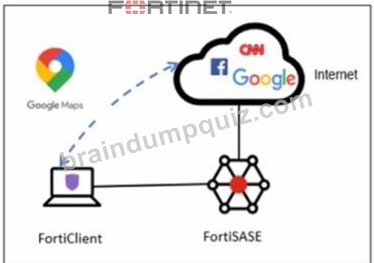
A company has a requirement to inspect all the endpoint internet traffic on FortiSASE, and exclude Google Maps traffic from the FortiSASE VPN tunnel and redirect it to the endpoint physical Interface.
Which configuration must you apply to achieve this requirement?
- A. Exempt the Google Maps FQDN from the endpoint system proxy settings.
- B. Configure a static route with the Google Maps FQDN on the endpoint to redirect traffic
- C. Change the default DNS server configuration on FortiSASE to use the endpoint system DNS.
- D. Configure the Google Maps FQDN as a split tunneling destination on the FortiSASE endpoint profile.
Answer: D
Explanation:
To meet the requirement of inspecting all endpoint internet traffic on FortiSASE while excluding Google Maps traffic from the FortiSASE VPN tunnel and redirecting it to the endpoint's physical interface, you should configure split tunneling. Split tunneling allows specific traffic to bypass the VPN tunnel and be routed directly through the endpoint's local interface.
* Split Tunneling Configuration:
* Split tunneling enables selective traffic to be routed outside the VPN tunnel.
* By configuring the Google Maps Fully Qualified Domain Name (FQDN) as a split tunneling destination, you ensure that traffic to Google Maps bypasses the VPN tunnel and uses the endpoint's local interface instead.
* Implementation Steps:
* Access the FortiSASE endpoint profile configuration.
* Add the Google Maps FQDN to the split tunneling destinations list.
* This configuration directs traffic intended for Google Maps to bypass the VPN tunnel and be routed directly through the endpoint's physical network interface.
References:
* FortiOS 7.2 Administration Guide: Provides details on split tunneling configuration.
* FortiSASE 23.2 Documentation: Explains how to set up and manage split tunneling for specific destinations.
NEW QUESTION # 19
During FortiSASE provisioning, how many security points of presence (POPs) need to be configured by the FortiSASE administrator?
- A. 0
- B. 1
- C. 2
- D. 3
Answer: A
Explanation:
During FortiSASE provisioning, the FortiSASE administrator needs to configure at least one security point of presence (PoP). A single PoP is sufficient to get started with FortiSASE, providing the necessary security services and connectivity for users.
* Security Point of Presence (PoP):
* A PoP is a strategically located data center that provides security services such as secure web gateway, firewall, and VPN termination.
* Configuring at least one PoP ensures that users can connect to FortiSASE and benefit from its security features.
* Scalability:
* While only one PoP is required to start, additional PoPs can be added as needed to enhance redundancy, load balancing, and performance.
References:
* FortiOS 7.2 Administration Guide: Provides details on the provisioning process for FortiSASE.
* FortiSASE 23.2 Documentation: Explains the configuration and role of security PoPs in the FortiSASE architecture.
NEW QUESTION # 20
When you configure FortiSASE Secure Private Access (SPA) with SD-WAN integration, you must establish a routing adjacency between FortiSASE and the FortiGate SD-WAN hub. Which routing protocol must you use?
- A. BGP
- B. OSPF
- C. EIGRP
- D. IS-IS
Answer: A
Explanation:
When configuring FortiSASE Secure Private Access (SPA) with SD-WAN integration, establishing a routing adjacency between FortiSASE and the FortiGate SD-WAN hub requires the use of the Border Gateway Protocol (BGP).
* BGP (Border Gateway Protocol):
* BGP is widely used for establishing routing adjacencies between different networks, particularly in SD-WAN environments.
* It provides scalability and flexibility in managing dynamic routing between FortiSASE and the FortiGate SD-WAN hub.
* Routing Adjacency:
* BGP enables the exchange of routing information between FortiSASE and the FortiGate SD-WAN hub.
* This ensures optimal routing paths and efficient traffic management across the hybrid network.
References:
* FortiOS 7.2 Administration Guide: Provides information on configuring BGP for SD-WAN integration.
* FortiSASE 23.2 Documentation: Details on setting up routing adjacencies using BGP for Secure Private Access with SD-WAN.
NEW QUESTION # 21
Which FortiSASE feature ensures least-privileged user access to all applications?
- A. thin branch SASE extension
- B. SD-WAN
- C. zero trust network access (ZTNA)
- D. secure web gateway (SWG)
Answer: C
NEW QUESTION # 22
Refer to the exhibits.


A FortiSASE administrator has configured an antivirus profile in the security profile group and applied it to the internet access policy. Remote users are still able to download the eicar.com-zip file from https://eicar.org.
Traffic logs show traffic is allowed by the policy.
Which configuration on FortiSASE is allowing users to perform the download?
- A. IPS is disabled in the security profile group.
- B. Force certificate inspection is enabled in the policy.
- C. Web filter is allowing the traffic.
- D. The HTTPS protocol is not enabled in the antivirus profile.
Answer: C
Explanation:
Based on the provided exhibits and the configuration details, the reason why users are still able to download the eicar.com-zip file despite having an antivirus profile applied is due to the Web Filter allowing the traffic.
Here is the step-by-step detailed explanation:
* Web Filtering Logs Analysis:
* The logs show that the traffic to the destination port 443 (which is HTTPS) is allowed and the security event triggered is Web Filter.
* The log details indicate that the URL belongs to an allowed category in the policy and thus, the traffic is permitted by the Web Filter.
* Security Profile Group Configuration:
* The Web Filter with Inline-CASB section indicates that the sitewww.eicar.orgis being monitored (93 occurrences) and not blocked.
* Since the Web Filter is set to allow traffic from this site, the antivirus profile will not block it because the Web Filter decision takes precedence.
* Antivirus Profile Configuration:
* Although the antivirus profile is configured, the logs do not show any antivirus actions being triggered. This indicates that the web filter is overriding the antivirus action.
* Policy Configuration:
* The policy named "Web Traffic" shows that it has logging enabled and is set to accept traffic.
* The profile group "SIA" applied to this policy includes both Web Filter and Antivirus settings.
However, since the Web Filter is allowing the traffic, the antivirus profile does not get the chance to inspect it.
References:
* FortiGate Security 7.2 Study Guide: Provides details on the precedence of web filtering over antivirus in security profiles.
* Fortinet Knowledge Base: Detailed explanation of web filtering and antivirus profiles interaction.
NEW QUESTION # 23
Refer to the exhibit.
To allow access, which web tiller configuration must you change on FortiSASE?
- A. URL Filter
- B. inline cloud access security broker (CASB) headers
- C. content filter
- D. FortiGuard category-based filter
Answer: A
Explanation:
The exhibit indicates that the URLhttps://www.bbc.com/is being blocked due to containing a banned word ("fight"). To allow access to this specific URL, you need to adjust the URL filter settings on FortiSASE.
* URL Filtering:
* URL filtering allows administrators to define policies that block or allow access to specific URLs or URL patterns.
* In this case, the URL filter is set to block any URL containing the word "fight."
* Modifying URL Filter:
* Navigate to the Web Filter configuration in FortiSASE.
* Locate the URL filter settings.
* Add an exception for the URLhttps://www.bbc.com/to allow access, even if it contains a banned word.
* Alternatively, remove or adjust the banned word list to exclude the word "fight" if it's not critical to the security policy.
References:
* FortiOS 7.2 Administration Guide: Provides details on configuring and managing URL filters.
* FortiSASE 23.2 Documentation: Explains how to set up and modify web filtering policies, including URL filters.
NEW QUESTION # 24
Refer to the exhibits.

When remote users connected to FortiSASE require access to internal resources on Branch-2. how will traffic be routed?
- A. FortiSASE will use the AD VPN protocol and determine that traffic will be directed to Branch-2 directly, using a dynamic route
- B. FortiSASE will use the SD-WAN capability and determine that traffic will be directed to HUB-2. which will then route traffic to Branch-2.
- C. FortiSASE will use the SD-WAN capability and determine that traffic will be directed to HUB-1, which will then route traffic to Branch-2.
- D. FortiSASE will use the AD VPN protocol and determine that traffic will be directed to Branch-2 directly, using a static route
Answer: C
Explanation:
When remote users connected to FortiSASE require access to internal resources on Branch-2, the following process occurs:
* SD-WAN Capability:
* FortiSASE leverages SD-WAN to optimize traffic routing based on performance metrics and priorities.
* In the priority settings, HUB-1 is configured with the highest priority (P1), whereas HUB-2 has a lower priority (P2).
* Traffic Routing Decision:
* FortiSASE evaluates the available hubs (HUB-1 and HUB-2) and selects HUB-1 due to its highest priority setting.
* Once the traffic reaches HUB-1, it is then routed to the appropriate branch based on internal routing policies.
* Branch-2 Access:
* Since HUB-1 has the highest priority, FortiSASE directs the traffic to HUB-1.
* HUB-1 then routes the traffic to Branch-2, providing the remote users access to the internal resources.
References:
* FortiOS 7.2 Administration Guide: Details on SD-WAN configurations and priority settings.
* FortiSASE 23.2 Documentation: Explains how FortiSASE integrates with SD-WAN to route traffic based on defined priorities and performance metrics.
NEW QUESTION # 25
Which two advantages does FortiSASE bring to businesses with multiple branch offices? (Choose two.)
- A. it offers customizable dashboard views for each branch location
- B. It offers centralized management for simplified administration.
- C. It eliminates the need to have an on-premises firewall for eachbranch.
- D. It enables seamless integration with third-party firewalls.
Answer: B,C
Explanation:
FortiSASE brings the following advantages to businesses with multiple branch offices:
* Centralized Management for Simplified Administration:
* FortiSASE provides a centralized management platform that allows administrators to manage security policies, configurations, and monitoring from a single interface.
* This simplifies the administration and reduces the complexity of managing multiple branch offices.
* Eliminates the Need for On-Premises Firewalls:
* FortiSASE enables secure access to the internet and cloud applications without requiring dedicated on-premises firewalls at each branch office.
* This reduces hardware costs and simplifies network architecture, as security functions are handled by the cloud-based FortiSASE solution.
References:
* FortiOS 7.2 Administration Guide: Provides information on the benefits of centralized management and cloud-based security solutions.
* FortiSASE 23.2 Documentation: Explains the advantages of using FortiSASE for businesses with multiple branch offices, including reduced need for on-premises firewalls.
NEW QUESTION # 26
......
FCSS_SASE_AD-23 Exam with Accurate FCSS FortiSASE 23 Administrator PDF Questions: https://www.braindumpquiz.com/FCSS_SASE_AD-23-exam-material.html