

Google Professional-Machine-Learning-Engineer Daily Practice Exam New 2021 Updated 72 Questions
Use Valid Professional-Machine-Learning-Engineer Exam - Actual Exam Question & Answer
Difficulty in Writing Professional Machine Learning Engineer - Google
This exam may go hard for you if you had not done its preparation properly. There are many websites that are offering the latest Google Machine Learning Professional questions and answers but these questions are not verified by Google certified experts and that’s why many are failed in their just first attempt. BraindumpQuiz is the best platform which provides the candidate with the necessary Google Machine Learning Professional exam questions that will help him to pass the Google Machine Learning Professional on the first time. Candidate will not have to take the Google Machine Learning Professional twice because with the help of Google Professional-Machine-Learning-Engineer exam dumps candidate will have every valuable material required to pass the Google Machine Learning Professional. We are providing the latest and actual questions and that is the reason why this is the one that he needs to use and there are no chances to fail when a candidate will have valid dumps from BraindumpQuiz. We have the guarantee that the questions that we have will be the ones that will pass candidate in the Google Machine Learning Professional in the very first attempt.
The aim is to keep candidates up-to-date and we shall automatically amend the material when and when the Offensive Protection reports any changes in the Google Professional-Machine-Learning-Engineer dumps.
NEW QUESTION 17
You were asked to investigate failures of a production line component based on sensor readings. After receiving the dataset, you discover that less than 1% of the readings are positive examples representing failure incidents. You have tried to train several classification models, but none of them converge. How should you resolve the class imbalance problem?
- A. Use a convolutional neural network with max pooling and softmax activation
- B. Downsample the data with upweighting to create a sample with 10% positive examples
- C. Remove negative examples until the numbers of positive and negative examples are equal
- D. Use the class distribution to generate 10% positive examples
Answer: A
NEW QUESTION 18
You are building a model to predict daily temperatures. You split the data randomly and then transformed the training and test datasets. Temperature data for model training is uploaded hourly. During testing, your model performed with 97% accuracy; however, after deploying to production, the model's accuracy dropped to 66%. How can you make your production model more accurate?
- A. Normalize the data for the training, and test datasets as two separate steps.
- B. Split the training and test data based on time rather than a random split to avoid leakage
- C. Add more data to your test set to ensure that you have a fair distribution and sample for testing
- D. Apply data transformations before splitting, and cross-validate to make sure that the transformations are applied to both the training and test sets.
Answer: C
NEW QUESTION 19
You are training a deep learning model for semantic image segmentation with reduced training time. While using a Deep Learning VM Image, you receive the following error: The resource 'projects/deeplearning-platforn/zones/europe-west4-c/acceleratorTypes/nvidia-tesla-k80' was not found. What should you do?
- A. Ensure that you have preemptible GPU quota in the selected region.
- B. Ensure that you have GPU quota in the selected region.
- C. Ensure that the required GPU is available in the selected region.
- D. Ensure that the selected GPU has enough GPU memory for the workload.
Answer: B
NEW QUESTION 20
As the lead ML Engineer for your company, you are responsible for building ML models to digitize scanned customer forms. You have developed a TensorFlow model that converts the scanned images into text and stores them in Cloud Storage. You need to use your ML model on the aggregated data collected at the end of each day with minimal manual intervention. What should you do?
- A. Create a serving pipeline in Compute Engine for prediction
- B. Use the batch prediction functionality of Al Platform
- C. Use Cloud Functions for prediction each time a new data point is ingested
- D. Deploy the model on Al Platform and create a version of it for online inference.
Answer: D
NEW QUESTION 21
During batch training of a neural network, you notice that there is an oscillation in the loss. How should you adjust your model to ensure that it converges?
- A. Decrease the size of the training batch
- B. Decrease the learning rate hyperparameter
- C. Increase the learning rate hyperparameter
- D. Increase the size of the training batch
Answer: C
NEW QUESTION 22
You have a functioning end-to-end ML pipeline that involves tuning the hyperparameters of your ML model using Al Platform, and then using the best-tuned parameters for training. Hypertuning is taking longer than expected and is delaying the downstream processes. You want to speed up the tuning job without significantly compromising its effectiveness. Which actions should you take?
Choose 2 answers
- A. Decrease the maximum number of trials during subsequent training phases.
- B. Set the early stopping parameter to TRUE
- C. Decrease the range of floating-point values
- D. Decrease the number of parallel trials
- E. Change the search algorithm from Bayesian search to random search.
Answer: A,E
NEW QUESTION 23
You were asked to investigate failures of a production line component based on sensor readings. After receiving the dataset, you discover that less than 1% of the readings are positive examples representing failure incidents. You have tried to train several classification models, but none of them converge. How should you resolve the class imbalance problem?
- A. Downsample the data with upweighting to create a sample with 10% positive examples
- B. Remove negative examples until the numbers of positive and negative examples are equal
- C. Use a convolutional neural network with max pooling and softmax activation
- D. Use the class distribution to generate 10% positive examples
Answer: B
NEW QUESTION 24
Your organization's call center has asked you to develop a model that analyzes customer sentiments in each call. The call center receives over one million calls daily, and data is stored in Cloud Storage. The data collected must not leave the region in which the call originated, and no Personally Identifiable Information (Pll) can be stored or analyzed. The data science team has a third-party tool for visualization and access which requires a SQL ANSI-2011 compliant interface. You need to select components for data processing and for analytics. How should the data pipeline be designed?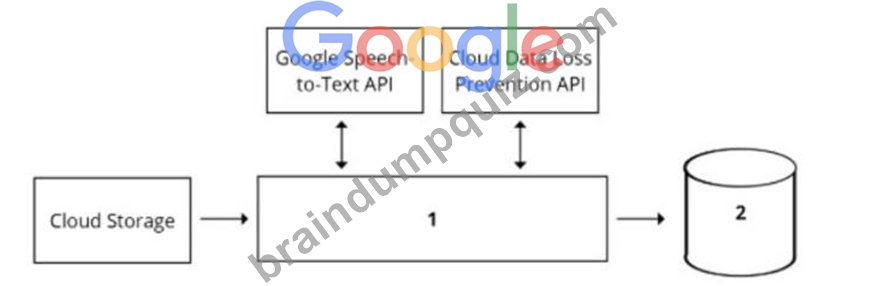
- A. 1 = Pub/Sub, 2 = Datastore
- B. 1 = Dataflow, 2 = BigQuery
- C. 1 = Dataflow, 2 = Cloud SQL
- D. 1 = Cloud Function, 2 = Cloud SQL
Answer: D
NEW QUESTION 25
A Machine Learning Specialist is developing a daily ETL workflow containing multiple ETL jobs. The workflow consists of the following processes:
* Start the workflow as soon as data is uploaded to Amazon S3.
* When all the datasets are available in Amazon S3, start an ETL job to join the uploaded datasets with multiple terabyte-sized datasets already stored in Amazon S3.
* Store the results of joining datasets in Amazon S3.
* If one of the jobs fails, send a notification to the Administrator.
Which configuration will meet these requirements?
- A. Use AWS Lambda to trigger an AWS Step Functions workflow to wait for dataset uploads to complete in Amazon S3. Use AWS Glue to join the datasets. Use an Amazon CloudWatch alarm to send an SNS notification to the Administrator in the case of a failure.
- B. Develop the ETL workflow using AWS Lambda to start an Amazon SageMaker notebook instance. Use a lifecycle configuration script to join the datasets and persist the results in Amazon S3. Use an Amazon CloudWatch alarm to send an SNS notification to the Administrator in the case of a failure.
- C. Use AWS Lambda to chain other Lambda functions to read and join the datasets in Amazon S3 as soon as the data is uploaded to Amazon S3. Use an Amazon CloudWatch alarm to send an SNS notification to the Administrator in the case of a failure.
- D. Develop the ETL workflow using AWS Batch to trigger the start of ETL jobs when data is uploaded to Amazon S3. Use AWS Glue to join the datasets in Amazon S3. Use an Amazon CloudWatch alarm to send an SNS notification to the Administrator in the case of a failure.
Answer: A
Explanation:
Explanation/Reference: https://aws.amazon.com/step-functions/use-cases/
NEW QUESTION 26
You have been asked to develop an input pipeline for an ML training model that processes images from disparate sources at a low latency. You discover that your input data does not fit in memory. How should you create a dataset following Google-recommended best practices?
- A. Create a tf.data.Dataset.prefetch transformation
- B. Convert the images to tf .Tensor Objects, and then run Dataset. from_tensor_slices{).
- C. Convert the images to tf .Tensor Objects, and then run tf. data. Dataset. from_tensors ().
- D. Convert the images Into TFRecords, store the images in Cloud Storage, and then use the tf. data API to read the images for training
Answer: B
NEW QUESTION 27
A company wants to predict the sale prices of houses based on available historical sales data. The target variable in the company's dataset is the sale price. The features include parameters such as the lot size, living area measurements, non-living area measurements, number of bedrooms, number of bathrooms, year built, and postal code. The company wants to use multi-variable linear regression to predict house sale prices.
Which step should a machine learning specialist take to remove features that are irrelevant for the analysis and reduce the model's complexity?
- A. Plot a histogram of the features and compute their standard deviation. Remove features with low variance.
- B. Run a correlation check of all features against the target variable. Remove features with low target variable correlation scores.
- C. Plot a histogram of the features and compute their standard deviation. Remove features with high variance.
- D. Build a heatmap showing the correlation of the dataset against itself. Remove features with low mutual correlation scores.
Answer: B
NEW QUESTION 28
A Data Scientist needs to create a serverless ingestion and analytics solution for high-velocity, real-time streaming data.
The ingestion process must buffer and convert incoming records from JSON to a query-optimized, columnar format without data loss. The output datastore must be highly available, and Analysts must be able to run SQL queries against the data and connect to existing business intelligence dashboards.
Which solution should the Data Scientist build to satisfy the requirements?
- A. Use Amazon Kinesis Data Analytics to ingest the streaming data and perform real-time SQL queries to convert the records to Apache Parquet before delivering to Amazon S3. Have the Analysts query the data directly from Amazon S3 using Amazon Athena and connect to BI tools using the Athena Java Database Connectivity (JDBC) connector.
- B. Write each JSON record to a staging location in Amazon S3. Use the S3 Put event to trigger an AWS Lambda function that transforms the data into Apache Parquet or ORC format and inserts it into an Amazon RDS PostgreSQL database. Have the Analysts query and run dashboards from the RDS database.
- C. Write each JSON record to a staging location in Amazon S3. Use the S3 Put event to trigger an AWS Lambda function that transforms the data into Apache Parquet or ORC format and writes the data to a processed data location in Amazon S3. Have the Analysts query the data directly from Amazon S3 using Amazon Athena, and connect to BI tools using the Athena Java Database Connectivity (JDBC) connector.
- D. Create a schema in the AWS Glue Data Catalog of the incoming data format. Use an Amazon Kinesis Data Firehose delivery stream to stream the data and transform the data to Apache Parquet or ORC format using the AWS Glue Data Catalog before delivering to Amazon S3. Have the Analysts query the data directly from Amazon S3 using Amazon Athena, and connect to BI tools using the Athena Java Database Connectivity (JDBC) connector.
Answer: D
Explanation:
Explanation/Reference:
NEW QUESTION 29
You are an ML engineer at a global car manufacturer. You need to build an ML model to predict car sales in different cities around the world. Which features or feature crosses should you use to train city-specific relationships between car type and number of sales?
- A. Three individual features binned latitude, binned longitude, and one-hot encoded car type
- B. One feature obtained as an element-wise product between latitude, longitude, and car type
- C. Two feature crosses as a element-wise product the first between binned latitude and one-hot encoded car type, and the second between binned longitude and one-hot encoded car type
- D. One feature obtained as an element-wise product between binned latitude, binned longitude, and one-hot encoded car type
Answer: D
NEW QUESTION 30
You have trained a deep neural network model on Google Cloud. The model has low loss on the training data, but is performing worse on the validation dat a. You want the model to be resilient to overfitting. Which strategy should you use when retraining the model?
- A. Run a hyperparameter tuning job on Al Platform to optimize for the L2 regularization and dropout parameters
- B. Run a hyperparameter tuning job on Al Platform to optimize for the learning rate, and increase the number of neurons by a factor of 2.
- C. Apply a dropout parameter of 0 2, and decrease the learning rate by a factor of 10
- D. Apply a 12 regularization parameter of 0.4, and decrease the learning rate by a factor of 10.
Answer: C
NEW QUESTION 31
You are an ML engineer at a regulated insurance company. You are asked to develop an insurance approval model that accepts or rejects insurance applications from potential customers. What factors should you consider before building the model?
- A. Redaction, reproducibility, and explainability
- B. Federated learning, reproducibility, and explainability
- C. Differential privacy federated learning, and explainability
- D. Traceability, reproducibility, and explainability
Answer: D
NEW QUESTION 32
Your team is working on an NLP research project to predict political affiliation of authors based on articles they have written. You have a large training dataset that is structured like this: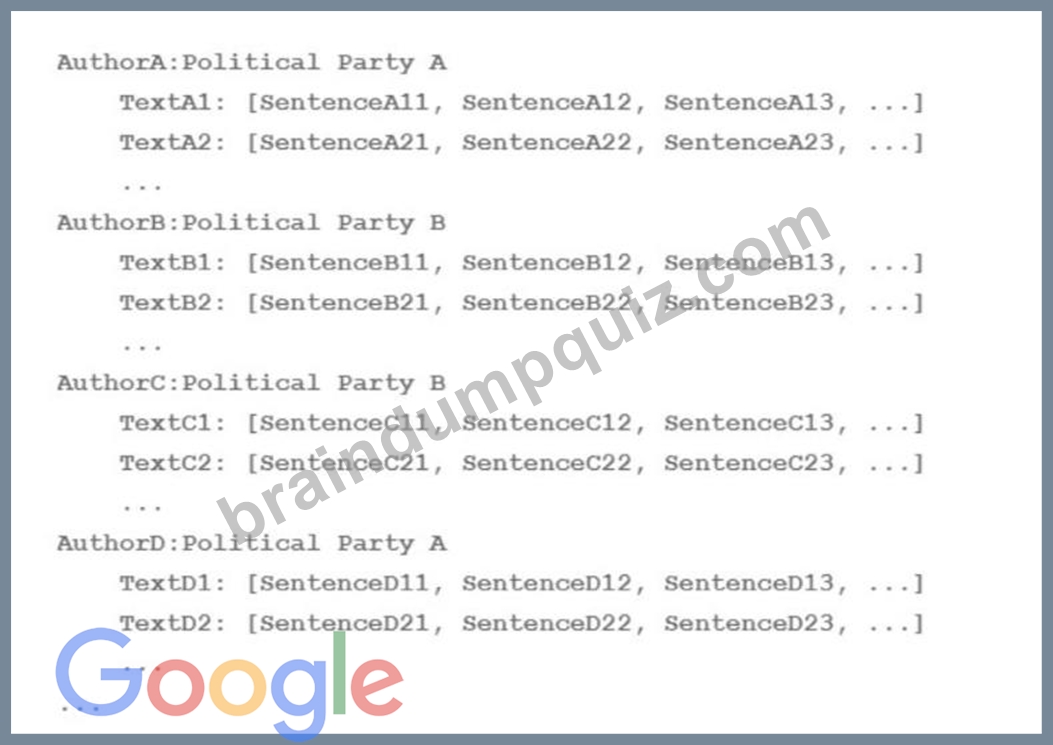
A)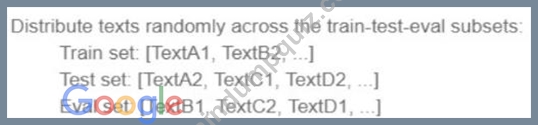
B)
C)
D)
- A. Option D
- B. Option B
- C. Option A
- D. Option C
Answer: A
NEW QUESTION 33
A Machine Learning Specialist is packaging a custom ResNet model into a Docker container so the company can leverage Amazon SageMaker for training. The Specialist is using Amazon EC2 P3 instances to train the model and needs to properly configure the Docker container to leverage the NVIDIA GPUs.
What does the Specialist need to do?
- A. Organize the Docker container's file structure to execute on GPU instances.
- B. Bundle the NVIDIA drivers with the Docker image.
- C. Build the Docker container to be NVIDIA-Docker compatible.
- D. Set the GPU flag in the Amazon SageMaker CreateTrainingJob request body.
Answer: B
NEW QUESTION 34
A Data Science team within a large company uses Amazon SageMaker notebooks to access data stored in Amazon S3 buckets. The IT Security team is concerned that internet-enabled notebook instances create a security vulnerability where malicious code running on the instances could compromise data privacy. The company mandates that all instances stay within a secured VPC with no internet access, and data communication traffic must stay within the AWS network.
How should the Data Science team configure the notebook instance placement to meet these requirements?
- A. Associate the Amazon SageMaker notebook with a private subnet in a VPC. Place the Amazon SageMaker endpoint and S3 buckets within the same VPC.
- B. Associate the Amazon SageMaker notebook with a private subnet in a VPC. Use IAM policies to grant access to Amazon S3 and Amazon SageMaker.
- C. Associate the Amazon SageMaker notebook with a private subnet in a VPC. Ensure the VPC has a NAT gateway and an associated security group allowing only outbound connections to Amazon S3 and Amazon SageMaker.
- D. Associate the Amazon SageMaker notebook with a private subnet in a VPC. Ensure the VPC has S3 VPC endpoints and Amazon SageMaker VPC endpoints attached to it.
Answer: D
NEW QUESTION 35
You built and manage a production system that is responsible for predicting sales numbers. Model accuracy is crucial, because the production model is required to keep up with market changes. Since being deployed to production, the model hasn't changed; however the accuracy of the model has steadily deteriorated. What issue is most likely causing the steady decline in model accuracy?
- A. Incorrect data split ratio during model training, evaluation, validation, and test
- B. Poor data quality
- C. Lack of model retraining
- D. Too few layers in the model for capturing information
Answer: A
NEW QUESTION 36
You work on a growing team of more than 50 data scientists who all use AI Platform. You are designing a strategy to organize your jobs, models, and versions in a clean and scalable way. Which strategy should you choose?
- A. Separate each data scientist's work into a different project to ensure that the jobs, models, and versions created by each data scientist are accessible only to that user.
- B. Use labels to organize resources into descriptive categories. Apply a label to each created resource so that users can filter the results by label when viewing or monitoring the resources.
- C. Set up a BigQuery sink for Cloud Logging logs that is appropriately filtered to capture information about AI Platform resource usage. In BigQuery, create a SQL view that maps users to the resources they are using
- D. Set up restrictive IAM permissions on the AI Platform notebooks so that only a single user or group can access a given instance.
Answer: D
NEW QUESTION 37
You are an ML engineer in the contact center of a large enterprise. You need to build a sentiment analysis tool that predicts customer sentiment from recorded phone conversations. You need to identify the best approach to building a model while ensuring that the gender, age, and cultural differences of the customers who called the contact center do not impact any stage of the model development pipeline and results. What should you do?
- A. Extract sentiment directly from the voice recordings
- B. Convert the speech to text and build a model based on the words
- C. Convert the speech to text and extract sentiments based on the sentences
- D. Convert the speech to text and extract sentiment using syntactical analysis
Answer: C
NEW QUESTION 38
......
Test Engine to Practice Professional-Machine-Learning-Engineer Test Questions: https://www.braindumpquiz.com/Professional-Machine-Learning-Engineer-exam-material.html
Professional-Machine-Learning-Engineer Real Exam Questions Test Engine Dumps Training With 72 Questions: https://drive.google.com/open?id=1w_bNhnRwsPOABpCPbaolXKQzhK6mknnz