

Excellent AI-103 Updated 2026 Dumps With 100% Exam Passing Guarantee
Best way to practice test for Microsoft AI-103
NEW QUESTION # 14
You have a Semantic Kernel agent that provides answers to product questions.
You plan to extend the capabilities of the agent to answer questions about the status of orders.
You need to ensure that the agent answers order status questions as quickly as possible. The solution must minimize development effort.
What should you include in the solution?
- A. a plugin
- B. an agent
- C. a function
- D. a kernel
Answer: A
Explanation:
To enable the agent to answer questions about order status, you need a plugin.
In Semantic Kernel, a plugin acts as a container for the specific capabilities (functions) that allow an agent to interact with external data or systems, such as an order database or API.
To help me give you a more specific example or guide, could you tell me:
The data source where order info is kept (e.g., a SQL database, a REST API, or Shopify) The programming language you're using for the Kernel (C# or Python) Reference:
https://learn.microsoft.com/en-us/semantic-kernel/frameworks/agent/agent-functions
NEW QUESTION # 15
Note: This section contains one or more sets of questions with the same scenario and problem. Each question presents a unique solution to the problem. You must determine whether the solution meets the stated goals. More than one solution in the set might solve the problem. It is also possible that none of the solutions in the set solve the problem.
After you answer a question in this section, you will NOT be able to return. As a result, these questions do not appear on the Review Screen.
You have a Microsoft Foundry project that contains an agent. The agent generates summaries from retrieved policy documents.
Users report that some responses omit required regulatory clauses, even when the clauses are present in the retrieved content.
You need to improve response completeness.
Solution: You increase the value of the temperatureparameter.
Does this meet the goal?
- A. Yes
- B. No
Answer: B
Explanation:
Correct:
* You add a reflection pass that regenerates the response if the required clauses are missing.
This is Self-Correction Strategy: A reflection pass allows an agent to evaluate its own initial output against specified constraints (e.g., checking for the presence of mandatory regulatory clauses). If the required text is missing, the agent triggers a programmatic self-correction or regeneration loop to include them before final delivery.
Incorrect:
* You increase the value of the max_tokens parameter.
Increasing the max_tokens parameter prevents the response from being cut off mid-sentence due to length constraints. However, it does not force the model's logic to explicitly include missing information that it chose to leave out earlier in the text.
* You increase the value of the temperature parameter.
Raising the temperature parameter increases randomness and creativity. For rigid compliance tasks like summarizing regulatory documents, higher temperature actually increases the risk of hallucination and omission.
* You run an evaluation flow that scores responses for completeness and blocks responses that fall below a defined threshold.
Evaluation Flow Block: Running an evaluation flow to score completeness and blocking bad responses identifies and stops low-quality outputs, but it does not fix or actively improve the response completeness. It simply filters failures out of the system.
Reference:
https://pub.towardsai.net/reflection-with-llm-how-to-make-ai-review-its-own-work-2db122fca1d8
NEW QUESTION # 16
You have an Azure subscription that contains an Azure Al Foundry instance named AI1.
You have an app that automatically triages and resolves issues presented in the log files of a system.
You create an incident manager agent and a DevOps agent that collaborate to resolve the issues.
You need to ensure that the incident manager agent can assign work to the DevOps agent. The solution must minimize development effort.
What should you do?
- A. Configure prompt flow for AI1.
- B. Create a plugin for the DevOps agent.
- C. Create a plugin for the incident manager agent.
- D. Configure a connected agent for AI1.
Answer: D
Explanation:
Ensuring that an incident manager agent can assign work to a DevOps agent in Azure AI Foundry is primarily achieved through a Connected Agents configuration. This setup allows a "main" agent to delegate tasks to "specialized" agents via natural language or defined function calls.
Key Implementation Steps
1. Configure Connected Agents
Within the Azure AI Foundry portal, you must register the DevOps agent as a "Connected Agent" of the incident manager.
2. Define Tool-Based Delegation
Use the ConnectedAgentToolDefinition in the Azure Python SDK or C# SDK to programmatically link them. This exposes the DevOps agent to the incident manager as a callable "tool".
3. Implement Handoff Orchestration Patterns
Choose an orchestration pattern that fits the triage-to-resolve workflow.
4. Manage Context and State
5. Enable Permissions and Roles
Reference:
https://learn.microsoft.com/en-us/azure/ai-foundry/agents/how-to/connected-agents
NEW QUESTION # 17
You have a Microsoft Foundry project that generates short promotional product videos.
After several clips are approved, reviewers notice a small watermark in the top-right corner of some videos.
You need to remove the watermark without regenerating the videos.
What should you do?
- A. Increase the guidance scale.
- B. Apply a mask-based inpainting edit to the affected part of the video.
- C. Crop the video by using the size parameter.
- D. Modify the original prompt to exclude watermarks.
Answer: B
Explanation:
The correct action to take is to apply a mask-based inpainting edit to the affected part of the video.
This is the only option that directly modifies the existing, approved video files. Inpainting allows you to isolate the specific top-right corner using a mask and seamlessly blend it with the surrounding pixels to erase the watermark without altering or regenerating the rest of the video footage.
Reference:
https://openart.ai/features/ai-video-inpainting/
NEW QUESTION # 18
You have a Microsoft Foundry project.
You need to deploy a model from the model catalog to support a search solution for internal policy documents. The model must generate vector representations of the text in the documents and of user queries.
Which type of model should you use?
- A. a large language model (LLM)
- B. a small language model (SLM)
- C. an image generation model
- D. an embedding model
Answer: D
Explanation:
To fulfill this requirement, you need an embeddings model from the Microsoft Foundry AI Model Catalog that captures semantic meaning and outputs numerical vectors for text chunks.
Reference:
https://learn.microsoft.com/en-us/azure/foundry-classic/openai/concepts/understand-embeddings
NEW QUESTION # 19
Hotspot Question
You have a Microsoft Foundry project that contains an agent named PaymentAgent.
PaymentAgent includes a function tool that issues customer refunds by using an external API.
You are creating a workflow in YAML.
You need to ensure that the workflow pauses for human approval and continues with the refund step only after approval is granted.
How should you complete the workflow definition? To answer, select the appropriate options in the answer area.
NOTE: Each correct selection is worth one point.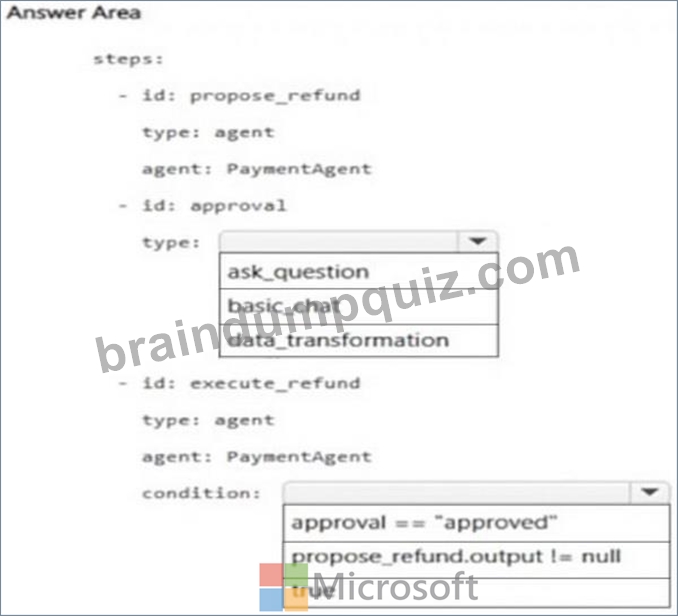
Answer:
Explanation: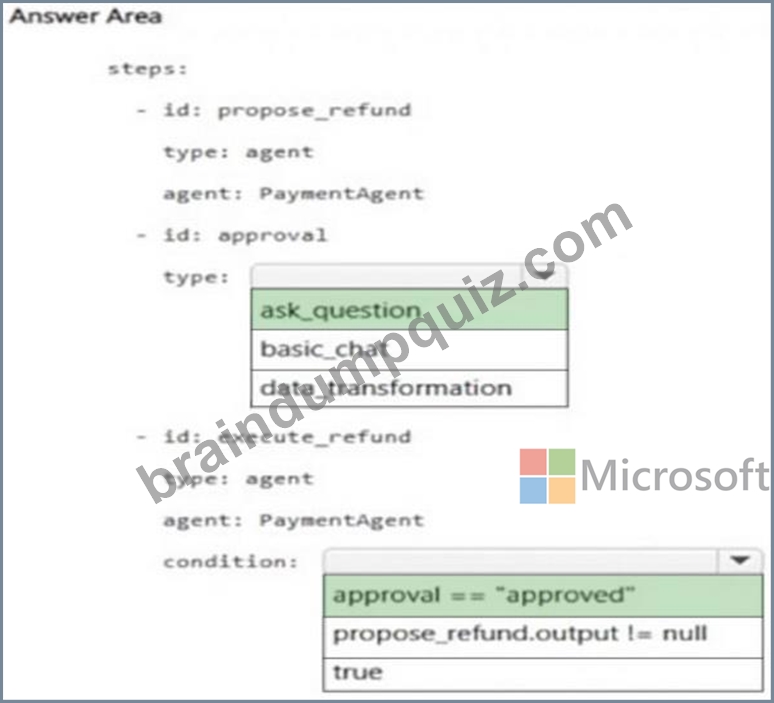
NEW QUESTION # 20
You need to configure Agent1 to answer customer questions about only the Contoso products. The solution must meet the business requirements.
What should you do?
- A. Increase the value of the temperature parameter.
- B. Add few-shot examples.
- C. Modify the system message instructions.
- D. Apply top-p sampling.
Answer: C
Explanation:
The correct answer is B. Modify the system message instructions . The case study states that Agent1 answers general questions about Contoso products and that a business requirement is for Agent1 to answer questions only about products sold by Contoso. This requirement defines the agent's allowed domain and refusal boundary, so it must be expressed in the agent's system-level instructions. Microsoft Foundry guidance states that system messages steer Azure OpenAI chat model behavior and are used to define the assistant's role, boundaries, output format, and safety or quality constraints.
The system message should instruct Agent1 to answer only Contoso-product questions, use Contoso product documentation when available, and decline questions about non-Contoso products. This directly enforces the intended business scope at the highest instruction level. Few-shot examples can reinforce desired behavior but are not the primary control for defining mandatory operating boundaries. Top-p sampling and temperature are decoding controls; they influence randomness and diversity, not whether the agent restricts answers to a specific product domain. Increasing temperature would likely reduce consistency. Reference topics: Microsoft Foundry agent instructions, system message design, prompt engineering, response boundaries, and grounded generative AI behavior.
NEW QUESTION # 21
You have a Microsoft Foundry project that contains an agent and an image generation model deployment.
The agent generates original images from user-supplied product photos.
You need to ensure that the generated images maintain the product identity and visual characteristics of the provided photo.
What should you do?
- A. Apply a groundedness detection filter.
- B. Set the input_fidelity parameter to high.
- C. Decrease the value of the temperature parameter.
- D. Include a prompt and input image in the request.
Answer: B
Explanation:
The correct answer is A. Set the input_fidelity parameter to high . The scenario requires the generated image to preserve the identity and visual characteristics of the user-supplied product photo. In Azure OpenAI image editing and generation workflows, input_fidelity controls how strongly the model attempts to match the style and features of the input image. Microsoft's documentation states that this parameter lets you make subtle edits without changing unrelated areas, and that high input fidelity preserves input-image features more accurately than standard mode.
Including a prompt and input image is necessary for image-guided generation, but it does not by itself maximize preservation of the product's appearance. The explicit preservation control is input_fidelity, and the requirement specifically asks to maintain product identity and visual characteristics. A groundedness detection filter applies to validating generated text against source data, not preserving visual features in image generation. Lowering temperature may reduce randomness in text generation, but it is not the image-control parameter used to retain product-specific visual details. Reference topics: Azure OpenAI image generation, image edit API, input images, input_fidelity, image-to-image generation, and visual identity preservation.
NEW QUESTION # 22
You have a Microsoft Foundry project that contains a model deployment.
You have an application that calls the deployment by using the Azure OpenAl v1 API and DefaultAzureCredential.
The developers at your company receive HTTP 403 errors when they send inference requests, even after running az login.
You need to ensure that the developers can perform model inference. The solution must follow the principle of least privilege.
Which role-based access control (RBAC) role should you assign to the developers?
- A. Contributor
- B. Cognitive Services User
- C. Cognitive Services Data Reader
- D. Cognitive Services OpenAl User
Answer: D
Explanation:
The correct role is Cognitive Services OpenAl User . The application is using DefaultAzureCredential, so az login only proves the developer's Microsoft Entra identity and enables token acquisition. It does not by itself grant authorization to the model deployment. Azure OpenAI and Microsoft Foundry separate authentication from authorization; Microsoft Entra ID provides token-based authentication, while Azure RBAC controls whether the signed-in principal can perform data-plane actions such as model inference. Microsoft's Foundry guidance states that Microsoft Entra ID supports granular RBAC and that data-plane operations include runtime usage such as chat completions and embedding generation.
For Azure OpenAI resources, the Cognitive Services OpenAI User role specifically allows users to make inference API calls with Microsoft Entra ID against deployed models, while preventing higher-privilege actions such as creating deployments, copying keys, fine-tuning, or managing the resource.
The other roles are not least privilege. Contributor grants broad management-plane permissions. Cognitive Services User is broader and less specific than the Azure OpenAI inference role. Cognitive Services Data Reader is read-oriented and does not provide the required model inference data action. Reference topics:
Microsoft Foundry authentication and authorization, Azure RBAC, Microsoft Entra ID keyless authentication, Azure OpenAI v1 API, and least-privilege model inference.
NEW QUESTION # 23
You are building a customer support web app named App1 in Microsoft Foundry that uses a GPT realtime model.
App1 must support:
- Live, low-latency voice conversations that use Azure OpenAI
- Streaming audio input from users and playback audio responses
You need to configure a connection method that supports real-time audio streaming in client application and targets approximately 100 ms latency.
Which connection method should you use?
- A. WebSocket
- B. WebRTC
- C. RTMP
- D. SIP
Answer: A
Explanation:
WebSockets is the best connection method for this application because it enables full-duplex, bi- directional streaming over a single TCP connection, meeting the strict ~100 ms latency requirement for real-time audio.
Reference:
https://www.chat-data.com/blog/implement-openai-realtime-api-for-chatgpt-voice
NEW QUESTION # 24
Case Study 1 - Contoso, Ltd
Overview
Company Information
Contoso, Ltd is a multinational retail company that builds, deploys, and manages generative AI and agent-based solutions by using Microsoft Foundry.
Existing Environment
Identity Environment
Contoso uses Microsoft Entra ID for identity management, authentication, and authorization capabilities that enable agents to access organizational resources and services.
Contoso recently formed a new AI engineering team named Agent1Dev Team to optimize and maintain existing AI solutions.
The team collaborates with solution architects, DevOps engineers, and security engineers to design, implement. monitor, and secure AI applications.
Contoso also has a team named Agent1Test Team that is responsible for validating AI solutions before the solution deployments.
Generative Environment
Contoso has a Microsoft Foundry deployment that contains two projects named Project1 and Project2.
Project1
Project1 contains a customer support agent named Agent1 that assists customers with product inquiries and troubleshooting requests.
Agent1 has the following configurations:
- Agent1 uses a base model deployment.
- A safety evaluation pipeline is NOT enabled.
- Tool invocation approval workflows are NOT enabled.
- Conversation memory constraints are NOT configured.
Agent1 interacts with customers by using digital support channels and answers general questions about Contoso products.
Project1 is deployed to an Azure region located in the European Union (EU).
Agent1Dev Team will use Project1 to optimize and maintain Agent1.
Project2
Project2 contains a deployed video generation model. The marketing department at Contoso has access to Project2 and plans to use the model to develop a video creation solution.
Development of the solution is incomplete.
Data Environment
Contoso stores product-related information in Azure resources that support AI applications.
The Azure environment contains an Azure Blob Storage account named storage1 that stores product detail sheets for all the Contoso products.
The product sheets include specifications, feature descriptions, and product support information that Agent1 can use to answer customer questions. The product sheets are stored in the PDF format.
Problem Statements
Contoso identifies the following issues:
- Agent1 has only general knowledge of the Contoso products.
- A recent chat interaction with Agent1 was analyzed for sentiment. The results of the analysis have NOT been processed yet.
- Agent1 does NOT use the detailed product information in the product sheets stored in storage1 when responding to customer questions.
- The finance department at Contoso reports that vendor invoices must be reviewed manually to ensure that the invoices match the terms defined in the vendor contracts. The invoices contain tables, logos, and varied layouts that make the documents difficult to process consistently.
Requirements
Planned Changes
Contoso plans to implement the following changes:
- Implement a solution for Project1 that analyzes the vendor invoices by evaluating both the visual layout and the textual content of the invoices, so that the invoice details can be verified against the vendor contract terms.
- Update the base model deployment used by Agent1 and standardize the model version to ensure continuity and consistent responses.
- Enable Agent1 to retrieve and use the detailed product information from the product sheets stored in storage1.
- Implement an indexing solution for the product sheets that Agent1 can use to answer customer questions.
- Complete the development of the video creation solution.
Technical Requirements
Contoso identifies the following technical requirements:
- The model deployment used by Agent1 must support scalable, high-throughput generative AI workloads and dynamically scale to handle variable customer support traffic, without requiring reserved throughput capacity.
- The product sheets must be processed by using an indexing pipeline that enables semantic and vector search, so that Agent1 can retrieve the relevant product information.
- Responses generated by using the product sheet information must be relevant, complete, and accurate.
- Agent1 must be able to use the product sheets to answer natural language questions about product details.
- The model version used by Agent1 must remain consistent to ensure stable responses.
- The data processed by the model must remain within the EU.
Security and Compliance Requirements
Contoso identifies the following security and compliance requirements:
- API keys must NOT be used to access Foundry-deployed models.
- Access to the Azure resources must follow the principle of least privilege.
- The developers at Contoso must authenticate to Microsoft Foundry resources by using Microsoft Entra authentication.
- Access to Project1 must be assigned to the members of Agent1Dev Team by using a security group named SC_Agent1_Dev.
- Access to Project1 must be assigned to the members of Agent1Test Team by using a security group named SC_Agent1_Test.
- Agent1 must never reveal customer information, even if a document that contains customer data is added erroneously to the product sheet repository in storage1.
- The product sheets might contain images that include embedded text. Agent1 must be protected from malicious instructions potentially hidden within the images.
Business Requirements
Contoso identifies the following business requirements:
- Users that interact with Agent1 must have a personalized experience in future interactions, including the ability for Agent1 to retain conversation context and recall relevant information from previous interactions.
- Agent1 must answer questions only about the products sold by Contoso.
You need to configure personalized user interactions for Agent1. The solution must meet the business requirements.
What should you include in the solution?
- A. memory
- B. guardrails
- C. knowledge
- D. tools
Answer: A
Explanation:
Scenario, Business Requirements:
*-> Users that interact with Agent1 must have a personalized experience in future interactions, including the ability for Agent1 to retain conversation context and recall relevant information from previous interactions.
Agent1 must answer questions only about the products sold by Contoso.
To configure personalized user interactions that retain context and recall previous information, you should use the Memory in Foundry Agent Service.
Managed Long-Term Memory: This allows the agent to extract meaningful information from user conversations and store it as durable knowledge (e.g., user preferences or historical details) to be recalled across future interactions.
Scoped Memory Stores: By using the scope parameter when creating memory stores, you can segment memories to ensure a secure, personalized experience for distinct users.
Automatic Injection: The agent will automatically inject these learned facts and user profile details into the prompt before new interactions, eliminating the need to rehydrate context manually.
References:
https://learn.microsoft.com/en-us/azure/foundry/agents/concepts/what-is-memory
NEW QUESTION # 25
You have a customer support agent that uses the Microsoft Foundry Agent Service.
Sometimes, customers return to a session days later to continue the same support case, and the agent must resume with the full historical context. The agent must provide the following:
* Multi-turn continuity within the session
* Cross-session continuity for the same case
* Access to the full interaction history, including user messages, agent messages, tool calls, and tool outputs You need to ensure that the agent automatically reloads the complete history on each new turn.
What should you do?
- A. Create and reuse a conversation by storing the conversation's ID and supplying the ID on subsequent requests.
- B. Persist only the final model response stored in the client application and prepend the response to future prompts.
- C. Enable memory summarization on the agent definition to persist the context automatically.
Answer: A
Explanation:
The correct approach is to create and reuse a conversation by storing the conversation's ID and supplying that ID on subsequent requests . In Microsoft Foundry Agent Service, conversations are durable objects with unique identifiers that can be reused across sessions. The official runtime guidance states that conversations store items, including messages, tool calls, tool outputs, and other data, and are intended for multi-turn continuity, cross-session continuity, and inspection of what happened over time. This directly satisfies the requirement to resume the same support case days later with the full historical context.
Persisting only the final model response is insufficient because it loses the full interaction chain, especially tool calls and tool outputs that may be essential to case state. Memory summarization is also not the best fit because the requirement asks for the complete history, not a compressed representation that may omit details.
Reusing the conversation ID allows Foundry to maintain the conversation server-side so the next turn can reuse prior context without the client manually rebuilding prompts. Reference topics: Foundry Agent Service runtime components, conversations, conversation items, multi-turn continuity, cross-session continuity, and tool output history.
NEW QUESTION # 26
You are planning a Microsoft Foundry project named Project1 that will contain multiple agents.
Each agent will access the same Azure AI Search resource.
You need to recommend a solution to centrally manage the Azure AI Search credentials within Project1. The solution must be implemented across all the agents.
What should you recommend?
- A. Disable key-based access control on the Azure AI Search resource.
- B. Create a managed private endpoint that connects to the Azure AI Search resource.
- C. Add a connection to the Azure AI Search resource.
- D. Enable role-based access control (RBAC) for the Azure AI Search resource.
Answer: C
Explanation:
To best manage security and centrally handle credentials across multiple agents, you should add a connection to the Azure AI Search resource at the Azure AI Foundry project level.
Why This Works
Central Hub: The project acts as the single security perimeter for all your agents.
Credential Masking: Agents inherit access without hardcoding secrets, API keys, or connection strings in their code.
Identity Management: It allows you to leverage Microsoft Entra ID (formerly Azure AD) for role- based access control (RBAC).
How to Implement It
1. Navigate to your Azure AI Foundry portal.
2. Select your specific project from the dashboard.
3. Open the "Management Center" or "Project settings" tab.
4. Click on "Connected resources" or "Connections".
5. Add the Azure AI Search resource.
6. Choose Entra ID (managed identity) over API keys for maximum security.
Reference:
https://partner.microsoft.com/en-us/blog/article/azure-updates-december-2025
NEW QUESTION # 27
You need to ensure that Agent1Dev Team can access Agent1. The solution must meet the security and compliance requirements.
How should you complete the Python code? To answer, select the appropriate options in the answer area.
NOTE: Each correct selection is worth one point.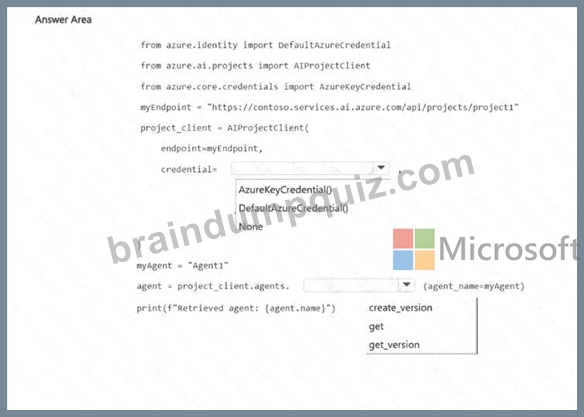
Answer:
Explanation: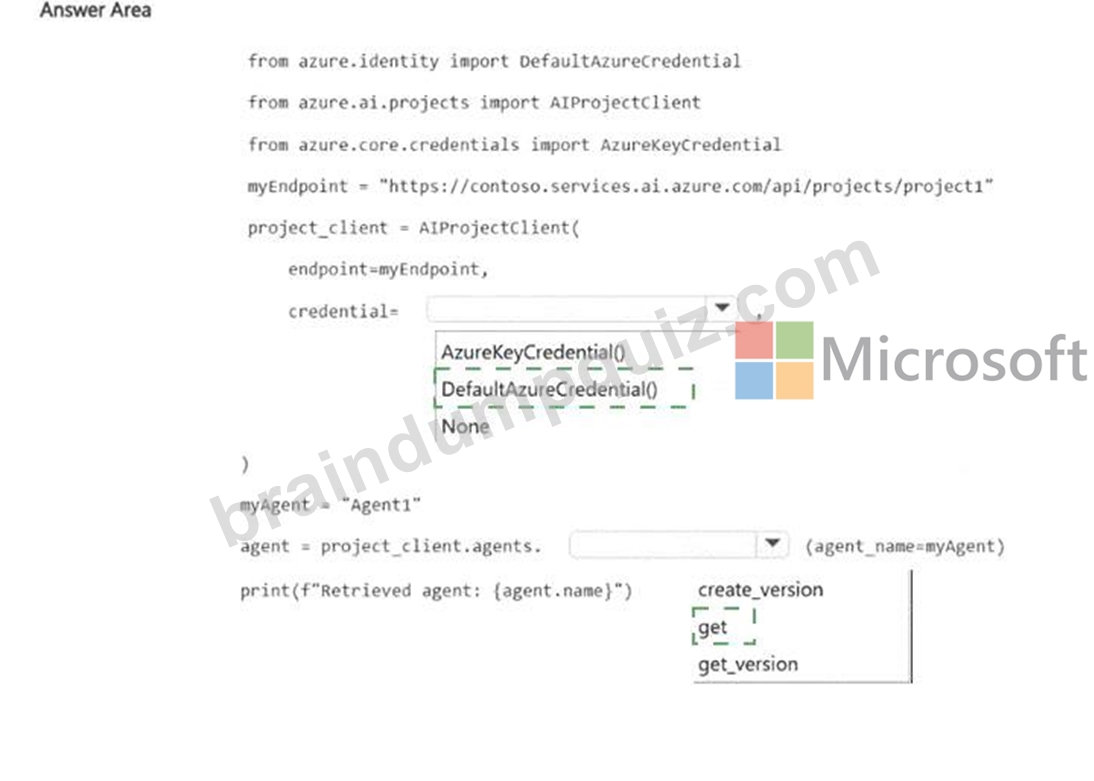
Explanation:
credential = DefaultAzureCredential()
agent = project_client.agents.get(agent_name=myAgent)
The correct authentication option is DefaultAzureCredential() because the case study states that API keys must not be used to access Foundry-deployed models and that Contoso developers must authenticate to Microsoft Foundry resources by using Microsoft Entra authentication. It also states that access to Project1 must be assigned to Agent1Dev Team by using the security group SC_Agent1_Dev . Microsoft Foundry authentication guidance recommends Microsoft Entra ID for production workloads because it supports least- privilege RBAC, per-principal auditing, and keyless authentication. AzureKeyCredential() would violate the no-API-key requirement, and None would not provide a valid credential.
The correct agent operation is get because the task is to access an existing agent named Agent1, not create a new version or retrieve a specific published version. Microsoft Foundry SDK examples show AIProjectClient created with DefaultAzureCredential() and then using project agent operations to create, retrieve, or interact with agents by name. To meet the compliance requirement, the group SC_Agent1_Dev must also be granted the appropriate project-scoped Foundry role, such as Foundry User, for Project1. Reference topics: Microsoft Entra authentication, Foundry RBAC, AIProjectClient, and project agent access.
NEW QUESTION # 28
You have a Microsoft Foundry project that contains a Retrieval Augmented Generation (RAG) chat solution used by customer support agents.
You are adding an automated pre-production evaluation step to a CI/CD pipeline named Pipeline1. The evaluation will run against a labeled test dataset that contains support questions and the expected grounding context.
You need to ensure that Pipeline1 fails if unsupported content or a retrieval mismatch exceeds a defined threshold:
- responses include claims not supported by the retrieved source
content
- retrieved source content does not align with the labeled expected
context
Which two built-in evaluators should you use in Pipeline1? Each correct answer presents pat of the solution.
NOTE: Each correct selection is worth one point.
- A. Coherence
- B. Fluency
- C. Retrieval
- D. Groundedness
- E. Response Completeness
Answer: C,D
Explanation:
The Groundedness Evaluator evaluator validates that the model's responses include only claims supported by the retrieved source content It flags ungrounded content or hallucinations. If the average score drops below your defined threshold, it triggers a pipeline failure.
The correct additional built-in evaluator appropriate for the pipeline is Retrieval (specifically, the RetrievalEvaluator or DocumentRetrievalEvaluator).
A standard RAG evaluation pipeline assesses both the generator (the LLM producing the answer) and the retriever (the search system pulling documentation). The CI/CD requirements specify two distinct failure thresholds:
Responses including claims not supported by the retrieved source content: This checks for model hallucinations and is handled by the Groundedness Evaluator.
Retrieved source content not aligning with the labeled expected context: This explicitly measures the performance of your search step against your ground-truth data. The built-in Retrieval evaluator maps to this requirement. It computes metrics like context recall to ensure your system successfully retrieves the exact reference documents specified in your labeled test dataset Reference:
https://learn.microsoft.com/en-us/microsoft-365/copilot/extensibility/evaluations-cli-evaluators
NEW QUESTION # 29
You have a Microsoft Foundry project that ingests scanned PDF invoices stored in Azure Blob Storage. Each invoice contains printed fine items and has a table-based layout.
Extracted results are stored as structured JSON and used as grounding data for an agent in a Retrieval Augmented Generation (RAG) solution.
You need to create a single analyzer that meets the following requirements:
- Extracts the invoice number, invoice date, vendor name, and total
amount across varying templates
- Returns confidence scores so that results with confidence below 0.80
can be routed for supervisor review
What should you use?
- A. a custom Azure Content Understanding in Foundry Tools analyzer that defines the required fields as the extracted fields and the returned confidence scores for routing
- B. the Azure Content Understanding in Foundry Tools prebuilt-documentSearch analyzer and search.score from the Azure AI Search results for routing
- C. a Foundry agent that has groundedness guardrails enabled to extract invoice fields and confidence scores
- D. the Azure Content Understanding in Foundry Tools prebuilt-layout analyzer
Answer: A
Explanation:
The best option in this scenario is a custom Azure Content Understanding in Foundry Tools analyzer that defines the required fields as the extracted fields and the returned confidence scores for routing.
Custom Field Targeting with Confidence Scores: Azure Content Understanding allows you to build a document analyzer with a user-defined schema. By defining your required fields (InvoiceNumber, InvoiceDate, VendorName, and TotalAmount), the service will handle extraction across varying layouts and return a dedicated field-level confidence score. You can natively evaluate these confidence metrics to implement your supervisor routing workflow.
RAG-Ready Output Structure: The service naturally returns highly structured JSON payloads.
This makes it perfectly optimized to be ingested directly as grounding data for a Retrieval- Augmented Generation (RAG) agent.
Incorrect:
[Not C]
The prebuilt-layout analyzer extracts raw structural elements such as blocks of text, hierarchy, selection marks, and complete tables. It does not automatically classify or cleanly isolate specific target entities (like vendor name or total amount) into dedicated schema properties, leaving you with heavy post-processing work to isolate the text.
[Not D]
The prebuilt-documentSearch analyzer is optimized for broad, layout-aware text extraction for indexing. Relying on Azure AI Search's search.score for supervisor routing is conceptually flawed; search.score represents a relevance score for a search query ranking rather than an accuracy metric for data extraction confidence.
Reference:
https://learn.microsoft.com/en-us/azure/ai-services/content-understanding/document/analyzer-improvement
NEW QUESTION # 30
You have a Microsoft Foundry project that contains an agent.
The agent uses Azure AI Search for Retrieval Augmented Generation (RAG).
You plan to ingest and index PDF product manuals.
You need to build a solution that supports semantic similarity matching. The solution must ensure that the agent retrieves relevant data when user questions use different wording than the product manuals.
Which indexing approach should you use?
- A. vector search
- B. semantic ranking
- C. analyzers
- D. suggesters
Answer: A
Explanation:
Vector search is the correct indexing and retrieval type to use for this solution.
Vector search versus semantic ranking
While both features help bridge the gap between different wordings, vector search is specifically designed at the indexing and retrieval layer to handle semantic similarity matching by converting text into mathematical vectors (embeddings) based on conceptual meaning. Semantic ranking is a secondary re-ranking layer applied after initial retrieval to improve precision, but it cannot function as the primary indexing method on its own.
Reference:
https://www.scribd.com/document/866453317/Agentforce-Specialist
NEW QUESTION # 31
You have a custom agent named Agent1.
You need to control access to and monitor activity for Agent1 by using Microsoft Foundry.
What should you do first?
- A. Add Agent1to a Microsoft Foundry project.
- B. Create a Microsoft Foundry project.
- C. Provision an Application Insights resource.
- D. Add Agent1 to the Microsoft Foundry playground.
Answer: B
Explanation:
To monitor and control access to a custom agent in Azure, you must first create a Microsoft Foundry project. Once the project is created, you register your custom agent within it to enable management capabilities such as access control and activity monitoring.
Reference:
https://learn.microsoft.com/en-us/azure/foundry/control-plane/register-custom-agent
NEW QUESTION # 32
A developer needs a managed identity to call a Microsoft Foundry project endpoint to run inference and use agents. Security policy requires the least-privilege role that grants data-plane access and nothing more. Which built-in role should you assign to the managed identity?
- A. Cognitive Services Contributor
- B. Foundry Account Owner
- C. Foundry User
- D. Azure AI Developer
Answer: C
Explanation:
Foundry User is the least-privilege built-in role for Microsoft Foundry projects and grants the data- plane actions needed to call a project endpoint, run inference, and use agents. Microsoft recommends assigning the project's managed identity the Foundry User role on the Foundry resource.
NEW QUESTION # 33
You are developing an app that will perform a sentiment analysis of social media posts by using the Azure AI Language service.
You perform a test on a sample post.
You need to quantify the results of the test.
Which JSON property should you review?
- A. relations
- B. confidenceThreshold
- C. sentiment
- D. confidenceScores
Answer: D
Explanation:
Sentiment analysis
The sentiment analysis feature assigns sentiment labels, such as "negative," "neutral," and
"positive." The service determines these labels using the highest confidence score. Sentiment is evaluated at both the sentence level and the document level. This feature also returns confidence scores between 0 and 1 for each document & sentences within it for positive, neutral, and negative sentiment.
In Azure AI Language's sentiment analysis, confidenceScores are numerical values between 0 and 1 that represent the probability that the text belongs to a specific sentiment (positive, neutral, or negative). A score closer to 1 indicates a higher confidence from the service that the text exhibits that sentiment, while a lower score signifies less confidence in that particular label. The service calculates these scores for both individual sentences and the entire document, providing a granular understanding of sentiment.
How to interpret confidenceScores:
High Score (close to 1): The model is very sure about the assigned sentiment. For example, a positive score of 0.95 means the model is 95% confident the text is positive.
Low Score (close to 0): The model is not very sure about the assigned sentiment.
Scores for each sentiment: For any given piece of text, the service returns a score for positive, neutral, and negative sentiment. The sentiment label that receives the highest score is assigned as the overall sentiment for that text.
Reference:
https://learn.microsoft.com/en-us/azure/ai-services/language-service/sentiment-opinion-mining/overview
NEW QUESTION # 34
Hotspot Question
You have a Microsoft Foundry project that contains a workflow for a customer support triage process.
You have an Ask a question node that stores user responses in a local variable named Var01.
You need to create the following Power Fx expressions:
- An if/else condition expression that ensures that Var01 contains a
value
- A Send message expression that returns the stored user response in
uppercase
How should you configure the expressions? To answer, select the appropriate options in the answer area.
NOTE: Each correct selection is worth one point.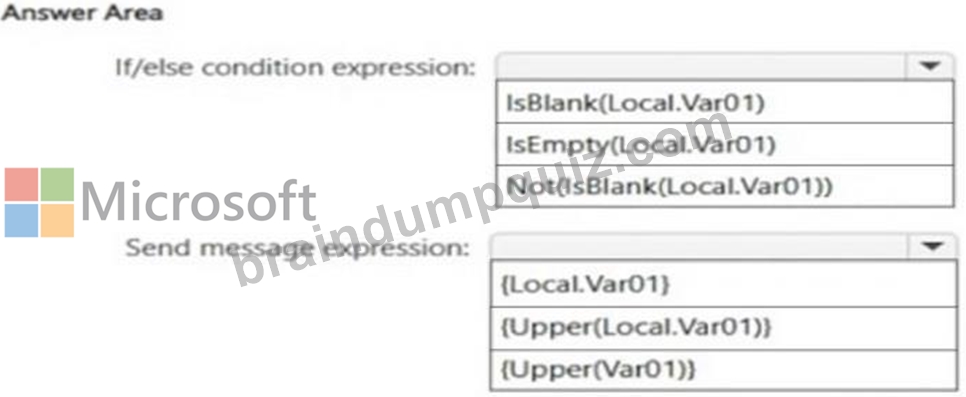
Answer:
Explanation: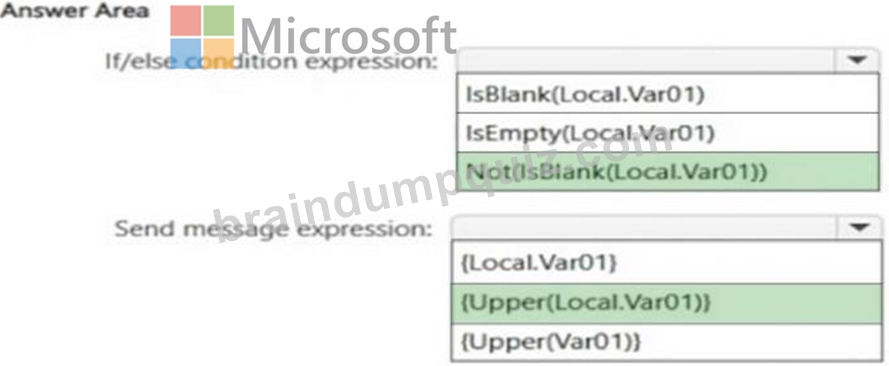
NEW QUESTION # 35
You have an Azure subscription that contains an Azure OpenAI resource.
You plan to build an agent by using the Azure AI Agent Service. The agent will perform the following actions:
- Interpret written and spoken questions from users.
- Generate answers to the questions.
- Output the answers as speech.
You need to create the project for the agent.
What should you use?
- A. the Azure portal
- B. Speech Studio
- C. Azure AI Foundry
- D. Language Studio
Answer: C
Explanation:
Azure AI Foundry is a platform for designing, customizing, managing, and supporting AI applications and agents. It acts as an AI app factory, providing a unified environment with tools, models, and deployment pipelines for various AI tasks. It enables teams to build and operate AI solutions, including those powered by generative AI, while ensuring security, governance, and cost-efficiency.
Reference:
https://learn.microsoft.com/en-us/azure/ai-foundry/what-is-azure-ai-foundry
NEW QUESTION # 36
......
Developing AI Apps and Agents on Azure Certification Sample Questions and Practice Exam: https://www.braindumpquiz.com/AI-103-exam-material.html
Real Exam Questions and Answers - Microsoft AI-103 Dump is Ready: https://drive.google.com/open?id=11A36OejOQi1v7Q3wDXUBM1onxIQg82nj