

2021 1Z0-821 Question Bank: Free PDF Download Recently Updated Questions
1Z0-821 Certification Exam Dumps with 245 Practice Test Questions
Oracle 1Z0-821 Exam Syllabus Topics:
| Topic | Details |
|---|---|
| Topic 1 |
|
| Topic 2 |
|
| Topic 3 |
|
| Topic 4 |
|
| Topic 5 |
|
| Topic 6 |
|
| Topic 7 |
|
| Topic 8 |
|
| Topic 9 |
|
| Topic 10 |
|
| Topic 11 |
|
NEW QUESTION 87
Which five statements describe options available for installing the Oracle Solaris 11operating system using the installation media?
- A. The LiveCD installer cannot be used if you need to preserve a specific Solaris Volume Table of Contents (VTOC) slice in your current operating system.
- B. The LiveCD Installer is for x86 platforms only.
- C. The text Installer does not install the GNOME desktop. The GNOME desktop package must he added after you have installed the operating system.
- D. The LiveCD Installation cannot be used to install multiple instances of Oracle Solaris.
- E. You can perform a text or LiveCD installation locally or over the network.
- F. The GUI installer cannot be used to upgrade your operating system from Solaris 10.
- G. The LiveCD installer can be used for SPARC or x86 platforms.
- H. If you are installing Oracle Solaris 11 on an x86-based system that will have more than one operating system installed in it, you cannot partition your disk during the installation process.
Answer: A,C,E,F
Explanation:
A: If the network is setup to perform automated installations, you can perform a text installation over the network by setting up an install service on the network and selecting a text installation when the client system boots.
B: After a fresh install of Solaris 11 express, only the console mode is activated. To add Gnome, simply do :
$ sudo pkg install slim_install This will install additional packages that are not installed by default.
D: The text installer advantages over the GUI installer include:
* In addition to modifying partitions, the text installer enables you to create and modify VTOC slices within the Solaris partition.
F: How do I upgrade my Solaris 10 or lower systems to Solaris 11?
Unfortunately, you CAN'T. There is no direct upgrade installer or other tool that will allow you to upgrade from earlier releases of Solaris to Solaris 11. This is primarily due to the vast changes in the packaging mechanism in Solaris 10.
Reference: Oracle Solaris 11 Information Library, Comparing Installation Options
NEW QUESTION 88
A local repository is available on this system and you need to enable clients to access this repository via HTTP. The repository information is:
PUBLISHERTYPESTATUSURI
solarisoriginonlinehttp://sysA.example.com
Identify two of the steps that are required to make the local repository on this server available to the client via HTTP.
- A. On the client: reset the origin for the solaris publisher.
- B. On the server: set the pkg/inst_root and pkg/readonly properties for the svc:/application/pkg/server:default service and enabled the service
- C. On the server: set the sharefs property on the ZFS file system containing the IPS repository.
- D. On the client: start the pkg.depotd process.
- E. On the client: set the pkg/inst_root and pkg/readonly properties for the svc:/application/server:default service enable the service.
Answer: B,D
Explanation:
A: Configure the Repository Server Service To enable clients to access the local repository via HTTP,enable the application/pkg/server Service Management Facility (SMF) service. # svccfg -s application/pkg/server setprop pkg/inst_root=/export/repoSolaris11 # svccfg -s application/pkg/server setprop pkg/readonly=true
E: Use pkg.depotd to serve the repository to clients. Start the Repository Service Restart the pkg.depotd repository service. # svcadm refresh application/pkg/server # svcadm enable application/pkg/server To check whether the repository server is working,open a browser window on the localhost location.
NEW QUESTION 89
You want to display the IP address assignments of the network interfaces. Which command should you use?
- A. ipadm show-addrprop
- B. ipadm show-if
- C. ipadm show-prop
- D. ipadm show-addr
Answer: D
Explanation:
'ipadm show-addr' displays all the configured addresses on the system.
Example:
# ipadm show-addr
ADDROBJ TYPE STATE ADDR
lo0/v4 static ok 127.0.0.1/8
lo0/v6 static ok ::1/128
NEW QUESTION 90
Which two statements are true when updating Solaris 11 from one Support Respository Update (SRU) to another SRU by using the pkg update command?
- A. The pkg update command can be used to update to a newer or older SRU.
- B. By default, the pkg update command automatically creates a backup Boot Environment whenever the kernel is affected by the update.
- C. The pkg update command can only be performed while running in the single-user milestone.
- D. The pkg update command can only be used to update to a newer SRU.
- E. By default, the pkg update command always updates Solaris 11 to the first SRU that was released after the Current SRU.
- F. By default, the pkg update command automatically creates a new Boot Environment whenever the kernel is affected by the update.
Answer: D,F
NEW QUESTION 91
Which modification needs to be made to the Service Management Facility before you publish a new package to the IPS repository?
- A. The Pkg/writabie_root property for the application/Pkg/server service must be set to true.
- B. The pkg/readonly property for the application/pkg/server service must be set to false.
- C. The pkg.depotd must be disabled.
- D. The pkg/image.root property for the application/pkg/server service must be set to the location of the repository.
Answer: D
Explanation:
pkg/image_root
(astring) The path to the image whose file information will be used as a cache for file data.
NEW QUESTION 92
Select two correct statements about the authentication services available in Oracle Solaris 11.
- A. The Secure Shell can be configured to allow logins across a network to remote servers without transmitting passwords across the network.
- B. Secure Remote Procedure Calls (Secure RPC) provides a mechanism to encrypt data on any IP Socket connection.
- C. Pluggable Authentication Modules (PAM) is used to implement the Secure Shell in Oracle Solaris 11.
- D. Simple Authentication and Security Layer (SASL) provides a mechanism to authenticate and encrypt access to local file system data.
- E. Pluggable Authentication Modules (PAM) is used to control the operation of services such console logins and ftp.
Answer: D,E
Explanation:
Explanation/Reference:
Explanation:
A: Pluggable Authentication Modules (PAM) are an integral part of the authentication mechanism for the Solaris. PAM provides system administrators with the ability and flexibility to choose any authentication service available on a system to perform end-user authentication.
By using PAM, applications can perform authentication regardless of what authentication method is defined by the system administrator for the given client.
PAM enables system administrators to deploy the appropriate authentication mechanism for each service throughout the network. System administrators can also select one or multiple authentication technologies without modifying applications or utilities. PAM insulates application developers from evolutionary improvements to authentication technologies, while at the same time allowing deployed applications to use those improvements.
PAM employs run-time pluggable modules to provide authentication for system entry services.
E: The Simple Authentication and Security Layer (SASL) is a method for adding authentication support to connection-based protocols.
Simple Authentication and Security Layer (SASL) is a framework for authentication and data security in Internet protocols. It decouples authentication mechanisms from application protocols, in theory allowing any authentication mechanism supported by SASL to be used in any application protocol that uses SASL.
Authentication mechanisms can also support proxy authorization, a facility allowing one user to assume the identity of another. They can also provide a data security layer offering data integrity and data confidentiality services. DIGEST-MD5 provides an example of mechanisms which can provide a data- security layer. Application protocols that support SASL typically also support Transport Layer Security (TLS) to complement the services offered by SASL.
NEW QUESTION 93
Select two statements that correctly describe the capabilities of the Distribution Constructor.
- A. ISO images for use with the Automated Installer (AI) can be created.
- B. A single installation server can be used to create ISO images for SPARC and x86 architectures.
- C. A single Installation server can be used to create ISO images for Solaris 10 and Solaris11 operating systems.
- D. Checkpoints can be used to pause the build, allowing scripts to run that modify the resulting ISO Image.
- E. Bootable USB images can be created for SPARC and x86 architectures.
Answer: A,D
Explanation:
A: You can use the distribution constructor to create the following types of Oracle Solaris images:
* (A) x86 or SPARC ISO Image for Automated Installations
* Oracle Solaris x86 live CD image
* x86 or SPARC Oracle Solaris text installer image
* x86 Oracle Solaris Virtual Machine
Note: You can use the distribution constructor to build custom Oracle Solaris images. Then, you can use the images to install the Oracle Solaris software on individual systems or multiple systems. You can, also, use the distribution constructor to create Virtual Machine (VM) images that run the Oracle Solaris operating system.
D: Checkpointing Options
You can use the options provided in the distro_const command to stop and restart the build process at various stages in the image-generation process, in order to check and debug the image that is being built. This process of stopping and restarting during the build process is called checkpointing.
NEW QUESTION 94
You have been tasked with creating a dedicated virtual network between two local zones within a single system.
In order to isolate the network traffic from other zones on that system.
To accomplish this, you will create__________.
- A. A virtual switch
- B. A virtual bridge.
- C. A virtual network interface
- D. An ether stub
- E. A virtual router
- F. Nothing because a virtual switch is automatically created then the virtual network interfaces are created.
Answer: D
Explanation:
Etherstubs are pseudo ethernet NICs which are managed by the system administrator. You can create VNICs over etherstubs instead of over physical links. VNICs over an etherstub become independent of the physical NICs in the system. With etherstubs, you can construct a private virtual network that is isolated both from the other virtual networks in the system and from the external network. For example, you want to create a network environment whose access is limited only to your company developers than to the network at large. Etherstubs can be used to create such an environment.
Note: Oracle Solaris 11 introduces a new and powerful network stack architecture which includes:
* Networking virtualization with virtual network interface cards (VNICs) and virtual switching (etherstubs)
* Tight integration with zones
* Network resource management - efficient and easy to manage integrated quality of service (QoS) to enforce bandwidth limit on VNICs and traffic flows
NEW QUESTION 95
You have set up the task.max-lwps resource control on your Solaris 11 system.
Which option describes how to configure the system so that syslogd notifies you when the resources control threshold value for the task.max-lwps resource has been exceeded?
- A. Use the setrct1 command to set the logging of all resource control violations for the task.max-lwps resource control.
- B. Modify the /etc/syslog.conf file to activate system logging of all violations of task.max-lwps and then refresh then svc: /system/system-log:default service.
- C. Activate system logging of all violations of task.max-lwpp in the /etc/rctldm.conf file and then execute the rctladm-u command.
- D. Use the rctladm command to enable the global action on the task.max-lwpa resource control.
- E. Use the prct1 command to set the logging of all resource control violations at the time the task.max- lwps resource control is being setup.
Answer: D
Explanation:
Explanation/Reference:
Explanation:
rctladm - display and/or modify global state of system
resource controls
The following command activates system logging of all violations of task.max-lwps.
# rctladm -e syslog task.max-lwps
#
NEW QUESTION 96
user1 has a disk quota of 0.5 MB. The user attempts to run the following command on a file called .bigfile that is 495 KB in size:
cp bigfile /tmp
Will the command execute successfully?
- A. Yes.Quotas do notinclude any of the system files such as /tmp /swap.
- B. Yes. The quota is set at the directory level, not the user level.
- C. No. The command will fail because it will cause him to exceed his user quota.
- D. No. A user cannot place files into the /tmp directory.
Answer: A
Explanation:
UFS quotas enable system administrators to control the size of file systems. Quotas limit the amount of disk space and the number of inodes, which roughly corresponds to the number of files, that individual users can acquire. For this reason, quotas are especially useful on the file systems where user home directories reside. As a rule, the public and /tmp file systems usually do not benefit significantly by establishing quotas.
Note: The cp command copies files and directories.
Reference: System Administration Guide: Advanced Administration, Managing UFS Quotas
NEW QUESTION 97
Which two options are characteristics of a fast reboot?
- A. A fast reboot bypasses grub.
- B. A fast reboot is the default on all platforms.
- C. A fast reboot can only be executed on the SPARC platform when theconfig/fastreboot_default property for the svc:/system/boot-config:default serviceis set to true.
- D. A fast reboot cannot be used after a system panic on the x86 platform.
- E. A fast reboot uses an in-kernel boot loader to load the kernelinto memory.
Answer: C,E
Explanation:
C: To change the default behavior of the Fast Reboot feature on the SPARC platform, so that a fast reboot is automatically performed when the system reboots, see below.
The following example shows how to set the property's value to true on the SPARC platform, so that a fast reboot is initiated by default:
# svccfg -s "system/boot-config:default" setprop config/fastreboot_default=true # svcadm refresh svc:/system/boot-config:default
D: Fast Reboot implements an in-kernel boot loader that loads the kernel into memory and then
switches to that kernel.
The firmware and boot loader processes are bypassed, which enables the system to reboot within
seconds.
The Fast Reboot feature is managed by SMF and implemented through a boot configuration service, svc:/system/boot-config. The boot-config service provides a means for setting or changing the default boot configuration parameters. When the config/fastreboot_default property is set to true, the system performs a fast reboot automatically, without the need to use the reboot -f command. This property's value is set to true on the x86 platform. For task-related information, including how to change the default behavior of Fast Reboot on the SPARC platform, see Accelerating the Reboot Process on an x86 Based System.
Note: One new feature, called Fast Reboot, will allow the system to boot up without doing the routine set of hardware checks, a move that can make system boot times up to two-and-a-half times faster, Oracle claimed. This feature can be handy in that an administrator applying a patch or software update across thousands of Solaris deployments can reboot them all the more quickly.
Reference: System Administration Guide: Basic Administration, Oracle Solaris 11, Using Fast Reboot
NEW QUESTION 98
A user brian is configured to use the bash shell. His home directory is /export/home/brian, and contains a
.profile and a .bashrc file.
In the -profile, there are these lines:
genius =ritchie
export genius
In the .bashrc us this line:
genius=kernighan
In /etc/profile are these lines:
genius=thompson
export genius
When brian logs in and asks for the value of genius, what will he find, and why?
- A. genius will be ritchie because .profile executes after .bashrc.
- B. genius will be kernighan, because .bashrc executes after .profile.
- C. genius will be thompson because /etc/profile system settings always override local settings.
- D. genius will be ritchie because variable settings in .profile take precedence over variable settings in
.bashrc. - E. genius will be ritchie, because that was the value exported in .profile.
Answer: D
Explanation:
Explanation/Reference:
Explanation:
NEW QUESTION 99
You have been tasked with creating a dedicated virtual network between two local zones within a single system,in order to isolate the network traffic from other zones on that system.
To accomplish this,you will create_____.
- A. nothing,because a virtual switch is automatically created when the virtual network interfaces are created
- B. virtual router
- C. an ether stub
- D. a virtual network interface
- E. a virtual bridge
Answer: D
Explanation:
First create a virtual switch,then create a virtual network interface.
NEW QUESTION 100
Which two accurately describe the Solaris IPS repository?
- A. It contains a collection of operating system patches.
- B. The packages in a catalog are associated with a specific publisher.
- C. It contains a collection of software packages.
- D. All packages within an IPS package repository reside in a catalog.
- E. It is an ISO image of the Solaris installation media.
Answer: B,C
Explanation:
Image Packaging System (IPS) is a new network based package management system included in Oracle Solaris 11. It provides a framework for complete software lifecycle management such as installation,upgrade and removal of software packages. IPS also enables you to create your own software packages,create and manage package repositories,and mirror existing package repositories.
Oracle Solaris software is distributed in IPS packages. IPS packages are stored in IPS package repositories,which are populated by IPS publishers.
E: The following command displays property information about the local repository.
$ pkgrepo get -s /export/repoSolaris11
SECTION PROPERTY VALUE publisher prefix solaris repository description This\
repository\ serves\ a\ copy\ of\ the\ Oracle\ Solaris\ 11\ Build\ 175b\ Package\ Repository.
repository name Oracle\ Solaris\ 11\ Build\ 175b\ Package\ Repository
repository version 4
The value of the publisher prefix specifies that solaris is to be used in the following cases:
When more than one publisher's packages are present and no publisher is specified in the
package name in the pkg command
When packages are published to the repository and no publisher is specified.
NEW QUESTION 101
The advantage of core tiles is that they allow you an opportunity to examine the cause of problems,so that they can be resolved.
However,core files must be managed because they_____.
- A. steal resources from the processor,slowing down system performance
- B. make numerous entries into the /var/adm/wtmpx file
- C. take up large amounts of disk space
- D. fill up swap space; this will begin to slow the system due to swaps
- E. fill up swap space; this will begin to slow the system due to paging
Answer: C
Explanation:
Part of the job of cleaning up heavily loaded file systems involves locating and removing files that have not been used recently. You can locate unused files by using the ls or find commands.
Other ways to conserve disk space include emptying temporary directories such as the directories located in /var/tmp or /var/spool,and deleting core and crash dump files.
Note: Core files are generated when a process or application terminates abnormally. Core files are managed with the coreadm command.
For example,you can use the coreadm command to configure a system so that all process core files are placed in a single system directory. This means it is easier to track problems by examining the core files in a specific directory whenever a process or daemon terminates abnormally.
NEW QUESTION 102
ServerA contains two ISO images of a package repository named so1.repo.iso-a and so1.repo.iso-b respectively. You need to create a single local package repository on server that clients can connect to. The package repository will be stored on the /export/IPS file system and named repo. The preferred publisher will be named solaris and the publisher URL will be http://serverA.example.com.
Which is the correct procedure to perform on ServerA to create the local Package repository?
- A. cat so1.repo.iso-a so1.repo.iso-b > /export/IPS/repoSet the pkg/inst_root property to true and the pkg/ readonly property to /export/IPSSet the preferred publisher by using pkg set-publisher -G http:// serverA.example.com/ \-g http://pkg/oracle.com/solaris/rekease/solaris
- B. cat so1.repo, iso-a so1.repo.iso-b > /export/IPS/repo.isoMount the ISO image and copy the repo directory from the ISO image to /export/IPS/reposet the pkg/inst_root property and the pkg/readonly property to / export/IPS/reposet the preferred pkg/inst_root property by using pkg set-publisher - G http:// serverA.example.com/ \- g http://pkg.oracle.com/solaris.com/release/- p solaris
- C. cat so1.repo.iso-a sol.repo.iso-b > so1.full.isoMount the ISO image and use the rsync command to extract the contents of the ISO file to the /export/IPS file system.Set the pkg/inst_root property to /export/IPS/repo and the pkg/readonly property to true.Set the preferred publisher by using pkg set-publisher -Ghttp:// pkg.oracle.com/solaris/release/ \-g http"//serverA.example.com/ solaris
- D. cat so1.repo.iso-a so1.repo.iso-b > so1.full.isoMount the ISO image and use the rsync command to extract the contents of the ISO file to /export/IPS/repoSet the pkg/inst_root property to /export/IPS/repo and the pkg/readonly property to trueSet the preferred publisher by using pkg set-publisher solaris \-g http:// pkg.oracle.com/
Answer: C
NEW QUESTION 103
Your system is assigned an IP address object 192.168.0.222/24. However, the net mask-expressed as four octets-is required. Which is the correct netmask?
- A. 255.255.255.255
- B. 255.255.255.24
- C. 255.0.0.0
- D. 255.255.0.0
- E. 255.255.255.0
Answer: E
Explanation:
A 24-bit network mask is expressed as 255.255.255.0.
Reference:http://www.subnet-calculator.com/
NEW QUESTION 104
Which command would you use to determine which package group is installed on your system?
- A. pkg info
- B. uname -a
- C. cat /var/sadm/system/admin/CLUSTEP
- D. pkg list group/system/\*
Answer: A
Explanation:
The pkg info command provides detailed information about a particular IPS package.
Note: The pkginfo command does the same for any SVR4 packages you may have installed on the same system.
pkg info example: $ pkg info p7zip Name: compress/p7zip Summary: The p7zip compression and archiving utility Description: P7zip is a unix port of the 7-Zip utility. It has support for numerous compression algorithms, including LZMA and LZMA2, as well as for various archive and compression file formats, including 7z, xz, bzip2, gzip, tar, zip (read-write) and cab, cpio, deb, lzh, rar, and rpm (read-only). Category: System/Core State: Installed Publisher: solaris Version: 9.20.1 Build Release: 5.11 Branch: 0.175.0.0.0.2.537 Packaging Date: Wed Oct 19 09:13:22 2011 Size: 6.73 MB FMRI: pkg://solaris/compress/[email protected], 5.11-0.175.0.0.0.2.537:20111019T091322Z
NEW QUESTION 105
Select two statements that correctly describe the capabilities of the Distribution Constructor.
- A. ISO images for use with the Automated Installer (AI) can be created.
- B. Checkpoints can be used to pause the build,allowing scripts to run that modify the resulting ISO Image.
- C. A single installation server can be used to create ISO images for SPARC and x86 architectures.
- D. A single Installation server can be used to create ISO images for Solaris 10 and Solaris11 operating systems.
- E. Bootable USB images can be created for SPARC and x86 architectures.
Answer: A,B
Explanation:
A: You can use the distribution constructor to create the following types of Oracle Solaris images:
*(A) x86 or SPARC ISO Image for Automated Installations
*Oracle Solaris x86 live CD image
*x86 or SPARC Oracle Solaris text installer image
*x86 Oracle Solaris Virtual Machine
Note: You can use the distribution constructor to build custom Oracle Solaris images. Then,you can use the images to install the Oracle Solaris software on individual systems or multiple systems. You can,also,use the distribution constructor to create Virtual Machine (VM) images that run the Oracle Solaris operating system.
D: Checkpointing Options You can use the options provided in the distro_const command to stop and restart the build process at various stages in the image-generation process,in order to check and debug the image that is being built. This process of stopping and restarting during the build process is called checkpointing.
NEW QUESTION 106
View the following information for a software package: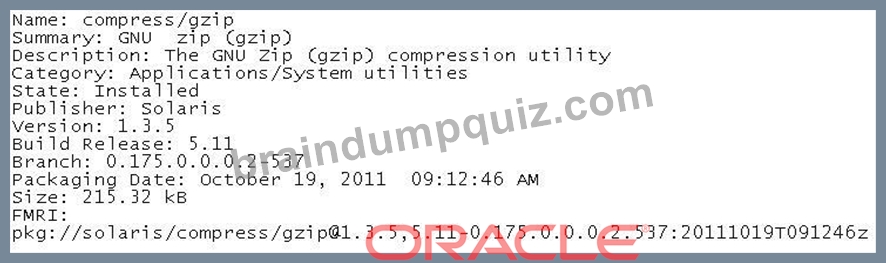
Which command would you use to display this information for a software package that is not currently installed on your system?
- A. pkg search -1 gzip
- B. pkg info -r gzip
- C. pkg contents gzip
- D. pkg list gzip
- E. pkg verify -v gzip
Answer: B
Explanation:
Explanation/Reference:
Explanation:
By default, the pkg info command only lists information about installed packages on the system; however, we can use a similar command to look up information about uninstalled packages, as shown in here:
Example:
Listing Information About an Uninstalled Package
# pkg info -r php-52
Name: web/php-52
Summary: PHP Server 5.2
Description: PHP Server 5.2
Category: Development/PHP
State: Not Installed
Publisher: solaris
Version: 5.2.17
Build Release: 5.11
Branch: 0.175.0.0.0.1.530
Packaging Date: Wed Oct 12 14:01:41 2011
Size: 44.47 MB
FMRI: pkg://solaris/web/[email protected], 5.11-0.175.0.0.0.1.530:20111012T140141Z Note: pkg info command displays information about packages in a human-readable form.
Multiple FMRI patterns may be specified; with no patterns, display information on all installed packages in the image.
With -l, use the data available from locally installed packages.
This is the default.
With -r, retrieve the data from the repositories of the image's configured publishers. Note that you must specify one or more package patterns in this case.
NEW QUESTION 107
In Oracle Solaris 11, where is the Oracle default repository located?
- A. /var/spool/pkg
- B. http://pkg.oracle.com/solaris/release
- C. /cdrom/cdrom0
- D. http://localhost/solaris
- E. http://www.oracle.com/Solaris/download
Answer: B
Explanation:
Explanation/Reference:
Explanation:
REPOSITORY DESCRIPTION
* http://pkg.oracle.com/solaris/release
The default repository for new Oracle Solaris 11 users. This repository receives updates for each new release of Oracle Solaris. Significant bug fixes, security updates, and new software may be provided at any time for users to install at Oracle's discretion.
*https://pkg.oracle.com/solaris/support
Provides bug fixes and updates. Accessible with a current support contract from Oracle.
* https://pkg.oracle.com/solaris/dev Provides the latest development updates. Accessible to users enrolled in the Oracle Solaris 11 Platinum Customer Program and approved Oracle Partners.
NEW QUESTION 108
You have been tasked with creating a dedicated virtual network between two local zones within a single system. In order to isolate the network traffic from other zones on that system.
To accomplish this, you will create__________.
- A. A virtual switch
- B. A virtual bridge.
- C. A virtual network interface
- D. An ether stub
- E. A virtual router
- F. Nothing because a virtual switch is automatically created then the virtual network interfaces are created.
Answer: D
Explanation:
Etherstubs are pseudo ethernet NICs which are managed by the system administrator. You can create VNICs over etherstubs instead of over physical links. VNICs over an etherstub become independent of the physical NICs in the system. With etherstubs, you can construct a private virtual network that is isolated both from the other virtual networks in the system and from the external network. For example, you want to create a network environment whose access is limited only to your company developers than to the network at large. Etherstubs can be used to create such an environment.
Note: Oracle Solaris 11 introduces a new and powerful network stack architecture which includes:
* Networking virtualization with virtual network interface cards (VNICs) and virtual switching (etherstubs)
* Tight integration with zones
* Network resource management - efficient and easy to manage integrated quality of service (QoS) to enforce bandwidth limit on VNICs and traffic flows
NEW QUESTION 109
Consider the following rule file for use with the Basic Audit Reporting Tool (BART).
CHECK all
IGNORE dirmtime
/etc/security
/etc/notices
IGNORE contents
/export/home
IGNORE mtime size contents
/var
CHECK
You are using BART to detect inappropriate changes to the file system.
Identify the two correct statements describing the attributes recorded.
- A. /var/spool/mqueue Attribute: size uid gid mode acl dirmtime
- B. /export/home/kate/.profile Attributes: uid gid mode acl dirmtime
- C. /etc/security/exec_attr Attribute: size uid mode acl mtime devnode
- D. /export/home/rick/.profile Attributes: size uid gid mode acl mtime contents
- E. /var/dhcp Attribute: size uid gid mode acl
- F. /etc/hosts Attributes: size uid gid mode acl intime dest
Answer: C,D
Explanation:
D: According to line /etc/security
F: According to line /export/home Not E: According to line IGNORE dirmtime Note: In default mode,the bart compare command,as shown in the following example,checks all the files installed on the system,with the exception of modified directory timestamps (dirmtime):
CHECK all IGNORE dirmtime
Note 2: The Basic Audit Reporting Tool (BART) feature of Oracle Solaris enables you to comprehensively validate systems by performing file-level checks of a system over time. By creating BART manifests,you can easily and reliably gather information about the components of the software stack that is installed on deployed systems.
BART is a useful tool for integrity management on one system or on a network of systems.
NEW QUESTION 110
You want to delete the IPv4 address on the interface net3. Which command should you use?
- A. ipadm delete-addr net3/v4
- B. ipadm down-addr net3/v4
- C. ipadm deiete-ipv4 ner3/v4
- D. ipadm disable-if net3/v4
- E. ipadm delete-vni net3/v4
- F. ipadm delete-ip net3/v4
Answer: A
Explanation:
Explanation/Reference:
Explanation:
The ipadm delete-addr subcommand removes addresses from interfaces.
To remove an address from the IPMP group, type the following command:
# ipadm delete-addr addrobj
The addrobj uses the naming convention inder-interface/user-string.
NEW QUESTION 111
......
New 1Z0-821 Exam Dumps with High Passing Rate: https://www.braindumpquiz.com/1Z0-821-exam-material.html
Oracle 1Z0-821 Actual Questions and Braindumps: https://drive.google.com/open?id=1_MPPjNenrzmDJFTINE5W9yTcsdZatn3j