We're so confident of our products that we provide no hassle product exchange.


Certification Topics of Microsoft AI-900 Exam
Our Microsoft AI-900 exam dumps covers the following objectives of Microsoft AI-900 Exam.
- Describe features of computer vision workloads on Azure (15-20%)
- Describe fundamental principles of machine learning on Azure (30-35%)
- Describe features of conversational AI workloads on Azure (15-20%)
- Describe features of Natural Language Processing (NLP) workloads on Azure (15-20%)
- Describe AI workloads and considerations (15-20%)
Exam AI-900: Microsoft Azure AI Fundamentals
Candidates for this exam should have foundational knowledge of machine learning (ML) and artificial intelligence (AI) concepts and related Microsoft Azure services.
This exam is an opportunity to demonstrate knowledge of common ML and AI workloads and how to implement them on Azure.
This exam is intended for candidates with both technical and non-technical backgrounds. Data science and software engineering experience are not required; however, some general programming knowledge or experience would be beneficial.
Azure AI Fundamentals can be used to prepare for other Azure role-based certifications like Azure Data Scientist Associate or Azure AI Engineer Associate, but it’s not a prerequisite for any of them.
Part of the requirements for: Microsoft Certified: Azure AI Fundamentals
Reference: https://docs.microsoft.com/en-us/learn/certifications/exams/ai-900
Microsoft AI-900 中文 Exam Overview:
| Certification Vendor: | Microsoft |
|---|---|
| Exam Name: | Microsoft Azure AI Fundamentals |
| Exam Number: | AI-900 |
| Real Exam Qty: | 40–60 |
| Available Languages: | Indonesian (Indonesia), Chinese (Simplified), Korean, French, Arabic (Saudi Arabia), Italian, Russian, Portuguese (Brazil), German, Chinese (Traditional), English, Japanese, Spanish |
| Passing Score: | 700 (on a scale of 1–1000) |
| Exam Price: | $99 USD |
| Related Certifications: | Microsoft Certified: Azure Fundamentals Microsoft Certified: Azure Data Fundamentals |
| Exam Duration: | 45 minutes |
| Exam Format: | Scenario-based questions, Multiple choice, Multiple select |
| Certificate Validity Period: | Valid indefinitely |
| Recommended Training: | Microsoft Learn: Azure AI Fundamentals Learning Path Instructor-led Training: AI-900 Course |
| Exam Registration: | Microsoft Certification Registration Pearson VUE Registration |
| Sample Questions: | Microsoft AI-900 中文 Sample Questions |
| Exam Way: | Online proctored or onsite testing at Pearson VUE test centers |
| Pre Condition: | No required prerequisites; basic familiarity with cloud computing or AI concepts is recommended but not mandatory |
| Official Syllabus URL: | https://learn.microsoft.com/en-us/credentials/certifications/exams/ai-900/ |
Microsoft AI-900 中文 Exam Syllabus Topics:
| Section | Weight | Objectives |
|---|---|---|
| Features of Natural Language Processing (NLP) workloads on Azure | 15–20% | - Describe capabilities of Azure Language - Describe capabilities of Azure Translator - Identify types of NLP solutions - Describe capabilities of Azure Speech |
| Features of computer vision workloads on Azure | 15–20% | - Describe capabilities of Azure Face - Describe capabilities of Azure Custom Vision - Describe capabilities of Azure Form Recognizer - Describe capabilities of Azure Computer Vision - Identify types of computer vision solutions |
| Features of generative AI workloads on Azure | 20–25% | - Describe use cases for generative AI - Describe generative AI concepts - Describe responsible AI practices for generative AI - Describe capabilities of Azure OpenAI Service |
| Fundamental principles of machine learning on Azure | 15–20% | - Describe automated machine learning - Describe capabilities of Azure Machine Learning - Describe core concepts of machine learning - Describe machine learning pipelines |
| Artificial Intelligence workloads and considerations | 15–20% | - Identify types of AI workloads - Describe responsible AI principles - Describe considerations for developing AI solutions |
Microsoft Azure AI Fundamentals (AI-900中文版) Sample Questions:
要完成句子,請在答案區中選擇適當的選項。
Correct Answer:
Explanation: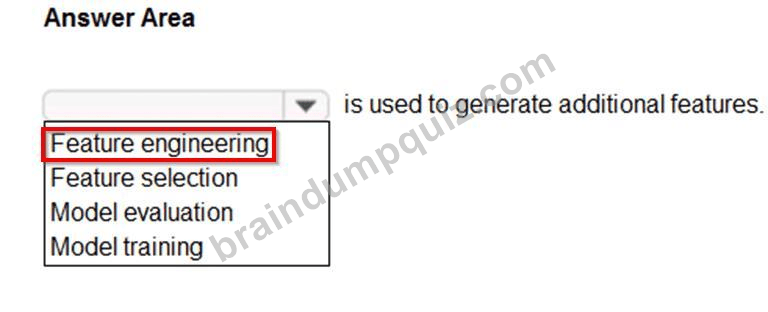
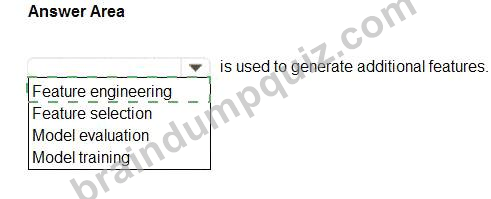
According to the Microsoft Azure AI Fundamentals (AI-900) official study guide and the Microsoft Learn module "Explore fundamental principles of machine learning", feature engineering is the process used to generate additional features or transform existing data into forms that improve model performance. Features are individual measurable properties or characteristics used as input for machine learning algorithms. The goal of feature engineering is to create new informative variables that better represent the underlying patterns in the data.
Feature engineering may include tasks such as:
* Combining or transforming raw data columns (e.g., creating a "total purchase amount" from price × quantity).
* Extracting time-based components (e.g., year, month, day, hour) from datetime values.
* Encoding categorical variables (e.g., one-hot encoding or label encoding).
* Scaling or normalizing numerical features.
* Creating polynomial or interaction terms to capture complex relationships.
Microsoft's AI-900 learning material emphasizes that the process of preparing data for machine learning involves data cleaning, feature engineering, and feature selection. While feature selection is about choosing the most relevant features from the existing dataset, feature engineering focuses on creating or generating new features to enhance model accuracy and generalization.
The other options do not fit this definition:
* Feature selection is about removing redundant or irrelevant features, not generating new ones.
* Model evaluation involves assessing the model's performance using metrics like accuracy or F1 score.
* Model training is the phase where the algorithm learns patterns from the data, not when features are created.
Therefore, based on the AI-900 official concepts and Microsoft's documentation, the correct answer is Feature engineering, as it is the process specifically used to generate additional features that improve machine learning model performance and predictive capability.
您正在 Azure 中開發自然語言處理解決方案。該解決方案將分析客戶評論並確定每個評論的正面或負面程度。
這是哪種類型的自然語言處理工作負載的範例?
- A. 實體識別
- B. 關鍵字詞擷取
- C. 情感分析
- D. 語言偵測
Correct Answer: C 🗳️
Explanation: Only visible for BraindumpQuiz members. You can sign-up / login (it's free).
您計劃使用機器學習設計器部署 Azure 機器學習模型 您應該依序執行哪四個動作?要回答,請將適當的操作從操作清單移至答案區域,並按正確的順序排列。
Correct Answer:

Explanation: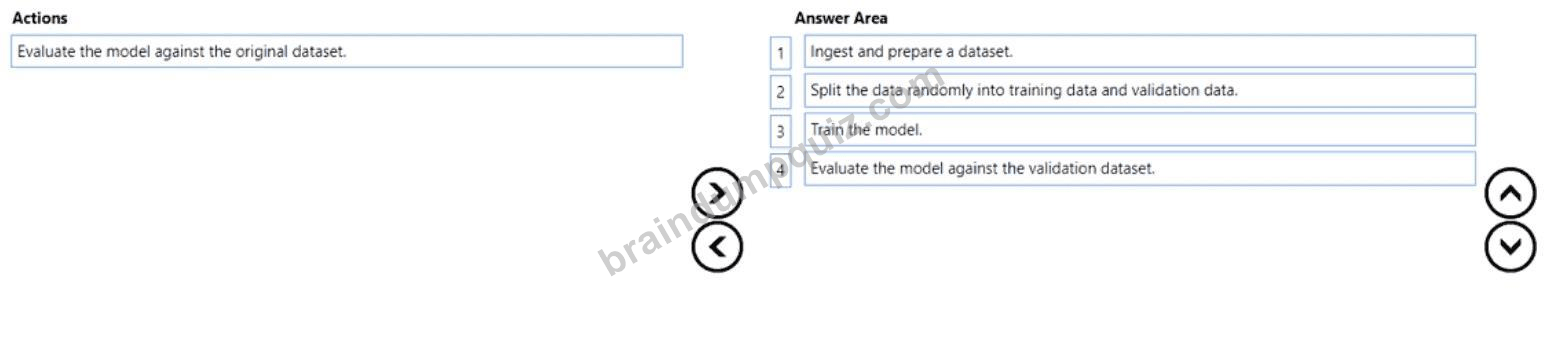
According to the Microsoft Azure AI Fundamentals (AI-900) official study guide and the Microsoft Learn module "Identify features of common machine learning types", the standard workflow for creating and deploying a machine learning model - especially within Azure Machine Learning Designer - follows a structured sequence of steps to ensure that the model is trained effectively and evaluated correctly.
Here's the detailed breakdown of the correct order:
* Import and prepare a dataset:This is always the first step in the machine learning lifecycle. The dataset is imported into Azure Machine Learning and cleaned or preprocessed. Preparation might include handling missing values, normalizing data, removing outliers, and encoding categorical variables. This ensures the dataset is ready for modeling.
* Split the data randomly into training data and validation data:The dataset is then divided into two parts
- the training set and the validation (or testing) set. Typically, around 70-80% of the data is used for training and 20-30% for validation. This step ensures that the model can be evaluated on unseen data later, preventing overfitting.
* Train the model:During this stage, the machine learning algorithm learns patterns from the training data. Azure Machine Learning Designer provides multiple algorithms (classification, regression, clustering, etc.) that can be applied using "Train Model" components.
* Evaluate the model against the validation dataset:Finally, the trained model's performance is tested using the validation dataset. Evaluation metrics such as accuracy, precision, recall, or RMSE (depending on the model type) are calculated to assess how well the model generalizes to new data.
The incorrect option - "Evaluate the model against the original dataset" - is not used in proper ML workflows, because evaluating on the same data used for training would give misleadingly high accuracy due to overfitting.
選出正確完成句子的答案。
Correct Answer:
Explanation:
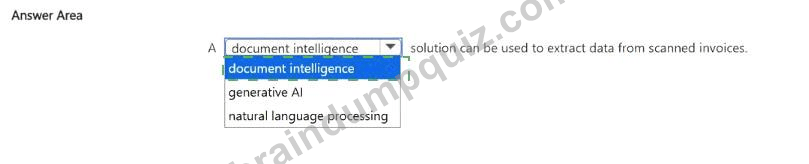
The correct answer is Document Intelligence.
According to the Microsoft Azure AI Fundamentals (AI-900) study materials and Microsoft Learn documentation, the Azure AI Document Intelligence service (formerly known as Form Recognizer) is specifically designed to extract structured data from documents, including scanned invoices, receipts, forms, and business cards.
This service combines optical character recognition (OCR) with machine learning to analyze both the layout and semantic meaning of document content. When processing scanned invoices, Document Intelligence identifies and extracts fields such as invoice numbers, dates, totals, taxes, vendor names, and line-item details.
The extracted information can then be automatically imported into business systems like accounting software or databases, eliminating manual data entry and improving operational efficiency.
Here's why the other options are incorrect:
* Generative AI: Focuses on creating new content such as text, images, or code (for example, using GPT-
4 or DALL E). It is not used for structured data extraction.
* Natural Language Processing (NLP): Deals with understanding and generating human language from text-based input, not document scanning or layout interpretation.
The Document Intelligence workload excels at handling semi-structured documents where the location and format of data vary between samples. Microsoft's prebuilt models-like Invoice, Receipt, Identity Document, and Contract-simplify extraction without requiring custom training.
In summary, if the task involves extracting data from scanned invoices, the appropriate Azure AI service is Azure AI Document Intelligence, which uses AI-powered document understanding to convert unstructured document images into structured, usable data.
選出正確完成句子的答案。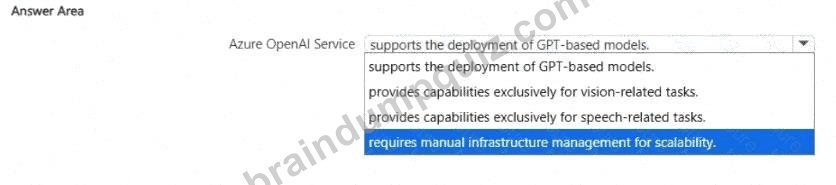
Correct Answer:
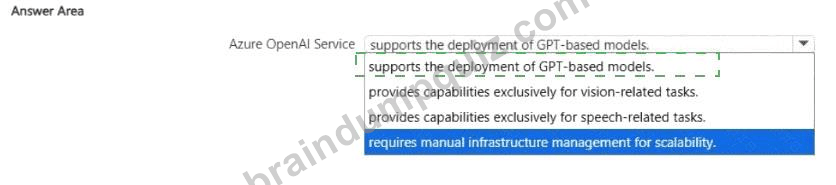
Explanation:
The Azure OpenAI Service provides access to advanced Generative Pre-trained Transformer (GPT) models developed by OpenAI, such as GPT-3, GPT-3.5, and GPT-4. These models are capable of performing a wide range of natural language processing (NLP) and generative AI tasks - including text completion, summarization, translation, question answering, content creation, and code generation.
According to the Microsoft Azure AI Fundamentals (AI-900) study guide and Microsoft Learn documentation for Azure OpenAI, this managed service allows developers to deploy and integrate GPT-based models within their own applications using REST APIs or the Azure SDK. The service handles scalability, performance, and infrastructure automatically, meaning users do not need to manage servers or computational resources manually.
Option review:
* Supports the deployment of GPT-based models - # Correct. Azure OpenAI is specifically designed for deploying and operationalizing GPT models and similar transformer-based architectures.
* Provides capabilities exclusively for vision-related tasks - # Incorrect. Vision tasks (like image classification or object detection) are part of Azure AI Vision.
* Provides capabilities exclusively for speech-related tasks - # Incorrect. Speech processing (speech-to- text, text-to-speech, translation) belongs to Azure AI Speech Services, not Azure OpenAI.
* Requires manual infrastructure management for scalability - # Incorrect. Azure OpenAI is a fully managed service; scalability and performance are handled automatically by Azure.
Therefore, the correct completion of the sentence is:
"Azure OpenAI Service supports the deployment of GPT-based models."
Viewing page 1 out of 68 pages.
Viewing questions 1-5 out of 336 questions.
 By Jim